



SAK3

Based on 1 Customer Validation
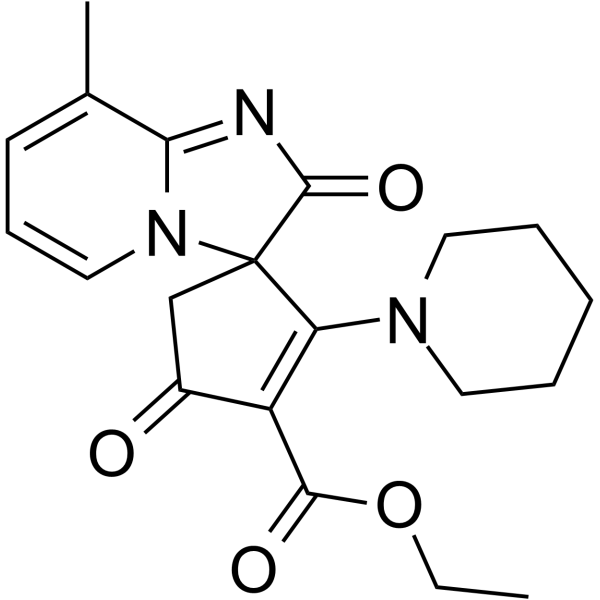
SAK3 is a potent T-type voltage-gated Ca2+ channels (T-VGCCs) enhancer. SAK3 enhances Cav3.1 and Cav3.3 T-type Ca2+ channel currents. Acute SAK3 administration improves memory deficits in olfactory-bulbectomized mice. SAK3 inhibits amyloid β plaque formation in APP-KI mice by activating the proteasome activity.
For research use only. We do not sell to patients.
- Purity : 99.80%
- CAS No.: 1256269-87-0
- Formula: C20H23N3O4
- Molecular Weight:369.41
-
Storage:Powder -20°C, 3 years , 4°C, 2 years ; In solvent -80°C, 6 months , -20°C, 1 month

To place orders, for customer services and technical support, please contact: MedChemExpress USA
Tel: 609-228-6898 E-mail: [email protected] [email protected]


-
 Biological Activity
-
Chemical Information
-
Solvent & Solubility
- Protocols
- Purity & Documentation
- References
-
 Help & FAQs


All Calcium Channel Isoforms
More

Biological Activity
Description
IC50 & Target
|
T-type calcium channel |
In Vitro
SAK3 (0.01-10 nM) significantly enhances Cav3.1 or Cav3.3 currents in neuro2A cells ectopically expressing Cav3.1 or Cav3.3, respectively[1].
MedChemExpress (MCE) has not independently confirmed the accuracy of these methods. They are for reference only.
-
Cell Line:Cav3.1 or Cav3.3-overexpressing neuro2A cells
-
Concentration:0.1 nM
-
Incubation Time:270 s
-
Result:Rapidly increased Ca2+ currents
In Vivo
MedChemExpress (MCE) has not independently confirmed the accuracy of these methods. They are for reference only.
-
Animal Model:Animal Model:Cav3.1 knockout (KO) mice[1]
-
Dosage:0.5 mg/kg
-
Administration:Administered p.o.
-
Result:Significantly increased ACh release in CA1, peaking at 20 min after oral administration.


Chemical Information
-
CAS No. 1256269-87-0
-
Appearance Solid
-
Molecular Weight 369.41
-
Formula C20H23N3O4
-
Color White to yellow
-
SMILES
O=C(OCC)C1=C(C2(CC1=O)N3C=CC=C(C3=NC2=O)C)N4CCCCC4
-
Shipping
Room temperature in continental US; may vary elsewhere.
-
Storage
Powder -20°C 3 years 4°C 2 years In solvent -80°C 6 months -20°C 1 month


Solvent & Solubility
In Vitro:
DMSO : 25 mg/mL (67.68 mM; Need ultrasonic; Hygroscopic DMSO has a significant impact on the solubility of product, please use newly opened DMSO)
Please refer to the solubility information to select the appropriate solvent. Once prepared, please aliquot and store the solution to prevent product inactivation from repeated freeze-thaw cycles.
Storage method and period of stock solution: -80°C, 6 months; -20°C, 1 month. When stored at -80°C, please use it within 6 months. When stored at -20°C, please use it within 1 month.
Please refer to the solubility information to select the appropriate solvent. Once prepared, please aliquot and store the solution to prevent product inactivation from repeated freeze-thaw cycles.
Storage method and period of stock solution: -80°C, 6 months; -20°C, 1 month. When stored at -80°C, please use it within 6 months. When stored at -20°C, please use it within 1 month.
Concentration (start) × Volume (start) = Concentration (final) × Volume (final)


Purity & Documentation
-
Data Sheet (283 KB)
-
SDS (251 KB)
- English - EN (251 KB)
- Français - FR (251 KB)
- Deutsch - DE (251 KB)
- Norwegian - NO (251 KB)
- Español - ES (251 KB)
- Swedish - SV (251 KB)
- Italian - IT (251 KB)
- Korean - KR (251 KB)
- Portuguese - PT (251 KB)
-
Handling Instructions (2659 KB)
References
[1]. Yasushi Yabuki, et al. Pharmacological properties of SAK3, a novel T-type voltage-gated Ca2+ channel enhancer. Neuropharmacology. 2017 May 1;117:1-13. [Content Brief]
[2]. Jing Xu, et al.T-Type Ca2+ Enhancer SAK3 Activates CaMKII and Proteasome Activities in Lewy Body Dementia Mice Model. Int J Mol Sci. 2021 Jun 8;22(12):6185. [Content Brief]


Complete Stock Solution Preparation Table
Please refer to the solubility information to select the appropriate solvent. Once prepared, please aliquot and store the solution to prevent product inactivation from repeated freeze-thaw cycles.
Storage method and period of stock solution: -80°C, 6 months; -20°C, 1 month. When stored at -80°C, please use it within 6 months. When stored at -20°C, please use it within 1 month.
| Optional Solvent | Concentration Solvent Mass | 1 mg | 5 mg | 10 mg | 25 mg |
|---|---|---|---|---|---|
| DMSO | 1 mM | 2.7070 mL | 13.5351 mL | 27.0702 mL | 67.6755 mL |
| 5 mM | 0.5414 mL | 2.7070 mL | 5.4140 mL | 13.5351 mL | |
| 10 mM | 0.2707 mL | 1.3535 mL | 2.7070 mL | 6.7675 mL | |
| 15 mM | 0.1805 mL | 0.9023 mL | 1.8047 mL | 4.5117 mL | |
| 20 mM | 0.1354 mL | 0.6768 mL | 1.3535 mL | 3.3838 mL | |
| 25 mM | 0.1083 mL | 0.5414 mL | 1.0828 mL | 2.7070 mL | |
| 30 mM | 0.0902 mL | 0.4512 mL | 0.9023 mL | 2.2558 mL | |
| 40 mM | 0.0677 mL | 0.3384 mL | 0.6768 mL | 1.6919 mL | |
| 50 mM | 0.0541 mL | 0.2707 mL | 0.5414 mL | 1.3535 mL | |
| 60 mM | 0.0451 mL | 0.2256 mL | 0.4512 mL | 1.1279 mL |


SAK3 Related Classifications
HY-120597 Related Classifications
 Powered by Bioz