



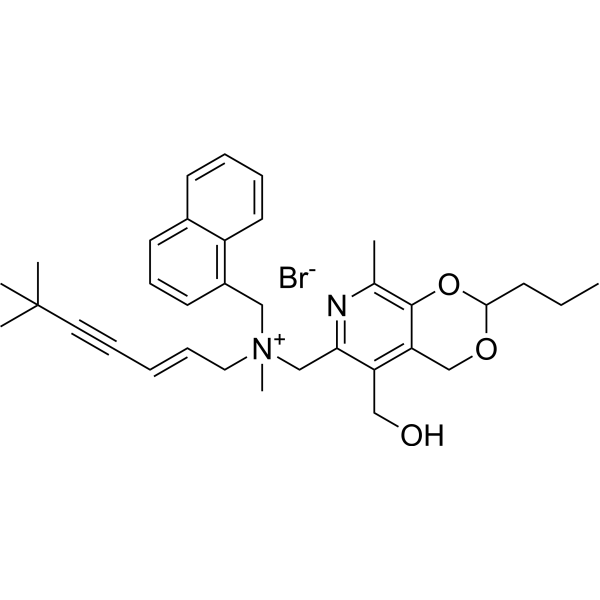
KFU-127
KFU-127 (Compound 6b) is a broad spectrum topical antimicrobial capable of one-shot targeting of bacterial and fungal-bacterial biofilms. KFU-127 is considerably toxic for eukaryotic cells. KFU-127 is a click chemistry reagent, it contains an Alkyne group and can undergo copper-catalyzed azide-alkyne cycloaddition (CuAAc) with molecules containing Azide groups.
연구목적의 판매만을 진행합니다. 환자를 대상으로 한 판매는 하지 않습니다.
- 화학식: C34H43BrN2O3
- 분자량:607.62
-
보관:
Please store the product under the recommended conditions in the Certificate of Analysis.

To place orders, for customer services and technical support, please contact: MedChemExpress USA
Tel: 609-228-6898 E-mail: [email protected] [email protected]


-
 Biological Activity
-
Chemical Information
- Protocol
- 순도&문서
- References
-
 Help & FAQs




Biological Activity
제품 설명
In Vitro
KFU-127 (Compound 6b) shows antimycotic activity with MIC values of 0.38, 3.1, 3.1 and 3.1 μg/mL against Candida albicans, Trichophyton rubrum, Aspergillus fumigatus and Fusarium oxysporum, respectively[1].
KFU-127 shows antibacterial activity with MIC values of 4, 4, 4 and 16 μg/mL against S. aureus ATCC 29213, B. subtilis 168, S. epidermidis and E. coli MG1655, respectively[1].
MedChemExpress (MCE) has not independently confirmed the accuracy of these methods. They are for reference only.


Chemical Information
-
분자량 607.62
-
화학식 C34H43BrN2O3
-
SMILES
CCCC1OCC2=C(C(C[N+](C/C=C/C#CC(C)(C)C)(CC3=C4C=CC=CC4=CC=C3)C)=NC(C)=C2O1)CO.[Br-]
-
선적
Room temperature in continental US; may vary elsewhere.
-
보관
Please store the product under the recommended conditions in the Certificate of Analysis.


순도&문서
References

Calculators
Concentration (start) × Volume (start) = Concentration (final) × Volume (final)


KFU-127 Related Classifications
HY-147814 Related Classifications
 Powered by Bioz