



Mazdutide

Based on 1 Customer Validation
Mazdutide (IBI-362; LY-3305677) is a long-acting synthetic oxyntomodulin analog. Mazdutide is also a co-agonist of glucagon-like peptide (GLP-1R) and glucagon receptor (GCGR). Mazdutide binds human and mouse GCGR (Ki: 17.7 nM and 15.9 nM, respectively) and GLP-1R (Ki: 28.6 nM and 25.1 nM, respectively) and stimulates insulin secretion from mouse islets (EC50: 5.2 nM). Mazdutide is used in studies of obesity and type 2 diabetes (T2D).
연구목적의 판매만을 진행합니다. 환자를 대상으로 한 판매는 하지 않습니다.
- Purity : 99.97%
- CAS No.: 2259884-03-0
- 화학식: C210H322N46O67
- 분자량:4563.06
-
보관:
Sealed storage, away from moisture and light, under nitrogen.
Powder -80°C, 2 years , -20°C, 1 year* In solvent : -80°C, 6 months; -20°C, 1 month (sealed storage, away from moisture and light, under nitrogen)


To place orders, for customer services and technical support, please contact: MedChemExpress USA
Tel: 609-228-6898 E-mail: [email protected] [email protected]


-
 Biological Activity
-
Chemical Information
-
용액&용해도
- Protocol
- 순도&문서
- References
-
 Help & FAQs


-

HY-P3506
RetatrutideGCGR/GIPR/GLP-1R Agonist -

HY-P4146
SurvodutideGCGR/GLP-1R Agonist -
HY-114118
SemaglutideGLP-1R Agonist -
HY-P3366
EcnoglutideGLP-1 Receptor Agonist -
HY-P2231
CotadutideGLP-1/GCGR Agonist -
HY-19904
AdomeglivantGluR Antagonist -
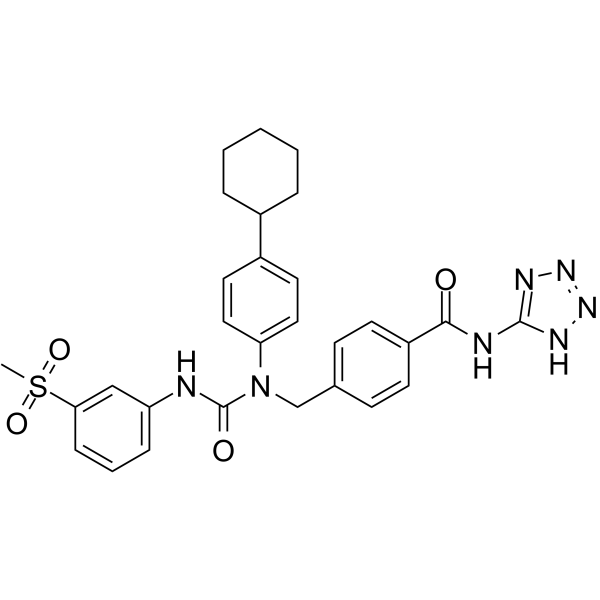
HY-124622
NNC-0640GCGR Modulator -
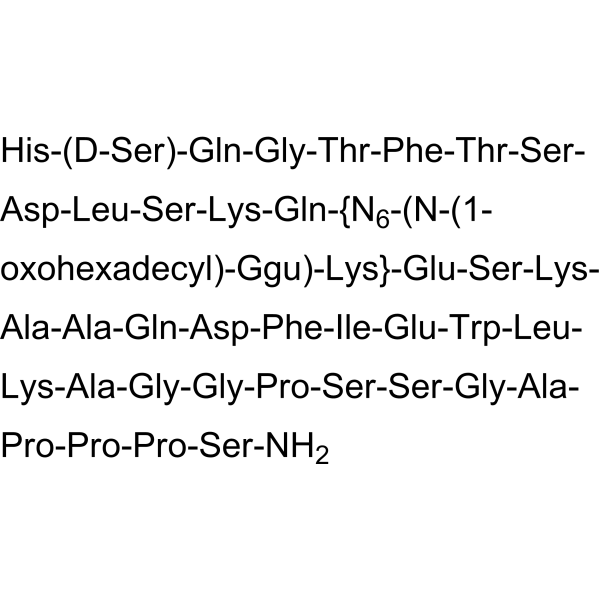
HY-P10018
BamadutideGLP-1R/GCGR Agonist -
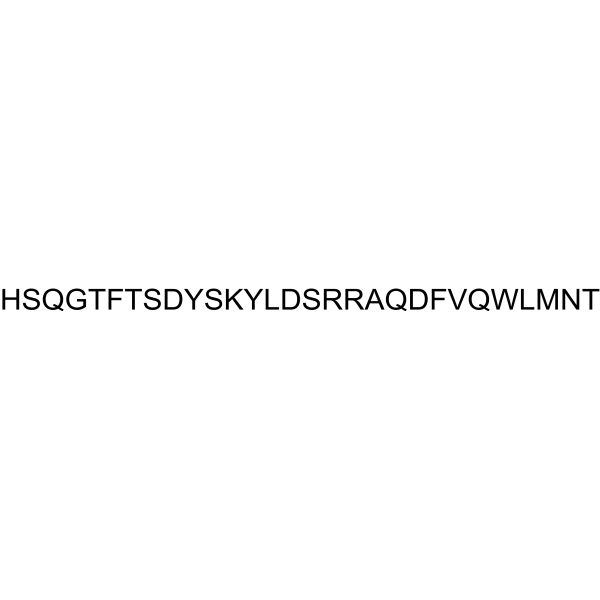
HY-P0082
Glucagon (1-29), bovine, humanPeptide Hormone -
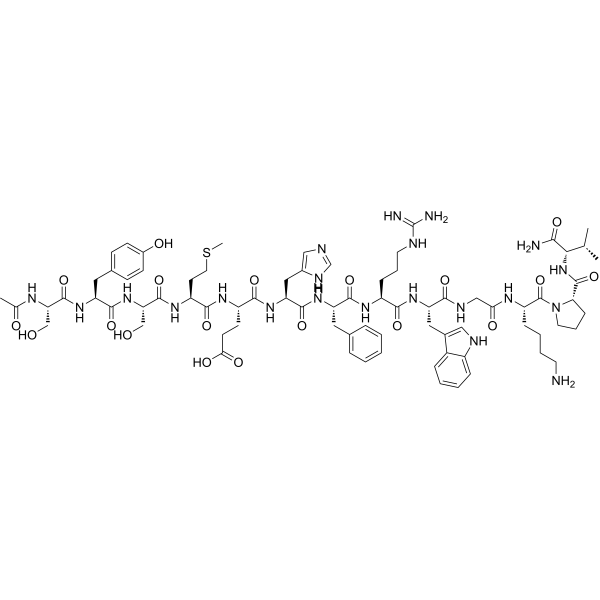
HY-P0252
α-MSHMC4R Agonist -
HY-114364
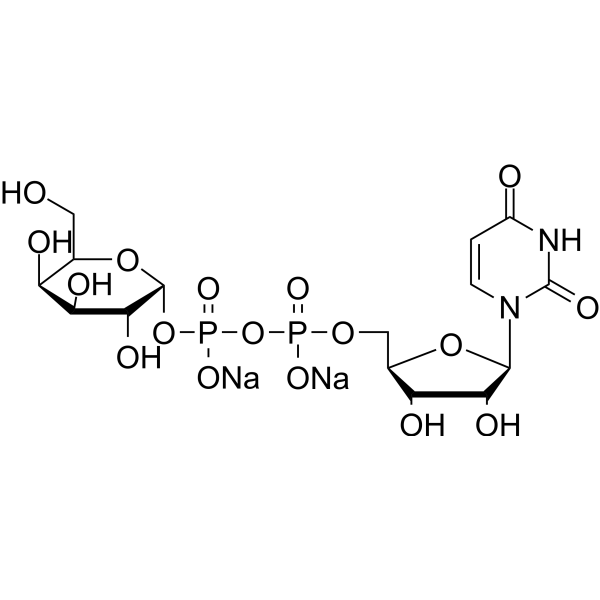
UDP-Galactose disodiumP2Y14 Receptor Agonist


Biological Activity
제품 설명
In Vivo
Clinical Trial
| NCT Number | Sponsor | Condition | Start Date |
Phase

|
|---|---|---|---|---|
| NCT01329991 | 2011-05 | PHASE1 |


Chemical Information
-
CAS No. 2259884-03-0
-
Appearance Solid
-
분자량 4563.06
-
화학식 C210H322N46O67
-
Color White to off-white
-
Synonyms
IBI-362; LY-3305677; OXM-3
-
Sequence
His-{Aib}-Gln-Gly-Thr-Phe-Thr-Ser-Asp-Tyr-Ser-Lys-Tyr-Leu-Asp-Glu-Lys-Lys-Ala-Lys-{AEEA-AEEA-γGlu-Nonadecanoic acid}-Glu-Phe-Val-Glu-Trp-Leu-Leu-Glu-Gly-Gly-Pro-Ser-Ser-Gly-NH2
-
Sequence Shortening
H-{Aib}-QGTFTSDYSKYLDEKKAK-{AEEA-AEEA-γGlu-Nonadecanoic acid}-EFVEWLLEGGPSSG-NH2
-
선적
Room temperature in continental US; may vary elsewhere.
-
보관
Sealed storage, away from moisture and light, under nitrogen
Powder -80°C 2 years -20°C 1 year * In solvent : -80°C, 6 months; -20°C, 1 month (sealed storage, away from moisture and light, under nitrogen)


용액&용해도
In Vitro:
H2O : 22.22 mg/mL (4.87 mM; ultrasonic and adjust pH to 2 with HCl)
Please refer to the solubility information to select the appropriate solvent. Once prepared, please aliquot and store the solution to prevent product inactivation from repeated freeze-thaw cycles.
Storage method and period of stock solution: -80°C, 6 months; -20°C, 1 month (sealed storage, away from moisture and light, under nitrogen). When stored at -80°C, please use it within 6 months. When stored at -20°C, please use it within 1 month.
* Note: If you choose water as the stock solution, please dilute it to the working solution, then filter and sterilize it with a 0.22 μm filter before use.
Please refer to the solubility information to select the appropriate solvent. Once prepared, please aliquot and store the solution to prevent product inactivation from repeated freeze-thaw cycles.
Storage method and period of stock solution: -80°C, 6 months; -20°C, 1 month (sealed storage, away from moisture and light, under nitrogen). When stored at -80°C, please use it within 6 months. When stored at -20°C, please use it within 1 month.
* Note: If you choose water as the stock solution, please dilute it to the working solution, then filter and sterilize it with a 0.22 μm filter before use.
Concentration (start) × Volume (start) = Concentration (final) × Volume (final)


순도&문서
-
Data Sheet (289 KB)
-
SDS (252 KB)
- English - EN (252 KB)
- Français - FR (252 KB)
- Deutsch - DE (252 KB)
- Norwegian - NO (252 KB)
- Español - ES (252 KB)
- Swedish - SV (252 KB)
- Italian - IT (252 KB)
- Korean - KR (252 KB)
- Portuguese - PT (252 KB)
-
Handling Instructions (2659 KB)
References
[1]. Chen T, et al. The Design and Optimization of Monomeric Multitarget Peptides for the Treatment of Multifactorial Diseases. J Med Chem. 2022 Mar 10;65(5):3685-3705. [Content Brief]
[2]. Jiang H, et al. A phase 1b randomised controlled trial of a glucagon-like peptide-1 and glucagon receptor dual agonist IBI362 (LY3305677) in Chinese patients with type 2 diabetes. Nat Commun. 2022 Jun 24;13(1):3613. [Content Brief]


Complete Stock Solution Preparation Table
Please refer to the solubility information to select the appropriate solvent. Once prepared, please aliquot and store the solution to prevent product inactivation from repeated freeze-thaw cycles.
Storage method and period of stock solution: -80°C, 6 months; -20°C, 1 month (sealed storage, away from moisture and light, under nitrogen). When stored at -80°C, please use it within 6 months. When stored at -20°C, please use it within 1 month.
| Optional Solvent | Concentration Solvent Mass | 1 mg | 5 mg | 10 mg | 25 mg |
|---|---|---|---|---|---|
| H2O | 1 mM | 0.2192 mL | 1.0958 mL | 2.1915 mL | 5.4788 mL |
* Note: If you choose water as the stock solution, please dilute it to the working solution, then filter and sterilize it with a 0.22 μm filter before use.


Mazdutide Related Classifications
HY-P3375 Related Classifications
 Powered by Bioz