



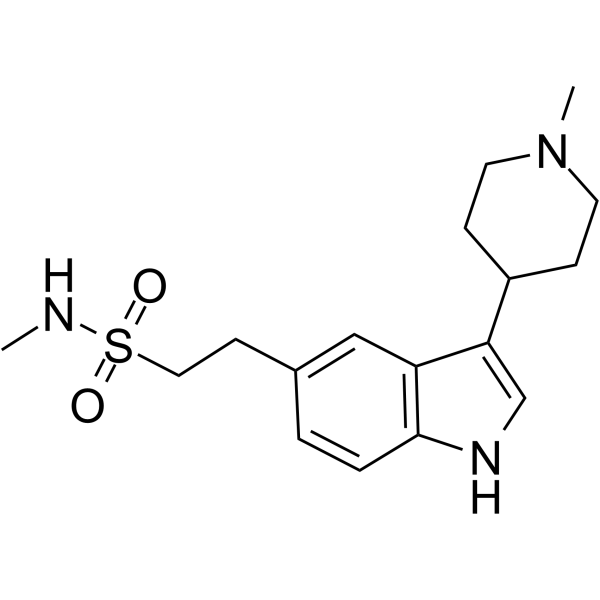
Naratriptan
Based on 2 publication(s) in Google Scholar
Naratriptan is an orally active and selective 5-HT1B/1D receptor agonist. Naratriptan is peripherally active and has good oral bioavailability, inducing cranial artery vasoconstriction by activating 5-HT1B/1D receptors (EC50=0.11 μM for dog basilar artery). Naratriptan also inhibits trigeminal nerve-mediated dural neurogenic plasma extravasation and reduces sterile inflammation. Naratriptan is mainly used in the research of acute migraine, targeting cranial vascular and neuroinflammatory mechanisms.
연구목적의 판매만을 진행합니다. 환자를 대상으로 한 판매는 하지 않습니다.
- Purity : 99.81%
- CAS No.: 121679-13-8
- 화학식: C17H25N3O2S
- 분자량:335.46
-
보관:Powder -20°C, 3 years , 4°C, 2 years ; In solvent -80°C, 6 months , -20°C, 1 month

To place orders, for customer services and technical support, please contact: MedChemExpress USA
Tel: 609-228-6898 E-mail: [email protected] [email protected]


-
 Biological Activity
-
Chemical Information
-
용액&용해도
- Protocol
- 순도&문서
- References
-
 Help & FAQs


Publications Citing Use of MedChemExpress (MCE) Naratriptan
MoreAll 5-HT Receptor Isoforms
More

Biological Activity
제품 설명
IC50 & Target
|
5-HT1B Receptor |
5-HT1 Receptor |
In Vitro
Naratriptan targets human recombinant 5-HT1B and 5-HT1D receptors with Ki of 0.47 nM and 0.69 nM, and EC50 of 4.4 nM and 23 nM, respectively; while for 5-HT1A, Ki=26 nM, EC50=79 nM[1].
Naratriptan targets 5-HT1B, 5-HT1D, and 5-HT1F with pKi of 8.7, 8.3, and 8.1, respectively[2].
Naratriptan can inhibit the discharge response of cat-derived nucleus tractus solitarius (NTS) cells that regulate vomiting by 54%; this activity suggests that Naratriptan has inhibitory activity on NTS in trigeminal nerve vessels and can be used in the study of migraine inhibition[2].
Naratriptan induces concentration-dependent contraction in isolated dog basilar artery and middle cerebral artery experiments, with EC50 of 0.11 M and 0.07 M, respectively[3].
Naratriptan induces contraction in isolated human epicardial coronary arteries with an EC50 value of 0.17 μM; the maximal contraction induced at this point is 33% of the maximal 5-HT response[3].
MedChemExpress (MCE) has not independently confirmed the accuracy of these methods. They are for reference only.
In Vivo
Naratriptan (10 mg/kg; oral; single dose) has an oral bioavailability of 71% in male Wistar rats. Naratriptan (0.5 mg/kg; oral; single dose) has an oral bioavailability of 95% in beagle dogs[3].
Contrary to the activity of μ-opioid receptor agonists, Naratriptan [(10, 30 μg/kg; intrathecal injection; single dose) or (10, 30 mg/kg; subcutaneous injection; single dose)] does not increase the latency of the tail flick response or hot plate response in mice in the tail flick test or hot plate test. Neither or Naratriptan (10, 30 mg/kg; subcutaneous injection; single dose) also does not increase the nociceptive paw pressure threshold in the paw pressure test in guinea pigs and rats[3].
Naratriptan (10 mg/mL; IV/iontophoresis; single dose) inhibits the responses of trigeminal nucleus caudalis neurons to sagittal sinus stimulation in the cat trigeminal neurovascular stimulation model, an effect that can be reversed by the 5-HT1B/1D receptor antagonists (5 mg/mL) SB224289 (HY-101105) and BRL15572 (HY-13200B)[4].
MedChemExpress (MCE) has not independently confirmed the accuracy of these methods. They are for reference only.
-
Animal Model:Cat Trigeminovascular Stimulation Model:
Adult cats (2.8±0.9 kg) with superior sagittal sinus electrical stimulation[2] -
Dosage:10-30 µg/kg
-
Administration:Intravenous injection, single dose; with or without SB224289 (300 µg/kg), BRL15572 (300 µg/kg)
-
Result:Suppressed neuronal responses to sagittal sinus stimulation in trigeminal nucleus caudalis by 47±4%, with selective inhibition of dural input over cutaneous receptive field input, and the effect was antagonized by 5-HT1B/1D or 5-HT1A receptor antagonists.
-
Animal Model:Rat Dural Neurogenic Inflammation Model:
Male rats (190-220 g) with trigeminal ganglion electrical stimulation-induced dural plasma protein extravasation[4] -
Dosage:0.1-10 µg/kg
-
Administration:Intravenous injection, single dose 15 min before stimulation
-
Result:Significantly inhibited dural plasma protein extravasation at 10 µg/kg, with an ID50 of 4.1 µg/kg, and showed no effect on extracranial tissues.
-
Animal Model:Dog Carotid Vasoconstriction Model:
Beagle dogs (7-9 kg) with carotid vascular resistance measurement[4] -
Dosage:1-300 µg/kg
-
Administration:Intravenous injection, cumulative dosing
-
Result:Caused dose-dependent carotid vasoconstriction with a CD50 of 19±3 µg/kg, increased carotid vascular resistance by 92±15%, and induced bradycardia without significant blood pressure changes.
Clinical Trial
| NCT Number | Sponsor | Condition | Start Date |
Phase

|
|---|---|---|---|---|
| NCT01329991 | Plexxikon| | 2011-05 | PHASE1 |


Chemical Information
-
CAS No. 121679-13-8
-
Appearance Solid
-
분자량 335.46
-
화학식 C17H25N3O2S
-
Color White to off-white
-
SMILES
O=S(CCC1=CC2=C(NC=C2C3CCN(C)CC3)C=C1)(NC)=O
-
Synonyms
GR-85548A
-
선적
Room temperature in continental US; may vary elsewhere.
-
보관
Powder -20°C 3 years 4°C 2 years In solvent -80°C 6 months -20°C 1 month


Publications (2)
-
Journal Impact Factor
-
Most Recent
-
J Exp Med
2022 Aug 1;219(8):e20212307. PMID: 35796804 -
Bioorg Chem
Identification of FTY720 and COH29 as novel topoisomerase I catalytic inhibitors by experimental and computational studies. [Abstract]2024 Jun:147:107412. PMID: 38696845


용액&용해도
In Vitro:
DMSO : 83.33 mg/mL (248.41 mM; Need ultrasonic; Hygroscopic DMSO has a significant impact on the solubility of product, please use newly opened DMSO)
Please refer to the solubility information to select the appropriate solvent. Once prepared, please aliquot and store the solution to prevent product inactivation from repeated freeze-thaw cycles.
Storage method and period of stock solution: -80°C, 6 months; -20°C, 1 month. When stored at -80°C, please use it within 6 months. When stored at -20°C, please use it within 1 month.
Please refer to the solubility information to select the appropriate solvent. Once prepared, please aliquot and store the solution to prevent product inactivation from repeated freeze-thaw cycles.
Storage method and period of stock solution: -80°C, 6 months; -20°C, 1 month. When stored at -80°C, please use it within 6 months. When stored at -20°C, please use it within 1 month.
Concentration (start) × Volume (start) = Concentration (final) × Volume (final)
In Vivo:
Select the appropriate dissolution method based on your experimental animal and administration route.
- For the following dissolution methods, please ensure to first prepare a clear stock solution using an In Vitro approach and then sequentially add co-solvents:
- To ensure reliable experimental results, the clarified stock solution can be appropriately stored based on storage conditions. As for the working solution for In Vivo experiments, it is recommended to prepare freshly and use it on the same day.
- The percentages shown for the solvents indicate their volumetric ratio in the final prepared solution. If precipitation or phase separation occurs during preparation, heat and/or sonication can be used to aid dissolution.
Add each solvent one by one: 10% DMSO 40% PEG300 5% Tween-80 45% Saline
Solubility: ≥ 2.5 mg/mL (7.45 mM); Clear solution
This protocol yields a clear solution of ≥ 2.5 mg/mL (saturation unknown).
Taking 1 mL working solution as an example, add 100 μL DMSO stock solution (25.0 mg/mL) to 400 μL PEG300, and mix evenly; then add 50 μL Tween-80 and mix evenly; then add 450 μL Saline to adjust the volume to 1 mL.
Preparation of Saline: Dissolve 0.9 g sodium chloride in ddH₂O and dilute to 100 mL to obtain a clear Saline solution.
Add each solvent one by one: 10% DMSO 90% (20% SBE-β-CD in Saline)
Solubility: ≥ 2.5 mg/mL (7.45 mM); Clear solution
This protocol yields a clear solution of ≥ 2.5 mg/mL (saturation unknown).
Taking 1 mL working solution as an example, add 100 μL DMSO stock solution (25.0 mg/mL) to 900 μL 20% SBE-β-CD in Saline, and mix evenly.
Preparation of 20% SBE-β-CD in Saline (4°C, storage for one week): 2 g SBE-β-CD powder is dissolved in 10 mL Saline, completely dissolve until clear.
In Vivo Dissolution Calculator
Please enter the basic information of animal experiments:
-
-
-
-
Recommended: Prepare an additional quantity of animals to account for potential losses during experiments.
Please enter your animal formula composition:
-
%DMSO +
Recommended: Keep the proportion of DMSO in working solution below 2% if your animal is weak.
-
%+
-
+%Tween-80 + +
-
%Saline +
The co-solvents required include: DMSO, . All of co-solvents are available by MedChemExpress (MCE). , Tween 80. All of co-solvents are available by MedChemExpress (MCE).
Working solution concentration: 0.22 mg/mL
Method for preparing stock solution: mg drug dissolved in μL DMSO. Stock solution concentration: mg/mL.
1. Take μL DMSO stock solution;
2. Add μL .
μL , mix evenly;
3. Then add μL Tween 80, mix evenly;
4. Then add μL
Please ensure that the stock solution in the first step is dissolved to a clear state, and add co-solvents in sequence. You can use ultrasonic heating (ultrasonic cleaner, recommended frequency 20-40 kHz), vortexing, etc. to assist dissolution.


순도&문서
-
Data Sheet (283 KB)
-
SDS (393 KB)
- English - EN (393 KB)
- Français - FR (393 KB)
- Deutsch - DE (393 KB)
- Norwegian - NO (393 KB)
- Español - ES (393 KB)
- Swedish - SV (393 KB)
- Italian - IT (393 KB)
- Korean - KR (393 KB)
- Portuguese - PT (393 KB)
-
Handling Instructions (2659 KB)
References
[1]. Rhoden E, et al. Anti-poliovirus activity of protease inhibitor AG-7404, and assessment of in vitro activity in combination with antiviral capsid inhibitor compounds. Antiviral Res. 2013 May;98(2):186-91. [Content Brief]
[2]. Hoskin KL, et al. The 5-hydroxytryptamine1B/1D/1F receptor agonists eletriptan and naratriptan inhibit trigeminovascular input to the nucleus tractus solitarius in the cat. Brain Res. 2004 Feb 13;998(1):91-9. [Content Brief]
[3]. Connor HE, et al. Naratriptan: biological profile in animal models relevant to migraine. Cephalalgia. 1997 May;17(3):145-52. [Content Brief]
[4]. Donaldson C, et al. The role of 5-HT1B and 5-HT1D receptors in the selective inhibitory effect of naratriptan on trigeminovascular neurons. Neuropharmacology. 2002 Mar;42(3):374-85. [Content Brief]


Complete Stock Solution Preparation Table
Please refer to the solubility information to select the appropriate solvent. Once prepared, please aliquot and store the solution to prevent product inactivation from repeated freeze-thaw cycles.
Storage method and period of stock solution: -80°C, 6 months; -20°C, 1 month. When stored at -80°C, please use it within 6 months. When stored at -20°C, please use it within 1 month.
| Optional Solvent | Concentration Solvent Mass | 1 mg | 5 mg | 10 mg | 25 mg |
|---|---|---|---|---|---|
| DMSO | 1 mM | 2.9810 mL | 14.9049 mL | 29.8098 mL | 74.5245 mL |
| 5 mM | 0.5962 mL | 2.9810 mL | 5.9620 mL | 14.9049 mL | |
| 10 mM | 0.2981 mL | 1.4905 mL | 2.9810 mL | 7.4525 mL | |
| 15 mM | 0.1987 mL | 0.9937 mL | 1.9873 mL | 4.9683 mL | |
| 20 mM | 0.1490 mL | 0.7452 mL | 1.4905 mL | 3.7262 mL | |
| 25 mM | 0.1192 mL | 0.5962 mL | 1.1924 mL | 2.9810 mL | |
| 30 mM | 0.0994 mL | 0.4968 mL | 0.9937 mL | 2.4842 mL | |
| 40 mM | 0.0745 mL | 0.3726 mL | 0.7452 mL | 1.8631 mL | |
| 50 mM | 0.0596 mL | 0.2981 mL | 0.5962 mL | 1.4905 mL | |
| 60 mM | 0.0497 mL | 0.2484 mL | 0.4968 mL | 1.2421 mL | |
| 80 mM | 0.0373 mL | 0.1863 mL | 0.3726 mL | 0.9316 mL | |
| 100 mM | 0.0298 mL | 0.1490 mL | 0.2981 mL | 0.7452 mL |


Naratriptan Related Classifications
HY-B0197 Related Classifications
 Powered by Bioz