



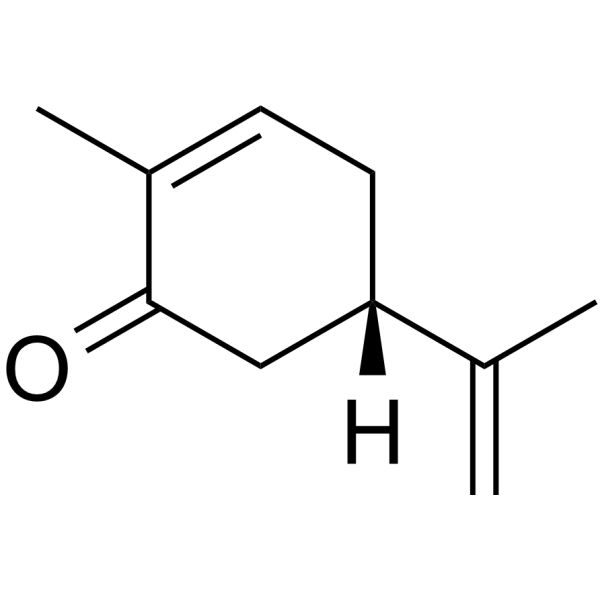
(S)-(+)-Carvone
Based on 1 publication(s) in Google Scholar
(S)-(+)-Carvone is an orally active natural product. (S)-(+)-Carvone increases the activity of antioxidant enzymes (SOD, CAT) and ROS, reduces the levels of oxidative stress markers (MDA, AChE), reduces the secretion of proinflammatory cytokines (IL-1β, IL-4, IL-6, IL-10), and downregulates NLRP3. (S)-(+)-Carvone increases the activities of caspase-8, -9 and -3. (S)-(+)-Carvone induces apoptotic death. (S)-(+)-Carvone has antimanic-like effect, liver protection and anticancer activity against skin cancer. (S)-(+)-Carvone improves memory and arthritis.
연구목적의 판매만을 진행합니다. 환자를 대상으로 한 판매는 하지 않습니다.
- Purity: 99.26%
- CAS No.: 2244-16-8
- 화학식: C10H14O
- 분자량:150.22
-
보관:Pure form -20°C, 3 years , 4°C, 2 years ; In solvent -80°C, 6 months , -20°C, 1 month

To place orders, for customer services and technical support, please contact: MedChemExpress USA
Tel: 609-228-6898 E-mail: [email protected] [email protected]


-
 Biological Activity
-
Chemical Information
-
용액&용해도
- 순도&문서
- References
-
 Help & FAQs



Publications Citing Use of MedChemExpress (MCE) (S)-(+)-Carvone
MoreAll Caspase Isoforms
More

Biological Activity
(S)-(+)-Carvone (5-35 μM; 24 h) inhibits proliferation and increases ROS in a dose-dependent manner as well as induces apoptosis through inhibition of JAK/STAT3 in human gastric cancer AGS cells[2].
S-(+)-Carvone (0.078 mM for SH-SY5Y cells, 0.625 mM for HepG2 cells; 48 h) shows neuroprotective and hepatoprotective activity, significantly decreasing the generation of ROS and inhibiting lipid peroxidation in SH-SY5Y and HepG2 cells[3].
(S)-(+)-Carvone (5-30 μM; 24 h) suppresses the viability of human leukemic Molt-4 cells and induces apoptotic death in Molt-4 cells[4].
(S)-(+)-Carvone (665 μM; 1 h before LPS treatment and maintained for the rest of the experimental period) inhibits LPS-induced JNK1 phosphorylation in murine macrophage Raw 264.7 cells[5].
(S)-(+)-Carvone (1 mM; 24 h) decreases the incorporation of isoprenoid precursors into Nicotiana tabacum proteins[6].
MedChemExpress (MCE) has not independently confirmed the accuracy of these methods. They are for reference only.
-
Cell Line:Molt-4 human leukemic cells
-
Concentration:5 μM, 10 μM, 15 μM, 20 μM, 25 μM, 30 μM
-
Incubation Time:24 h
-
Result:Induced apoptotic cell death.
Increased the activities of caspase-8, -9 and -3.
(S)-(+)-Carvone (25-50 mg/kg; intragastrically; 3 consecutive days) significantly alleviated LPS-induced lung injury in mice, reduced the number of inflammatory cells in bronchoalveolar lavage fluid (BALF), the levels of proinflammatory cytokines (TNF-α, IL-1β, IL-6) in serum, and improved pathological changes in lung tissue[7].
(S)-(+)-Carvone (10-20 mg/kg; i.p.; started 15 min before reperfusion, once a day, for 15 consecutive days) alleviated brain I/R injury in rats, reduced brain water content, infarct volume, and neurological deficit scores[8].
(S)-(+)-Carvone (30-60 mg/kg; p.o., 25 days) significantly improves the body weight, reduces the paw swelling, edema formation, and organ index in arthritic rats, and also modulates inflammatory cytokine levels and improves ankle joint pathology against CFA-induced arthritic inflammation[9].
(S)-(+)-Carvone (50-100 mg/kg; i.p.; once; acute and 21-day chronic treatment) blocks hyperlocomotion induced by Methylphenidate and sleep deprivation in mice, indicating an antimanic-like effect[10].
(S)-(+)-Carvone (175 mg/kg; i.p.; twice a week; 8 weeks) blocks high-fat diet-induced weight gain, fat accumulation in the liver, and insulin resistance in C57BL/6 male mice[11].
(S)-(+)-Carvone (20-30 mg/kg; p.o.; three times a week; from one week before DMBA painting to 25th week) totally prevents tumor occurrence in DMBA (HY-W011845)-induced skin carcinogenesis in Swiss albino mice[12].
MedChemExpress (MCE) has not independently confirmed the accuracy of these methods. They are for reference only.
-
Animal Model:Native adult male Swiss mice (weight: 20-25 g)[3]
-
Dosage:50 mg/kg, 100 mg/kg (suspended in 1% Tween 20 solution)
-
Administration:Intraperitoneally, single-dose or multiple-dose (single-dose: once, multiple-dose: twice daily for 6 days), single-dose experiment was conducted once, multiple-dose experiment was conducted for 6 days
-
Result:Did not significantly affect memory processes related to acquisition (in the passive avoidance test, single-dose administration).
Increased the latency index, indicating improved memory acquisition (multiple-dose administration of 100 mg/kg).
Impaired locomotor activity compared to the control group within 30 min of administration and reduced the distance traveled by animals over 60 min (both single-dose and multiple-dose administration).


Chemical Information
-
CAS No. 2244-16-8
-
Appearance Liquid (Density: 0.960 g/cm3 )
-
분자량 150.22
-
화학식 C10H14O
-
Color Colorless to light yellow
-
SMILES
C=C([C@H](C1)CC=C(C)C1=O)C
-
Synonyms
D-Carvone
-
Structure Classification
-
Initial Source
-
선적
Room temperature in continental US; may vary elsewhere.
-
보관
Pure form -20°C 3 years 4°C 2 years In solvent -80°C 6 months -20°C 1 month


Publications (1)
-
Journal Impact Factor
-
Most Recent
-
Microbiol Spectr
Evaluation of the combined efficacy of carvone and colistin against colistin-resistant Pseudomonas aeruginosa: in vitro and in vivo studies. [Abstract]2026 May 14:e0230725. PMID: 42132390


용액&용해도
DMSO : 100 mg/mL (665.69 mM; Need ultrasonic; Hygroscopic DMSO has a significant impact on the solubility of product, please use newly opened DMSO)
Please refer to the solubility information to select the appropriate solvent. Once prepared, please aliquot and store the solution to prevent product inactivation from repeated freeze-thaw cycles.
Storage method and period of stock solution: -80°C, 6 months; -20°C, 1 month. When stored at -80°C, please use it within 6 months. When stored at -20°C, please use it within 1 month.
Please refer to the solubility information to select the appropriate solvent. Once prepared, please aliquot and store the solution to prevent product inactivation from repeated freeze-thaw cycles.
Storage method and period of stock solution: -80°C, 6 months; -20°C, 1 month. When stored at -80°C, please use it within 6 months. When stored at -20°C, please use it within 1 month.
Concentration (start) × Volume (start) = Concentration (final) × Volume (final)
Select the appropriate dissolution method based on your experimental animal and administration route.
- For the following dissolution methods, please ensure to first prepare a clear stock solution using an In Vitro approach and then sequentially add co-solvents:
- To ensure reliable experimental results, the clarified stock solution can be appropriately stored based on storage conditions. As for the working solution for In Vivo experiments, it is recommended to prepare freshly and use it on the same day.
- The percentages shown for the solvents indicate their volumetric ratio in the final prepared solution. If precipitation or phase separation occurs during preparation, heat and/or sonication can be used to aid dissolution.
Add each solvent one by one: 10% DMSO 40% PEG300 5% Tween-80 45% Saline
Solubility: ≥ 2.5 mg/mL (16.64 mM); Clear solution
This protocol yields a clear solution of ≥ 2.5 mg/mL (saturation unknown).
Taking 1 mL working solution as an example, add 100 μL DMSO stock solution (25.0 mg/mL) to 400 μL PEG300, and mix evenly; then add 50 μL Tween-80 and mix evenly; then add 450 μL Saline to adjust the volume to 1 mL.
Preparation of Saline: Dissolve 0.9 g sodium chloride in ddH₂O and dilute to 100 mL to obtain a clear Saline solution.
Add each solvent one by one: 10% DMSO 90% (20% SBE-β-CD in Saline)
Solubility: ≥ 2.5 mg/mL (16.64 mM); Clear solution
This protocol yields a clear solution of ≥ 2.5 mg/mL (saturation unknown).
Taking 1 mL working solution as an example, add 100 μL DMSO stock solution (25.0 mg/mL) to 900 μL 20% SBE-β-CD in Saline, and mix evenly.
Preparation of 20% SBE-β-CD in Saline (4°C, storage for one week): 2 g SBE-β-CD powder is dissolved in 10 mL Saline, completely dissolve until clear.
Please enter the basic information of animal experiments:
-
-
-
-
Recommended: Prepare an additional quantity of animals to account for potential losses during experiments.
Please enter your animal formula composition:
-
%DMSO +
Recommended: Keep the proportion of DMSO in working solution below 2% if your animal is weak.
-
%+
-
+%Tween-80 + +
-
%Saline +
The co-solvents required include: DMSO, . All of co-solvents are available by MedChemExpress (MCE). , Tween 80. All of co-solvents are available by MedChemExpress (MCE).
Working solution concentration: 0.22 mg/mL
Method for preparing stock solution: mg drug dissolved in μL DMSO. Stock solution concentration: mg/mL.
1. Take μL DMSO stock solution;
2. Add μL .
μL , mix evenly;
3. Then add μL Tween 80, mix evenly;
4. Then add μL
Please ensure that the stock solution in the first step is dissolved to a clear state, and add co-solvents in sequence. You can use ultrasonic heating (ultrasonic cleaner, recommended frequency 20-40 kHz), vortexing, etc. to assist dissolution.


순도&문서
-
Data Sheet (282 KB)
-
SDS (393 KB)
- English - EN (393 KB)
- Français - FR (393 KB)
- Deutsch - DE (393 KB)
- Norwegian - NO (393 KB)
- Español - ES (393 KB)
- Swedish - SV (393 KB)
- Italian - IT (393 KB)
- Korean - KR (393 KB)
- Portuguese - PT (393 KB)
-
Handling Instructions (2659 KB)
References
[2]. Lv L, et al. d-Carvone inhibits the JAK/STAT3 signaling pathway and induced the apoptotic cell death in the human gastric cancer AGS cells. J Biochem Mol Toxicol. 2021 May;35(5):e22746. [Content Brief]
[3]. Wojtunik-Kulesza KA, et al. S-(+)-Carvone, a Monoterpene with Potential Anti-Neurodegenerative Activity-In Vitro, In Vivo and Ex Vivo Studies. Molecules. 2024 Sep 13;29(18):4365. [Content Brief]
[4]. Iyappan P, et al. D-carvone induced ROS mediated apoptotic cell death in human leukemic cell lines (Molt-4). Bioinformation. 2021 Jan 31;17(1):171-180. [Content Brief]
[5]. Sousa C, et al. Elucidation of the Mechanism Underlying the Anti-Inflammatory Properties of (S)-(+)-Carvone Identifies a Novel Class of Sirtuin-1 Activators in a Murine Macrophage Cell Line. Biomedicines. 2021 Jul 4;9(7):777. [Content Brief]
[6]. Huchelmann A, et al. S-carvone suppresses cellulase-induced capsidiol production in Nicotiana tabacum by interfering with protein isoprenylation. Plant Physiol. 2014 Feb;164(2):935-50. [Content Brief]
[8]. Dai M, et al. D-Carvone inhibit cerebral ischemia/reperfusion induced inflammatory response TLR4/NLRP3 signaling pathway. Biomed Pharmacother. 2020 Dec;132:110870. [Content Brief]
[9]. Chen G, et al. Anti-arthritic activity of D-carvone against complete Freund's adjuvant-induced arthritis in rats through modulation of inflammatory cytokines. Korean J Physiol Pharmacol. 2020 Nov 1;24(6):453-462. [Content Brief]
[10]. Nogoceke FP, et al. Antimanic-like effects of (R)-(-)-carvone and (S)-(+)-carvone in mice. Neurosci Lett. 2016 Apr 21;619:43-8. [Content Brief]
[11]. Alsanea S, et al. BITC and S-Carvone Restrain High-Fat Diet-Induced Obesity and Ameliorate Hepatic Steatosis and Insulin Resistance. Pharm Res. 2017 Nov;34(11):2241-2249. [Content Brief]
[12]. Gopalakrishnan T, et al. Preventive effect of D-carvone during DMBA induced mouse skin tumorigenesis by modulating xenobiotic metabolism and induction of apoptotic events. Biomed Pharmacother. 2019 Mar;111:178-187. [Content Brief]


Complete Stock Solution Preparation Table
Please refer to the solubility information to select the appropriate solvent. Once prepared, please aliquot and store the solution to prevent product inactivation from repeated freeze-thaw cycles.
Storage method and period of stock solution: -80°C, 6 months; -20°C, 1 month. When stored at -80°C, please use it within 6 months. When stored at -20°C, please use it within 1 month.
| Optional Solvent | Concentration Solvent Mass | 1 mg | 5 mg | 10 mg | 25 mg |
|---|---|---|---|---|---|
| DMSO | 1 mM | 6.6569 mL | 33.2845 mL | 66.5690 mL | 166.4226 mL |
| 5 mM | 1.3314 mL | 6.6569 mL | 13.3138 mL | 33.2845 mL | |
| 10 mM | 0.6657 mL | 3.3285 mL | 6.6569 mL | 16.6423 mL | |
| 15 mM | 0.4438 mL | 2.2190 mL | 4.4379 mL | 11.0948 mL | |
| 20 mM | 0.3328 mL | 1.6642 mL | 3.3285 mL | 8.3211 mL | |
| 25 mM | 0.2663 mL | 1.3314 mL | 2.6628 mL | 6.6569 mL | |
| 30 mM | 0.2219 mL | 1.1095 mL | 2.2190 mL | 5.5474 mL | |
| 40 mM | 0.1664 mL | 0.8321 mL | 1.6642 mL | 4.1606 mL | |
| 50 mM | 0.1331 mL | 0.6657 mL | 1.3314 mL | 3.3285 mL | |
| 60 mM | 0.1109 mL | 0.5547 mL | 1.1095 mL | 2.7737 mL | |
| 80 mM | 0.0832 mL | 0.4161 mL | 0.8321 mL | 2.0803 mL | |
| 100 mM | 0.0666 mL | 0.3328 mL | 0.6657 mL | 1.6642 mL |


(S)-(+)-Carvone Related Classifications
HY-W013579 Related Classifications
 Powered by Bioz