

153 Results for "

protease substrates

" in MedChemExpress (MCE) Product Catalog:
Products (153)

153 Results for "protease substrates" in MCE Product Catalog:

Cat. No.: HY-139814
CAS No.: 1979130-73-8
연구분야:  

Others

d-Phe-Pro-Arg-PABA-Resorufin is a selective Thrombin substrate. d-Phe-Pro-Arg-PABA-Resorufin can be cleaved by thrombin to release fluorescent and chromogenic products. d-Phe-Pro-Arg-PABA-Resorufin enables sensitive detection of the thrombin inhibitor Dabigatran (HY-10163) via thrombin-mediated cleavage attenuation .
loading...
    loading...
Cat. No.: HY-E70226
CAS No.: 71965-46-3
Synonyms: CTSS
Human Cathepsin S (CTSS) is a cysteine protease with elastinolytic activity. Human Cathepsin S is inhibited by cysteine protease inhibitors such as E-64 (HY-15282) and cystatin C. Human Cathepsin S cleaves substrates including elastin, TGF-β1, Myelin basic protein (HY-P1821), PAR2, SIRT1, collagen 18A1, FKN, and MHC-II invariant chain fragments, thereby driving processes such as elastic matrix degradation, TGF-β1 signaling, demyelination, PAR2-mediated calcium mobilization, NF-κB activation, hepatic fibrosis, immune homeostasis regulation, and antigen presentation. Human Cathepsin S can be used in the research of cardiovascular diseases, chronic kidney diseases, autoimmune diseases, tumors, Alzheimer's disease, and obesity .
loading...
    loading...
Cat. No.: HY-153573
Synonyms: dCym-JQ1
연구분야:  

Infection

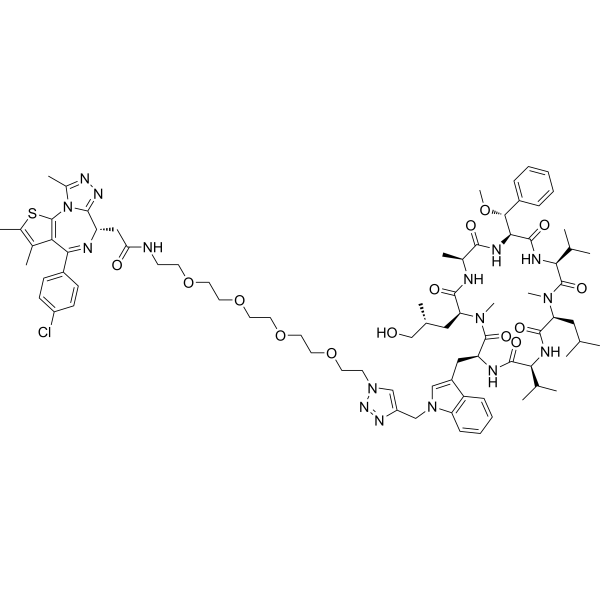
SRG-II-19F (dCym-JQ1) is a BRDTBD1 PROTAC degrader. Its dCym moiety at one end binds to the N-terminal domain of ClpC1 (ClpC1NTD), while its JQ1 moiety at the other end binds to bromodomain 1 of BRDT (BRDTBD1). This molecule induces the degradation of BRDTBD1 by recruiting the BRDTBD1 substrate to the ClpC1P1P2 protease complex. SRG-II-19F serves as a research tool for studies related to mycobacterial protein degradation .
loading...
    loading...
Cat. No.: HY-N1181R
CAS No.: 603-61-2
Synonyms: 4'-O-Methyl Quercetin (Standard)
Tamarixetin (Standard) is the analytical standard of Tamarixetin. This product is intended for research and analytical applications. Tamarixetin (4'-O-Methyl Quercetin) is an orally active natural flavonoid derivative of quercetin and caseinolytic protease p (ClpP) inhibitor with anti-inflammatory, antioxidant and antitumor effects. Tamarixetin inhibits the hydrolytic activity of ClpP to the fluorescent substrate Suc-LY-AMC with an IC50 of 49.73 μM, which can be used for the study of Staphylococcus aureus infection. Tamarixetin inhibits tumor cell growth, induces apoptosis, and cell cycle arrest. Tamarixetin prevents cardiac hypertrophy by inhibiting the NFAT and AKT pathways .
loading...
    loading...
Cat. No.: HY-137199
CAS No.: 65147-21-9
Target:  

Kallikrein

연구분야:  

Others

Pro-Phe-Arg-AMC is a substrate for human glandular kallikrein 2. Pro-Phe-Arg-AMC can be used for the quantitative detection of enzyme activity .
loading...
    loading...
Cat. No.: HY-P2618
CAS No.: 2237216-30-5
Target:  

Kallikrein

연구분야:  

Others

Pro-Phe-Arg-AMC acetate is a substrate for human glandular kallikrein 2. Pro-Phe-Arg-AMC acetate can be used for the quantitative detection of enzyme activity .
loading...
    loading...
Cat. No.: HY-110210R
CAS No.: 146616-66-2
Synonyms: BODIPY FL,SE (Standard)
연구분야:  

Others

BODIPY-FL NHS ester (Standard) is the analytical standard of BODIPY-FL NHS ester (HY-110210). This product is intended for research and analytical applications. BODIPY FL NHS ester (BODIPY FL, SE) is a cell membranes-penatrable amine-reactive fluorescent probe. The maximum excitation/emission wavelength of the BODIPY-FL NHS ester are 502/511 nm, respectively. BODIPY-FL NHS ester has high stability and is insensitive to the polarity, pH and type of solvent, and can maintain stable fluorescence properties under different environmental conditions. BODIPY-FL NHS ester can be used for the synthesis of protease substrates, live cell imaging, protein labeling and immunoassay .
loading...
    loading...
Cat. No.: HY-183851
CAS No.: 639048-45-6
Target:  

Bacterial mRNA

연구분야:  

Infection

KKL-55 is a broad-spectrum antibacterial agent that inhibits the trans-translation pathway and the ClpXP protease. KKL-55 suppresses trans-translation of non-stop mRNA, interferes with the binding of EF-Tu to tmRNA, and inhibits the proteolysis of substrates by ClpXP. KKL-55 blocks spore germination of Bacillus anthracis and protects macrophages from damage induced by anthrax toxin. By virtue of its inhibitory effect on ClpXP, KKL-55 synergistically enhances the antibacterial activity of antibiotics against drug-resistant Staphylococcus aureus. KKL-55 can be used in studies related to bacterial infections .
loading...
    loading...
Cat. No.: HY-D2379
CAS No.: 1629965-68-9
Target:  

Fluorescent Dye

연구분야:  

Others

HMRG is a fluorescent dye, which serves as the fluorescent active product generated by enzyme-activated fluorescent probes targeting proteases and glycosidases. Its detection mechanism relies on the intramolecular spirocyclization equilibrium: HMRG itself exists in an open non-spirocyclic structure under physiological pH, which maintains a conjugated π system and produces strong fluorescence; whereas its probe precursors (such as Leu-HMRG, Ac-GlyPro-HMRG and βGal-HMRG) exist in a closed spirocyclic form and show no fluorescence due to the disruption of the π-conjugated system; when the target enzyme cleaves the substrate fragment linked to the probe precursor, the closed spirocyclic structure converts to the open structure of HMRG, restoring the conjugated system and generating a strong fluorescent signal. Its detection wavelength is Ex/Em = 501/524 nm .
loading...
    loading...
Cat. No.: HY-P4122
CAS No.: 1676104-81-6
Target:  

HIV

연구분야:  

Others

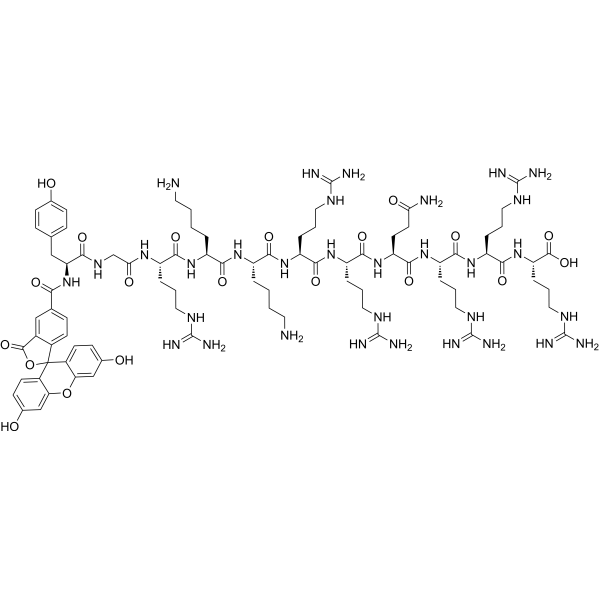
TAT (47-57), FAM-labeled is a 5(6)-Carboxyfluorescein (HY-15940)-labeled TAT (HY-P0281). TAT (YGRKKRRQRRR) is derived from the transactivator of transcription (TAT) of human immunodeficiency virus-1 (HIV-1) and is a cell-penetrating peptide .
loading...
    loading...
Cat. No.: HY-P3012
CAS No.: 107200-92-0
Cathepsin G is a pH-dependent serine protease. Cathepsin G hydrolyzes diverse synthetic and protein substrates and remodels extracellular matrix. Cathepsin G exerts immunomodulatory effects via recruiting phagocytes, enhancing T cell motility, activating ERK1/2 and p38 MAPK signaling, and mediating PKCζ membrane translocation. Cathepsin G regulates inflammatory responses by cleaving inflammatory mediators. Cathepsin G participates in vascular regulation by converting angiotensin I to angiotensin II. Cathepsin G induces PAR4-dependent platelet activation, facilitates platelet-neutrophil aggregation, and mediates VITT-related NETosis, thrombus formation. Cathepsin G can be used for the research of immune thrombotic thrombocytopenia, cardiovascular disease, and select autoimmune and inflammatory diseases .
loading...
    loading...
Cat. No.: HY-D2379A
CAS No.: 7449-51-6
Target:  

Fluorescent Dye

연구분야:  

Others

closed-HMRG is an HMRG (HY-D2379) with a closed spiro-ring structure. HMRG is a fluorescent dye, which serves as the fluorescent active product generated by enzyme-activated fluorescent probes targeting proteases and glycosidases. Its detection mechanism relies on the intramolecular spirocyclization equilibrium: HMRG itself exists in an open non-spirocyclic structure under physiological pH, which maintains a conjugated π system and produces strong fluorescence; whereas its probe precursors (such as Leu-HMRG, Ac-GlyPro-HMRG and βGal-HMRG) exist in a closed spirocyclic form and show no fluorescence due to the disruption of the π-conjugated system; when the target enzyme cleaves the substrate fragment linked to the probe precursor, the closed spirocyclic structure converts to the open structure of HMRG, restoring the conjugated system and generating a strong fluorescent signal. Its detection wavelength is Ex/Em = 501/524 nm .
loading...
    loading...
Cat. No.: HY-153572A
Target:  

PROTACs Bacterial

연구분야:  

Infection

Homo-BacPROTAC7 TFA is a PROTAC protein degrader targeting ClpC1/ClpC2 with a Kd of 0.5-2.5 nM for both targets. Homo-BacPROTAC7 (TFA) acts as a bactericidal agent, induces killing of pathogenic mycobacteria, retains activity against dormant-like mycobacterial cells with reduced intracellular ATP levels, and shows elevated antibiotic potency relative to its parent monomer. Homo-BacPROTAC7 (TFA) can be used for the research of tuberculosis .
loading...
    loading...

