



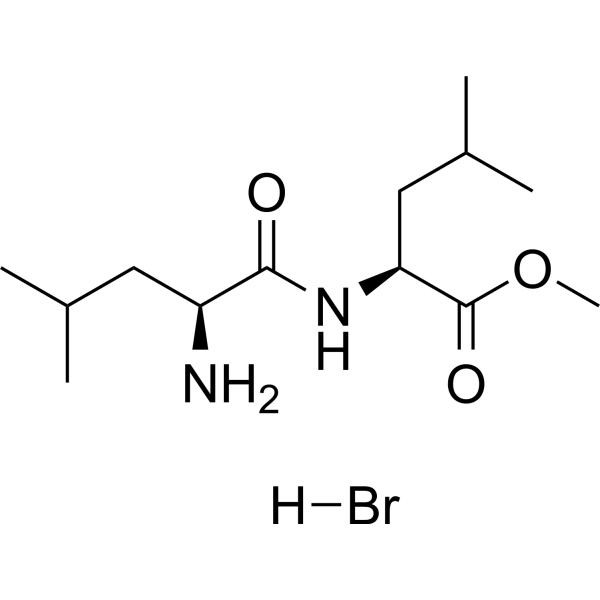
L-Leucyl-L-Leucine methyl ester hydrobromide
Based on 22 publication(s) in Google Scholar
L-Leucyl-L-Leucine methyl ester (LLOMe) hydrobromide, a dipeptide condensation product of L-leucine methyl ester generated by human monocytes or polymorphonuclear leukocytes, selectively eliminates lymphocytes with cytotoxic potential. L-Leucyl-L-Leucine methyl ester hydrobromide also can induce endolysosomal pathway stress.
For research use only. We do not sell to patients.
- Purity : 99.69%
- CAS No.: 16689-14-8
- Formula: C13H27BrN2O3
- Molecular Weight:339.27
-
Storage:
4°C, sealed storage, away from moisture
* In solvent : -80°C, 6 months; -20°C, 1 month (sealed storage, away from moisture)

To place orders, for customer services and technical support, please contact: MedChemExpress USA
Tel: 609-228-6898 E-mail: [email protected] [email protected]


-
 Biological Activity
-
Chemical Information
-
Solvent & Solubility
- Purity & Documentation
- References
-
 Help & FAQs



Publications Citing Use of MedChemExpress (MCE) L-Leucyl-L-Leucine methyl ester hydrobromide
More- Cell Res. 2026 Jan;36(1):51-71. [Abstract]
- Autophagy. 2026 Jul 10:1-21.
- Autophagy. 2024 Dec;20(12):2697-2718. [Abstract]
- Adv Sci (Weinh). 2026 May;13(25):e21681. [Abstract]
- Biomaterials. 2026 Jun 27:335:124405. [Abstract]
- Biomaterials. 2025 Jun:317:123091. [Abstract]
- Environ Chem Ecotoxicol. 2025 Nov 19;8:267-280.
- J Neuroinflammation. 2025 Oct 29;22(1):252. [Abstract]
- EMBO J. 2025 May;44(9):2596-2619. [Abstract]
- World J Gastroenterol. 2026 Feb 28;32(8):113299. [Abstract]
- J Cell Biol. 2025 Nov 3;224(11):e202404018. [Abstract]
- PLoS Pathog. 2025 Sep 16;21(9):e1013513. [Abstract]
- PLoS Pathog. 2024 Feb 14;20(2):e1011981. [Abstract]
- Toxicol Appl Pharmacol. 2026 Jan:506:117632. [Abstract]
- Int Immunol. 2021 Aug 23;33(9):491-504. [Abstract]
- FEBS Lett. 2026 Apr 24. [Abstract]
- Traffic. 2022 May;23(5):238-269. [Abstract]
- bioRxiv. 2026 Apr 21.
- SSRN. 2025 Aug 13.
- Preprints. 2025 Jul 8.
- bioRxiv. 2024 July 07.
- bioRxiv. 2024 Mar 13:2024.03.12.584718. [Abstract]
 Customer Validation & Images

-
IP
-
IF
-
Cell Imaging/Staining
-
IP
-
IP
All Endogenous Metabolite Isoforms
More

Biological Activity
Description
In Vitro
L-Leucyl-L-Leucine methyl ester (1 mM; 0.5-2 h) enhances LRRK2-mediated Rab10 and Rab12 phosphorylation in MEFs and A549 cells[3].
L-Leucyl-L-Leucine methyl ester (10-250 μM; 15 min) is converted to a CCI3COOH-insoluble product by CD4- lymphocytes[2].
MedChemExpress (MCE) has not independently confirmed the accuracy of these methods. They are for reference only.


Chemical Information
-
CAS No. 16689-14-8
-
Appearance Solid
-
Molecular Weight 339.27
-
Formula C13H27BrN2O3
-
Color White to off-white
-
SMILES
CC(C)C[C@@H](C(OC)=O)NC([C@H](CC(C)C)N)=O.[H]Br
-
Synonyms
LLOMe hydrobromide; Leu-Leu methyl ester hydrobromide; H-Leu-Leu-OMe hydrobromide
-
Structure Classification
-
Initial Source
-
Shipping
Room temperature in continental US; may vary elsewhere.
-
Storage
4°C, sealed storage, away from moisture
* In solvent : -80°C, 6 months; -20°C, 1 month (sealed storage, away from moisture)


Publications (22)
-
Journal Impact Factor
-
Most Recent
-
Cell Res
2026 Jan;36(1):51-71. PMID: 41478856 -
-
Autophagy
2024 Dec;20(12):2697-2718. PMID: 39081059 -
Adv Sci (Weinh)
Loss of VMP1 Impairs Tight Junction Recycling and Aggravates Intestinal Barrier Dysfunction in Inflammatory Bowel Disease. [Abstract]2026 May;13(25):e21681. PMID: 41757559 -
Biomaterials
In-situ cascade assembled peptide-drug conjugate for the treatment of bladder cancer by enhancing membrane-entry and lysosome destabilization. [Abstract]2026 Jun 27:335:124405. PMID: 42372507 -
Biomaterials
Engineered cell membrane vesicles loaded with lysosomophilic drug for acute myeloid leukemia therapy via organ-cell-organelle cascade-targeting. [Abstract]2025 Jun:317:123091. PMID: 39778270 -
-
J Neuroinflammation
Immune subversion by Leishmania infantum parasites suppresses NLRP3-driven inflammatory responses in amyloid-β-activated microglia. [Abstract]2025 Oct 29;22(1):252. PMID: 41162989 -
EMBO J
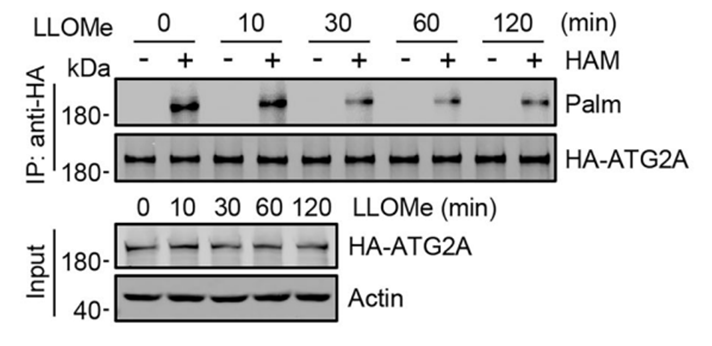
S-palmitoylation modulates ATG2-dependent non-vesicular lipid transport during starvation-induced autophagy. [Abstract]2025 May;44(9):2596-2619. PMID: 40128367
L-Leucyl-L-Leucine methyl ester hydrobromide purchased from MedChemExpress. Usage Cited in: EMBO J. 2025 May;44(9):2596-2619. [Abstract]
S-palmitoylation of HA-ATG2A detected by ABE assay in HEK293T cells treated with 1 mM LLOMe for indicated times.
-
World J Gastroenterol
Wogonin derivative V8 enhances bortezomib efficacy in gastric carcinoma by disrupting lysosome-mediated drug resistance. [Abstract]2026 Feb 28;32(8):113299. PMID: 41809875 -
J Cell Biol
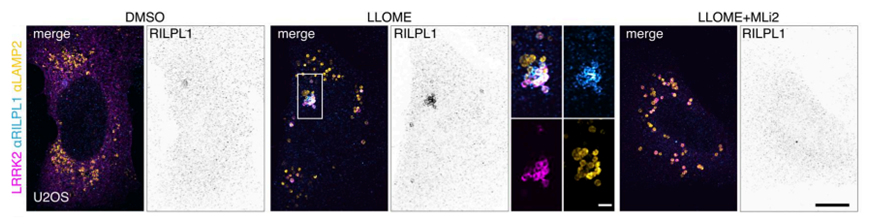
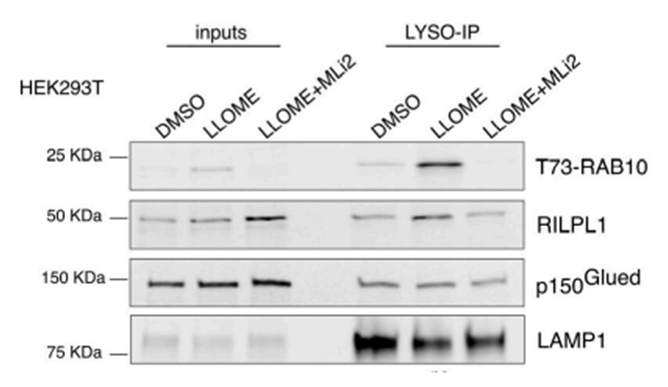
JIP4 and RILPL1 utilize opposing motor force to dynamically regulate lysosomal tubulation. [Abstract]2025 Nov 3;224(11):e202404018. PMID: 40990465
L-Leucyl-L-Leucine methyl ester hydrobromide purchased from MedChemExpress. Usage Cited in: J Cell Biol. 2025 Nov 3;224(11):e202404018. [Abstract]
U2OS cells were transfected with HaloTag-LRRK2 for 36 h. Cells were then treated with DMSO, LLOME (1 mM), or LLOME+MLi2 for 2 h before fixation. Cells were then stained for RILPL1 and LAMP2.
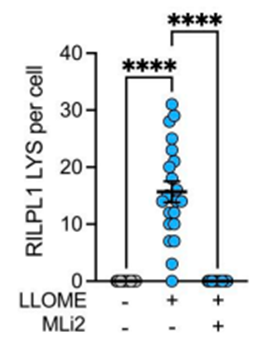
L-Leucyl-L-Leucine methyl ester hydrobromide purchased from MedChemExpress. Usage Cited in: J Cell Biol. 2025 Nov 3;224(11):e202404018. [Abstract]
Quantification of the RILPL1 lysosomes per cell. Cells were treated with DMSO, LLOME (1 mM), or LLOME+MLi2 for 2 h.
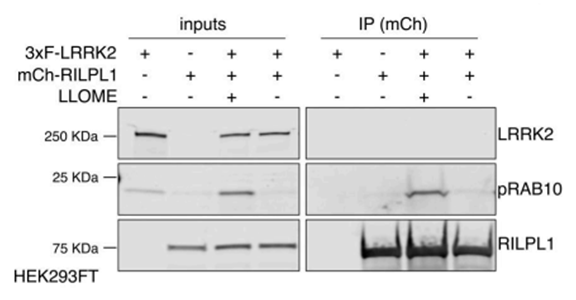
L-Leucyl-L-Leucine methyl ester hydrobromide purchased from MedChemExpress. Usage Cited in: J Cell Biol. 2025 Nov 3;224(11):e202404018. [Abstract]
HEK293FT cells were transfected with 3xflag-LRRK2 and mCherry-RILPL1 for 24 h. Cells were treated or not with LLOME (1 mM) for 2 h, and lysates were subjected to immunoprecipitation with anti-RFP antibodies. RFP, LRRK2, and pT73-RAB10 were blotted.
L-Leucyl-L-Leucine methyl ester hydrobromide purchased from MedChemExpress. Usage Cited in: J Cell Biol. 2025 Nov 3;224(11):e202404018. [Abstract]
HEK293T cells stably expressing GFP-LRRK2 and TMEM192-3xHA were seeded and treated with DMSO, LLOME (1 mM), or LLOME + MLi2 24 h later. Lysosomes were purified with anti-HA beads following the LYSO-IP technique. Lysosomes were then lysed, and their content was analyzed via immunoblotting.
-
PLoS Pathog
A non-canonical activation of the host's ESCRT machinery is required for the scission of parasitophorous vacuoles and the replication of Leishmania donovani. [Abstract]2025 Sep 16;21(9):e1013513. PMID: 40956840 -
PLoS Pathog
The HN protein of Newcastle disease virus induces cell apoptosis through the induction of lysosomal membrane permeabilization. [Abstract]2024 Feb 14;20(2):e1011981. PMID: 38354122 -
Toxicol Appl Pharmacol
Honokiol ameliorates hepatic fibrosis by inducing lysosomal membrane permeabilization and impairing lipophagy in hepatic stellate cells. [Abstract]2026 Jan:506:117632. PMID: 41207513 -
Int Immunol
Helicobacter urease suppresses cytotoxic CD8+ T-cell responses through activating Myh9-dependent induction of PD-L1. [Abstract]2021 Aug 23;33(9):491-504. PMID: 34297096 -
FEBS Lett
2026 Apr 24. PMID: 42032884 -
Traffic
2022 May;23(5):238-269. PMID: 35343629 -
-
-
-
-
bioRxiv
Autophagosome turnover requires Arp2/3 complex-mediated maintenance of lysosomal integrity. [Abstract]2024 Mar 13:2024.03.12.584718. PMID: 38559247


Solvent & Solubility
In Vitro:
DMSO : 125 mg/mL (368.44 mM; Need ultrasonic; Hygroscopic DMSO has a significant impact on the solubility of product, please use newly opened DMSO)
H2O : 100 mg/mL (294.75 mM; Need ultrasonic)
Please refer to the solubility information to select the appropriate solvent. Once prepared, please aliquot and store the solution to prevent product inactivation from repeated freeze-thaw cycles.
Storage method and period of stock solution: -80°C, 6 months; -20°C, 1 month (sealed storage, away from moisture). When stored at -80°C, please use it within 6 months. When stored at -20°C, please use it within 1 month.
* Note: If you choose water as the stock solution, please dilute it to the working solution, then filter and sterilize it with a 0.22 μm filter before use.
Please refer to the solubility information to select the appropriate solvent. Once prepared, please aliquot and store the solution to prevent product inactivation from repeated freeze-thaw cycles.
Storage method and period of stock solution: -80°C, 6 months; -20°C, 1 month (sealed storage, away from moisture). When stored at -80°C, please use it within 6 months. When stored at -20°C, please use it within 1 month.
* Note: If you choose water as the stock solution, please dilute it to the working solution, then filter and sterilize it with a 0.22 μm filter before use.
Concentration (start) × Volume (start) = Concentration (final) × Volume (final)
In Vivo:
Select the appropriate dissolution method based on your experimental animal and administration route.
- For the following dissolution methods, please ensure to first prepare a clear stock solution using an In Vitro approach and then sequentially add co-solvents:
- To ensure reliable experimental results, the clarified stock solution can be appropriately stored based on storage conditions. As for the working solution for In Vivo experiments, it is recommended to prepare freshly and use it on the same day.
- The percentages shown for the solvents indicate their volumetric ratio in the final prepared solution. If precipitation or phase separation occurs during preparation, heat and/or sonication can be used to aid dissolution.
Add each solvent one by one: 10% DMSO 40% PEG300 5% Tween-80 45% Saline
Solubility: ≥ 2.08 mg/mL (6.13 mM); Clear solution
This protocol yields a clear solution of ≥ 2.08 mg/mL (saturation unknown).
Taking 1 mL working solution as an example, add 100 μL DMSO stock solution (20.8 mg/mL) to 400 μL PEG300, and mix evenly; then add 50 μL Tween-80 and mix evenly; then add 450 μL Saline to adjust the volume to 1 mL.
Preparation of Saline: Dissolve 0.9 g sodium chloride in ddH₂O and dilute to 100 mL to obtain a clear Saline solution.
Add each solvent one by one: 10% DMSO 90% (20% SBE-β-CD in Saline)
Solubility: ≥ 2.08 mg/mL (6.13 mM); Clear solution
This protocol yields a clear solution of ≥ 2.08 mg/mL (saturation unknown).
Taking 1 mL working solution as an example, add 100 μL DMSO stock solution (20.8 mg/mL) to 900 μL 20% SBE-β-CD in Saline, and mix evenly.
Preparation of 20% SBE-β-CD in Saline (4°C, storage for one week): 2 g SBE-β-CD powder is dissolved in 10 mL Saline, completely dissolve until clear.
For the following dissolution methods, please prepare the working solution directly:
It is recommended to prepare fresh solutions and use them promptly within a short period of time.
The percentages shown for the solvents indicate their volumetric ratio in the final prepared solution. If precipitation or phase separation occurs during preparation, heat and/or sonication can be used to aid dissolution.
Add each solvent one by one: PBS
Solubility: 100 mg/mL (294.75 mM); Clear solution; Need ultrasonic
In Vivo Dissolution Calculator
Please enter the basic information of animal experiments:
-
-
-
-
Recommended: Prepare an additional quantity of animals to account for potential losses during experiments.
Working solution concentration: 0.22 mg/mL
This product has good water solubility, please refer to the measured solubility data in water/PBS/Saline for details.


Purity & Documentation
-
Data Sheet (274 KB)
-
SDS (252 KB)
- English - EN (252 KB)
- Français - FR (252 KB)
- Deutsch - DE (252 KB)
- Norwegian - NO (252 KB)
- Español - ES (252 KB)
- Swedish - SV (252 KB)
- Italian - IT (252 KB)
- Korean - KR (252 KB)
- Portuguese - PT (252 KB)
-
Handling Instructions (2659 KB)
References
[1]. Thiele DL, et, al. The immunosuppressive activity of L-leucyl-L-leucine methyl ester: selective ablation of cytotoxic lymphocytes and monocytes. J Immunol. 1986 Feb 1;136(3):1038-48. [Content Brief]
[2]. Thiele DL, et, al. Mechanism of L-leucyl-L-leucine methyl ester-mediated killing of cytotoxic lymphocytes: dependence on a lysosomal thiol protease, dipeptidyl peptidase I, that is enriched in these cells. Proc Natl Acad Sci U S A. 1990 Jan;87(1):83-7. [Content Brief]
[3]. Kalogeropulou AF, et, al. Endogenous Rab29 does not impact basal or stimulated LRRK2 pathway activity. Biochem J. 2020 Nov 27;477(22):4397-4423. [Content Brief]


Complete Stock Solution Preparation Table
Please refer to the solubility information to select the appropriate solvent. Once prepared, please aliquot and store the solution to prevent product inactivation from repeated freeze-thaw cycles.
Storage method and period of stock solution: -80°C, 6 months; -20°C, 1 month (sealed storage, away from moisture). When stored at -80°C, please use it within 6 months. When stored at -20°C, please use it within 1 month.
| Optional Solvent | Concentration Solvent Mass | 1 mg | 5 mg | 10 mg | 25 mg |
|---|---|---|---|---|---|
| H2O / DMSO | 1 mM | 2.9475 mL | 14.7375 mL | 29.4751 mL | 73.6876 mL |
| 5 mM | 0.5895 mL | 2.9475 mL | 5.8950 mL | 14.7375 mL | |
| 10 mM | 0.2948 mL | 1.4738 mL | 2.9475 mL | 7.3688 mL | |
| 15 mM | 0.1965 mL | 0.9825 mL | 1.9650 mL | 4.9125 mL | |
| 20 mM | 0.1474 mL | 0.7369 mL | 1.4738 mL | 3.6844 mL | |
| 25 mM | 0.1179 mL | 0.5895 mL | 1.1790 mL | 2.9475 mL | |
| 30 mM | 0.0983 mL | 0.4913 mL | 0.9825 mL | 2.4563 mL | |
| 40 mM | 0.0737 mL | 0.3684 mL | 0.7369 mL | 1.8422 mL | |
| 50 mM | 0.0590 mL | 0.2948 mL | 0.5895 mL | 1.4738 mL | |
| 60 mM | 0.0491 mL | 0.2456 mL | 0.4913 mL | 1.2281 mL | |
| 80 mM | 0.0368 mL | 0.1842 mL | 0.3684 mL | 0.9211 mL | |
| 100 mM | 0.0295 mL | 0.1474 mL | 0.2948 mL | 0.7369 mL |
* Note: If you choose water as the stock solution, please dilute it to the working solution, then filter and sterilize it with a 0.22 μm filter before use.


L-Leucyl-L-Leucine methyl ester hydrobromide Related Classifications
HY-129905A Related Classifications
 Powered by Bioz