



Phosphatidic acids (PA)
- 1
- 2

- Formula: C39H76NO8P
- Molecular Weight: 718.00
1,2-Dioleoyl-sn-glycero-3-PA (ammonium) is a phospholipid. Phospholipids have good biocompatibility and significant amphiphilic characteristics, making them the main and suitable dosage form or excipient in drug formulations, thereby achieving better therapeutic effects. 1,2-Dioleoyl-sn-glycero-3-PA (ammonium)can be used in drug delivery research.

- Formula: C21H38NaO7P
- Molecular Weight: 456.49
18:2 Lyso PA sodium is an unsaturated lysophosphatidic acid (LysoPA), a lipid mediator mainly present in plasma and thought to be involved in the pathogenesis of acute coronary syndrome (ACS). 18:2 Lyso PA sodium significantly correlates with serum autotaxin (ATX) in peripheral arteries.
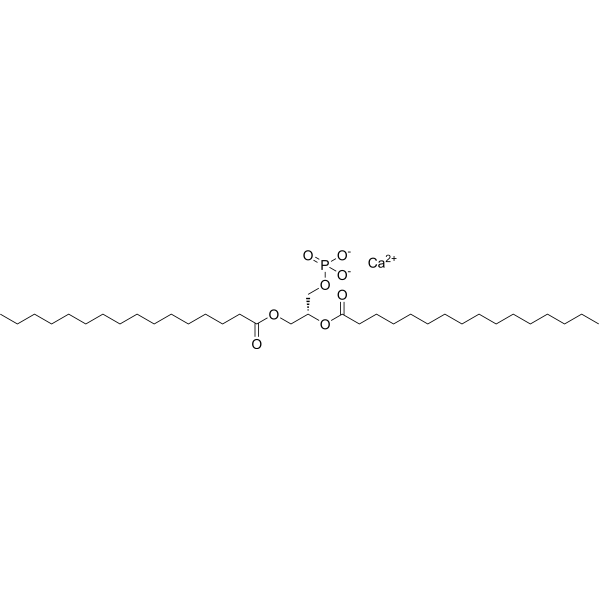
- Formula: C35H67CaO8P
- Molecular Weight: 686.95
1,2-Dipalmitoyl-sn-glycero-3-phosphate (calcium) is a biochemical reagent that can be used as a biological material or organic compound for life science related research.

- Formula: C15H28NaO8P
- Molecular Weight: 390.34
06:0 PA sodium is a phosphatidic acid.

- Formula: C51H99N4O16P
- Molecular Weight: 1055.32
16:0 PA-PEG3-Mannose ammonium is a functionalized lipid.

- Formula: C42H79O10P
- Molecular Weight: 775.04
(S,S) Bisoleoyl-lysobisphosphatidic acid is a lysobisphosphatidic acid (LBPA). LBPA plays a role in modulating the cholesterol flux through endosomes.

- Formula: C22H41O5P
- Molecular Weight: 416.53
Oleoyl 3-carbacyclic phosphatidic acid is a biochemical reagent.

- Formula: C31H61O8P
- Molecular Weight: 592.79
DMPA (1,2-Dimyristoyl-sn-glycero-3-phosphate; 1,2-Dimyristoyl-PA) is a phospholipid that can be used for preparing liposomes. DMPA, when used as a negatively charged lipid component in fluid liposomes, supports liposome-bacterium fusion. DMPA can be used in the research of drug delivery.

- Formula: C41H69NaO8P
- Molecular Weight: 743.96
16:0-22:6 PA (sodium) is a phosphatidic acid.

- Formula: C20H42NO6P
- Molecular Weight: 423.52
17:0 Cyclic LPA ammonium is a lipid that can be used to prepare lipid nanoparticles (LNPs) for drug delivery.

- Formula: C47H68NaO8P
- Molecular Weight: 815.00
22:6 PA sodium is a phosphatidic acid.

- Formula: C19H42NO5P
- Molecular Weight: 395.51
C16 Cyclic LPA ammonium is a lipid that can be used to prepare lipid nanoparticles (LNPs) for drug delivery.

- Formula: C20H40NaO7P
- Molecular Weight: 446.49
17:0 Lyso PA sodium is a lysophosphatidic acid.

- Formula: C34H50F3N2O6P
- Molecular Weight: 670.74
VPC 51299 is a phosphatidic acid.

- Formula: C23H39O7P
- Molecular Weight: 458.53
1-Arachidonoyl-2-hydroxy-sn-glycero-3-PA is a phospholipid containing arachidonic acid at the sn-1 position. It is a precursor to 1-arachidonoyl glycerol (1-Monoarachidin; HY-130567). 1-Arachidonoyl-2-hydroxy-sn-glycero-3-PA binds to the LPA2/EDG4 receptor with an EC50 value of approximately 10 nM. It prevents TNF-α and IL-6 secretion in wild-type but not Lpa2-/- dendritic cells stimulated by LPS. It also decreases differentiation of HT-29 human colon carcinoma cells to goblet cells in the presence of sodium butyrate.

- Formula: C21H42NaO7P
- Molecular Weight: 460.52
1-Stearoyl-sn-glycerol 3-phosphate sodium is a bioactive phospholipid that plays a crucial role in modulating cellular processes such as motility, proliferation, invasion, survival, and growth factor production, primarily through its interaction with G protein-coupled receptors (GPCRs). Typically found at low concentrations in plasma (~100nM), this compound is synthesized during the formation of membrane phospholipids and is derived from various cell types, including activated platelets, epithelial cells, leukocytes, neuronal cells, and tumor cells. Its unique structure includes stearic acid at the sn-1 position alongside a hydroxyl group at the sn-2 position.
- 1
- 2



