



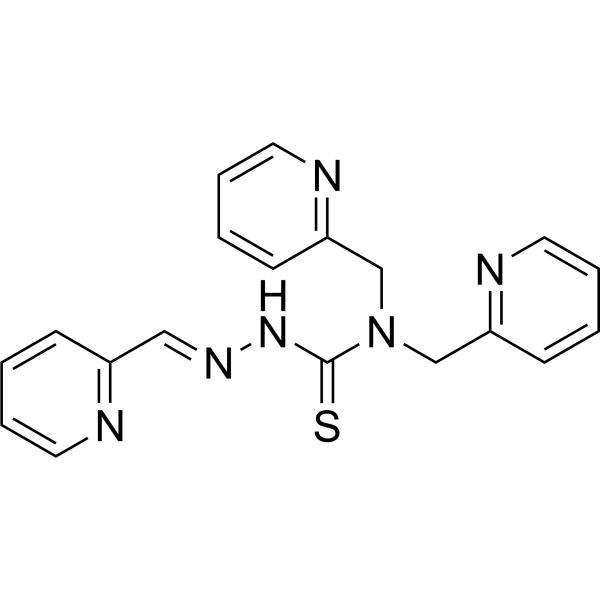
NSC 689534
Based on 1 publication(s) in Google Scholar
NSC 689534 can form copper chelate with Cu2+. NSC 689534/Cu2+ complex is a potent oxidative stress inducer, and has antitumor activity.
For research use only. We do not sell to patients.
- Purity : 96.31%
- CAS No.: 907958-80-9
- Formula: C19H18N6S
- Molecular Weight:362.45
-
Storage:Powder -20°C, 3 years , 4°C, 2 years ; In solvent -80°C, 6 months , -20°C, 1 month

To place orders, for customer services and technical support, please contact: MedChemExpress USA
Tel: 609-228-6898 E-mail: [email protected] [email protected]


-
 Biological Activity
-
Chemical Information
- Protocols
- Purity & Documentation
- References
-
 Help & FAQs


Publications Citing Use of MedChemExpress (MCE) NSC 689534
More

Biological Activity
Description
In Vitro
NSC 689534/Cu2+ complex (48 h) inhibits cell viability of HL60 and PC3 cell with IC50s of 0.2 and 0.4 μM respectively, which is about 4 times more potent than NSC 689534 alone[1].
NSC 689534/Cu2+ complex (2.5 μM, 24 h) induces oxidative stress and depletes GSH in PC3 cells, whereas with no effect by NSC 689534 alone[1].
NSC 689534/Cu2+ complex (2.5 μM, 24 h) induces macroautophagy (indicated by LC3 accumulation into large autophagosomes) and an ER-stress response (upregulation of GRP78 and CHOP) in PC3 cells[1].
MedChemExpress (MCE) has not independently confirmed the accuracy of these methods. They are for reference only. Further protocols information, click here.
In Vivo
MedChemExpress (MCE) has not independently confirmed the accuracy of these methods. They are for reference only.


Chemical Information
-
CAS No. 907958-80-9
-
Appearance Solid
-
Molecular Weight 362.45
-
Formula C19H18N6S
-
Color Light yellow to yellow
-
SMILES
S=C(N(CC1=NC=CC=C1)CC2=NC=CC=C2)N/N=C/C3=NC=CC=C3
-
Shipping
Room temperature in continental US; may vary elsewhere.
-
Storage
Powder -20°C 3 years 4°C 2 years In solvent -80°C 6 months -20°C 1 month


Publications (1)
-
Journal Impact Factor
-
Most Recent
-
Front Biosci (Landmark Ed)
Novel Signaling Pathway and NSC689534 as a Potential Drug Candidate for Cutaneous Squamous Cell Carcinoma. [Abstract]2024 Jan 17;29(1):19. PMID: 38287820

Protocols
-
ROS/oxidative-stress fluorescent staining
ROS/oxidative-stress fluorescent staining uses cell-permeant fluorogenic probes that become fluorescent after oxidation inside cells or tissues; commonly used examples include DCFH-DA/DCFDA for broad cellular oxidant detection, DHE for superoxide-related signal detection, MitoSOX for mitochondrial superoxide-related signal detection, and CellROX probes for oxidative-stress-associated fluorescence readouts. The assay detects probe oxidation rather than a single ROS species unless the probe and analysis method have been chemically validated for that species. DCFH-DA enters cells, is deacetylated by intracellular esterases to DCFH, and produces fluorescent DCF after oxidation, so the readout is used as an operational measure of total cellular oxidative stress rather than a species-specific ROS measurement. DHE and MitoSOX can report superoxide-related oxidation, but red fluorescence alone can include non-specific ethidium-like oxidation products; HPLC or optimized spectral approaches are
-
Subcutaneous Cell-Line-Derived Xenograft
Subcutaneous cell-line-derived xenograft (CDX) models are established by implanting cultured human cancer cell lines into immunodeficient mice, where the injected cells form localized tumors that can be monitored in vivo as a measure of tumorigenic potential, growth kinetics, and treatment response. These models are widely used in oncology research because they allow reproducible tumor formation and enable comparative assessment of tumor growth between different cell lines or genetic manipulations in a controlled in vivo microenvironment. Subcutaneous implantation of cancer cells in immunodeficient mice is a standard approach for evaluating tumor growth behavior and therapeutic response across multiple cancer types, including prostate, esophageal, pancreatic, and colon cancer models.


Purity & Documentation
-
Data Sheet (272 KB)
-
SDS (254 KB)
- English - EN (254 KB)
- Français - FR (254 KB)
- Deutsch - DE (254 KB)
- Norwegian - NO (254 KB)
- Español - ES (254 KB)
- Swedish - SV (254 KB)
- Italian - IT (254 KB)
- Korean - KR (254 KB)
- Portuguese - PT (254 KB)
-
Handling Instructions (2659 KB)
References
[1]. Chad N Hancock, et al. A copper chelate of thiosemicarbazone NSC 689534 induces oxidative/ER stress and inhibits tumor growth in vitro and in vivo. Free Radic Biol Med. 2011 Jan 1;50(1):110-21. [Content Brief]
[2]. Hancock CN, et al. A copper chelate of thiosemicarbazone NSC 689534 induces oxidative/ER stress and inhibits tumor growth in vitro and in vivo. Free Radic Biol Med. 2011 Jan 1;50(1):110-21. [Content Brief]

Calculators
Concentration (start) × Volume (start) = Concentration (final) × Volume (final)


NSC 689534 Related Classifications
HY-156780 Related Classifications
 Powered by Bioz