



Alkaline Phosphatase/ALPP Protein, Human (HEK293, C-His)

Based on 1 Customer Validation
Alkaline Phosphatase/ALPP Proteinas, an enzyme, effectively hydrolyzes various phosphate compounds. Alkaline Phosphatase/ALPP Protein, Human (HEK293, C-His) is the recombinant human-derived Alkaline Phosphatase/ALPP protein, expressed by HEK293 , with C-6*His labeled tag.
- Species: Human
- Source: HEK293
-
Storage:Stored at -20°C for 2 years from date of receipt. After reconstitution, it is stable at 4°C for 1 week or -20°C for longer (with carrier protein). It is recommended to freeze aliquots at -20°C or -80°C for extended storage.


To place orders, for customer services and technical support, please contact: MedChemExpress USA
Tel: 609-228-6898 E-mail: [email protected] [email protected]


-
 Biological Activity
-
Technical Parameters
-
Product Properties
- Documentation
- Help & FAQs




Biological Activity
Description
Alkaline Phosphatase/ALPP Proteinas, an enzyme, effectively hydrolyzes various phosphate compounds. Alkaline Phosphatase/ALPP Protein, Human (HEK293, C-His) is the recombinant human-derived Alkaline Phosphatase/ALPP protein, expressed by HEK293 , with C-6*His labeled tag.
Background
Alkaline phosphatase (ALP), encoded by the ALPP gene, is an enzyme known for its efficient hydrolysis of various phosphate compounds under alkaline conditions. This protein plays a crucial role in maintaining phosphate homeostasis and is involved in diverse physiological processes. ALP is notably expressed by osteoblasts in bone tissue, where it is essential for mineralization during bone formation. Moreover, ALP serves as a valuable biomarker, particularly in assessing liver and bone health, with elevated serum levels indicative of certain disorders.
Verified Bioactivity
Immobilized Human ALPP at 1 μg/mL (100 μL/well) can bind Anti-ALPP Antibody, The ED50 for this effect is 3.432 ng/mL.
MCE Validation Data
-
Purity - SDS-PAGE
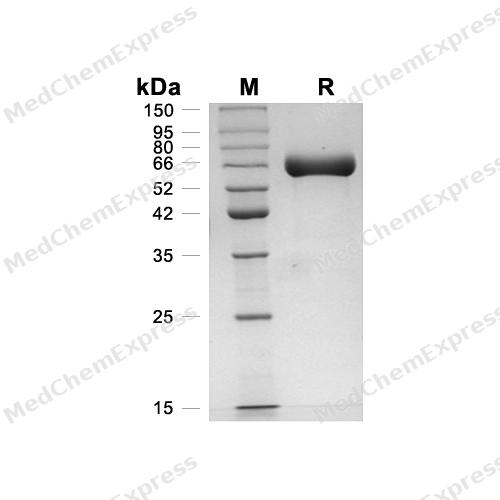
Purity - SDS-PAGE

Assay Procedure
Materials
Alkaline Phosphatase/ALPP Protein, Human (HEK293, C-His) (HY-P7487A)
Wash buffer: 1X PBST
Blocking buffer: 1% BSA in 1X PBS-T
TMB Substrate Solution: Mix Substrate Solution A and B at a 1:1 ratio immediately before use
Stop Solution: 2 M H2SO4
Procedure
1. Coating: Dilute the test protein to 1 μg/mL in 1X PBS, add 100 μL/well, and incubate overnight at 4°C.
2. Washing: Wash the plate with wash buffer (260 μL/well) , once, and pat dry.
3. Blocking: Add 150 μL/well of blocking buffer (1% BSA in 1X PBST) , incubate at 25°C with shaking at 450 rpm for 4 hours.
4. Dilute Primary Antibody: Dilute the antibody to concentrations of 0, 0.01, 0.1, 1, 5, 10, 50, 100, 500, 1000, 5000, 10000, 50000 ng/mL.
5. Add Primary Antibody: Add 100 μL/well, incubate at 25°C with shaking at 450 rpm for 2 hours.
6. Washing: Wash the plate with wash buffer (260 μL/well) , five times, with each wash lasting 1 minute, then pat dry.
7. Add Secondary Antibody: Add 100 μL/well, incubate at 25°C with shaking at 450 rpm for 1 hour.
8. Washing: Wash the plate with wash buffer (260 μL/well) , three times, with each wash lasting 1 minute, then pat dry.
9. Add TMB Substrate Solution: Add 100 μL/well, incubate at room temperature in the dark for 15 minutes.
10. Stop Reaction: Add 100 μL of 2 M H2SO4 per well.
11. Read Plate: Measure absorbance at 450 nm.
12. Using GraphPad Prism software, plot a curve with OD values on the vertical axis and primary antibody concentration on the horizontal axis to calculate the ED50 value.


Technical Parameters
-
Species Human
-
Source HEK293
-
Tag C-6*His
-
Accession
P05187 (I23-D506)
-
Molecular Construction
-
N-term
-
ALPP (I23-D506)
Accession # P05187 -
6*His
-
C-term
-
-
Protein Length
Full Length of Mature Protein
-
Synonyms
ALPP; PLAP-1; Alkaline Phosphatase, Placental; Alkaline Phosphatase, Placental (Regan Isozyme); PLAP; Placental Alkaline Phosphatase; PALP; Alkaline Phosphomonoesterase; Alkaline Phosphatase, Placental Type; Glycerophosphatase; Alkaline Phosphatase Regan
-
AA Sequence
IIPVEEENPDFWNREAAEALGAAKKLQPAQTAAKNLIIFLGDGMGVSTVTAARILKGQKKDKLGPEIPLAMDRFPYVALSKTYNVDKHVPDSGATATAYLCGVKGNFQTIGLSAAARFNQCNTTRGNEVISVMNRAKKAGKSVGVVTTTRVQHASPAGTYAHTVNRNWYSDADVPASARQEGCQDIATQLISNMDIDVILGGGRKYMFRMGTPDPEYPDDYSQGGTRLDGKNLVQEWLAKRQGARYVWNRTELMQASLDPSVTHLMGLFEPGDMKYEIHRDSTLDPSLMEMTEAALRLLSRNPRGFFLFVEGGRIDHGHHESRAYRALTETIMFDDAIERAGQLTSEEDTLSLVTADHSHVFSFGGYPLRGSSIFGLAPGKARDRKAYTVLLYGNGPGYVLKDGARPDVTESESGSPEYRQQSAVPLDEETHAGEDVAVFARGPQAHLVHGVQEQTFIAHVMAFAACLEPYTACDLAPPAGTTD
-
Molecular Weight
Approximately 64-66 kDa, based on SDS-PAGE under reducing conditions, due to the glycosylation.
-
Glycosylation
Yes
-
Purity
≥ 95%, as determined by reducing SDS-PAGE.


Product Properties
Lyophilized powder.
Lyophilized from a 0.2 μm filtered solution of 20 mM PB, 150 mM NaCl, pH 7.4.
<1 EU/μg, determined by LAL method.
It is not recommended to reconstitute to a concentration less than 100 μg/mL in ddH2O. For long term storage it is recommended to add a carrier protein (0.1% BSA, 5% HSA, 10% FBS or 5% Trehalose).
Stored at -20°C for 2 years from date of receipt. After reconstitution, it is stable at 4°C for 1 week or -20°C for longer (with carrier protein). It is recommended to freeze aliquots at -20°C or -80°C for extended storage.
Room temperature in continental US; may vary elsewhere.


Documentation
-
Data Sheet (238 KB)
-
SDS (254 KB)
- English - EN (254 KB)
- Français - FR (254 KB)
- Deutsch - DE (254 KB)
- Norwegian - NO (254 KB)
- Español - ES (254 KB)
- Swedish - SV (254 KB)
- Italian - IT (254 KB)
- Korean - KR (254 KB)
- Portuguese - PT (254 KB)
-
Handling Instructions (2659 KB)

Calculators
Concentration (start) × Volume (start) = Concentration (final) × Volume (final)


 Powered by Bioz

