



CD40L/CD154/TRAP Protein, Human
Based on 1 publication(s) in Google Scholar
CD40L (CD154; TRAP) is a ligand to CD40/TNFRSF5, acts function by generating a costimulatory signal that up-regulates IL-4 synthesis. CD40L is specifically expressed on activated CD4+ T-lymphocytes and involves in activation of NF-κB/MAPK pathway. CD40L also involves in B cell differentiation, maturation, and apoptosis. CD40L in human, cleaved into 2 chains of membrane form (1-261 a.a.) and soluble form (113-261 a.a.) which serves as a ligand for integrins (ITGA5:ITGB1 and ITGAV:ITGB3). CD40L/CD154/TRAP Protein, Human has a total length of 149 amino acids (M113-L261), is expressed in E. coli cells with tag free.
- Species: Human
- Source: E. coli
-
Storage:Stored at -20°C for 2 years from date of receipt. After reconstitution, it is stable at 4°C for 1 week or -20°C for longer (with carrier protein). It is recommended to freeze aliquots at -20°C or -80°C for extended storage.


To place orders, for customer services and technical support, please contact: MedChemExpress USA
Tel: 609-228-6898 E-mail: [email protected] [email protected]


-
 Biological Activity
-
Technical Parameters
-
Product Properties
- Documentation
- References
- Help & FAQs


-

HY-D1056
Lipopolysaccharides, from E. coli O55:B5 -

HY-P7038
IL-21 Protein, Human -
HY-13740
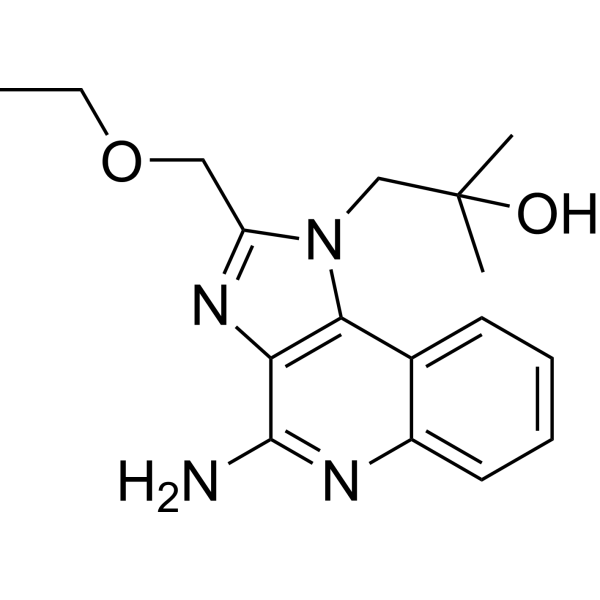
Resiquimod -
HY-P70445
IL-4 Protein, Human -
HY-B2176
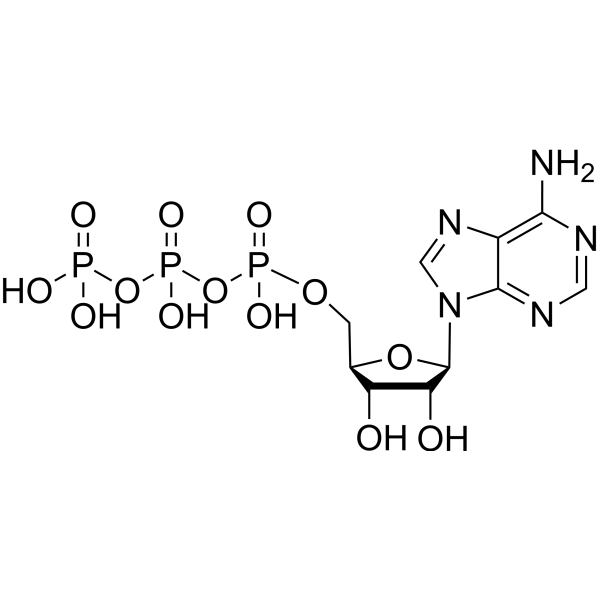
ATP -
HY-P7090
TNF-alpha/TNFSF2 Protein, Mouse (156a.a) -
HY-P7037
IL-2 Protein, Human -
HY-P7036
IL-17A Protein, Human -
HY-P7424
RANKL/TNFSF11 Protein, Human -
HY-P70730
BAFF/TNFSF13B Protein, Human (HEK293, Fc) -
HY-P7786
CD14 Protein, Human (HEK293, His) -
HY-P79098
MD-2/LY96 Protein, Human (His)


Biological Activity
Description
CD40L (CD154; TRAP) is a ligand to CD40/TNFRSF5, acts function by generating a costimulatory signal that up-regulates IL-4 synthesis[1]. CD40L is specifically expressed on activated CD4+ T-lymphocytes and involves in activation of NF-κB/MAPK pathway[2][3]. CD40L also involves in B cell differentiation, maturation, and apoptosis[4]. CD40L in human, cleaved into 2 chains of membrane form (1-261 a.a.) and soluble form (113-261 a.a.) which serves as a ligand for integrins (ITGA5:ITGB1 and ITGAV:ITGB3). CD40L/CD154/TRAP Protein, Human has a total length of 149 amino acids (M113-L261), is expressed in E. coli cells with tag free.
Background
"CD40 Ligand (CD40L; CD154; TRAP) belongs to the tumor necrosis factor (TNF) family, is the ligand for CD40/TNFRSF5, specifically expressed on activated CD4+ T-lymphocytes[1].
CD40L is a type II transmembrane protein on B cells triggers important signals for B cell differentiation, maturation, and apoptosis[4].
CD40L acts function by cross-linking on T-cells to generate a costimulatory signal and thus enhances the production of IL4 and IL10 in conjunction with the TCR/CD3 ligation and CD28 costimulation, as well as promoting the production of interferon-γ, and TNF-α[1][4].
CD40L, binding with CD40 on antigen-presenting cells (APC), activates TNFR-associated factor 2- and IKK2-dependent pathways with stimulating I-κB kinase (IKK), increasing NF-κB DNA binding, and p65 nuclear translocation. The activation of I-κB kinase leads to strongly c-Jun N-terminal kinase activation as well as GST-I-κB and GST-p65 phosphorylation[2].
CD40L involves in MAPK pathways that strongly repress Bcl-6 with inducing the phosphorylation of Erk1/2, p38 and Jnk1/2 and activating IRF4 mediated by NF-κB[3].
CD40L also binds to and signals through several integrins, including αvβ3 and α5β1, which bind to the trimeric interface of CD40L. CD40L plays a major role in immune response and is a major target for inflammation[5].
CD40L is widely found in different animals, while the the sequence in Human is highly similar to Rhesus macaque (98.08%), but very different from Rat and Mouse with similarities of 77.31% and 77.69%, respectively. CD40L in Human is cleaved into 2 chains of membrane form (1-261 a.a.) and soluble form (113-261 a.a.), while the soluble form derives from the membrane form by proteolytic processing. Release of soluble CD40L from platelets is partially regulated by GP IIb/IIIa, actin polymerization, and a matrix metalloproteinases (MMP) inhibitor-sensitive pathway[6].
"
In Vitro
"CD40 Ligand (1 ng/mL; 24 hr) induces endothelial cell vascular cell adhesion molecule-1 (VCAM-1) expression. CD40 Ligand shows costimulation effect with IL-4 against VCAM-1[7].
CD40 Ligand (1 ng/mL; 24 hr) combined with IL-4 enhances IL-6 and inhibits IL-8 production by HUVEC[7].
CD40 Ligand (500 ng/mL; 72 hr) with 50 ng/mL IL-21 stimulates eripheral blood mononuclear cells (PBMCs) to secrete donor-specific antibodies (DSA)[8].
"
In Vivo
CD40 Ligand (2.86 ng/mL or 2.09 ng/mL) has been demonstrated to be a mark of cardiovascular risk, while the level (2.86 ng/mL) in who subsequently developed myocardial infarction, stroke, or cardiovascular death (cases) is higher than control group (2.09 ng/mL)[8].
Verified Bioactivity
1.Measured in a cell proliferation assay using human B cells (Ramos) in the presence of 10 ng/mL Human IL-4. The ED50 this effect is 0.1-3 ng/mL.
2.The ED50 as determined by the dose-dependant stimulation of IL-12 & IL-8 induction by PMB (Peripheral Mononuclear) cells was found to be <20 μg/mL.
3.Loaded Tegoprubart (HY-P990083) on ProA biosensor, can bind CD40L/CD154/TRAP Protein, Human with an affinity constant of 4.923×10⁻¹⁰ M as determined in BLI assay.


Publications (1)
-
Journal Impact Factor
-
Most Recent
-
Immunother Adv
Abnormal glucose and lipid metabolism promotes disrupted differentiation of T and B cell subsets in Behçet's disease. [Abstract]2025 Mar 24;5(1):ltaf010. PMID: 40297266


Technical Parameters
-
Species Human
-
Source E. coli
-
Tag Tag Free
-
Accession
P29965 (M113-L261)
-
Molecular Construction
-
N-term
-
CD40L (M113-L261)
Accession # P29965 -
C-term
-
-
Protein Length
Full Length of CD40 ligand, soluble form
-
Synonyms
CD40LG; T-BAM; Prev. TNFSF5; Tumor Necrosis Factor (Ligand) Superfamily Member 5; Prev. HIGM1; Tumor Necrosis Factor Ligand Superfamily Member 5; Prev. IMD3; T-B Cell-Activating Molecule; CD40-L; CD40 Antigen Ligand; CD40L; T-Cell Antigen Gp39; TRAP; Tumo
-
AA Sequence
MQKGDQNPQIAAHVISEASSKTTSVLQWAEKGYYTMSNNLVTLENGKQLTVKRQGLYYIYAQVTFCSNREASSQAPFIASLCLKSPGRFERILLRAANTHSSAKPCGQQSIHLGGVFELQPGASVFVNVTDPSQVSHGTGFTSFGLLKL
-
Molecular Weight
Approximately 16 kDa, based on SDS-PAGE under reducing conditions.
-
Purity
≥ 95%, as determined by reducing SDS-PAGE.


Product Properties
Lyophilized powder
Lyophilized from a 0.22 μm filtered solution of 50 mM Tris, 250 mM NaCl, pH 8.0.
Note: For SPR assay, please replace the buffer. Primary amine components (e.g., Tris, imidazole) can affect protein-coupled chips.
<1 EU/μg, determined by LAL method.
It is not recommended to reconstitute to a concentration less than 100 μg/mL in ddH2O. For long term storage it is recommended to add a carrier protein (0.1% BSA, 5% HSA, 10% FBS or 5% Trehalose).
Stored at -20°C for 2 years from date of receipt. After reconstitution, it is stable at 4°C for 1 week or -20°C for longer (with carrier protein). It is recommended to freeze aliquots at -20°C or -80°C for extended storage.
Room temperature in continental US; may vary elsewhere.


Documentation
-
Data Sheet (266 KB)
-
SDS (252 KB)
- English - EN (252 KB)
- Français - FR (252 KB)
- Deutsch - DE (252 KB)
- Norwegian - NO (252 KB)
- Español - ES (252 KB)
- Swedish - SV (252 KB)
- Italian - IT (252 KB)
- Korean - KR (252 KB)
- Portuguese - PT (252 KB)
-
Handling Instructions (2659 KB)


References
[1]. Blotta MH, et al. Cross-linking of the CD40 ligand on human CD4+ T lymphocytes generates a costimulatory signal that up-regulates IL-4 synthesis. J Immunol. 1996 May 1;156(9):3133-40. [Content Brief]
[2]. Schwabe RF, et al. CD40 activates NF-kappa B and c-Jun N-terminal kinase and enhances chemokine secretion on activated human hepatic stellate cells. J Immunol. 2001 Jun 1;166(11):6812-9. [Content Brief]
[3]. Batlle A, et al. CD40 and B-cell receptor signalling induce MAPK family members that can either induce or repress Bcl-6 expression. Mol Immunol. 2009 May;46(8-9):1727-35. [Content Brief]
[4]. Mikolajczak SA, et al. The modulation of CD40 ligand signaling by transmembrane CD28 splice variant in human T cells. J Exp Med. 2004 Apr 5;199(7):1025-31. [Content Brief]
[5]. Takada YK, et al. Soluble CD40L activates soluble and cell-surface integrin αvβ3, α5β1, and α4β1 by binding to the allosteric ligand-binding site (site 2). J Biol Chem. 2021 Jan-Jun;296:100399. [Content Brief]
[6]. Pietravalle F, et al. Human native soluble CD40L is a biologically active trimer, processed inside microsomes. J Biol Chem. 1996 Mar 15;271(11):5965-7. [Content Brief]
[7]. Kotowicz K, et al. Biological function of CD40 on human endothelial cells: costimulation with CD40 ligand and interleukin-4 selectively induces expression of vascular cell adhesion molecule-1 and P-selectin resulting in preferential adhesion of lymphocytes. Immunology. 2000 Aug;100(4):441-8. [Content Brief]
[8]. Schönbeck U, et al. Soluble CD40L and cardiovascular risk in women. Circulation. 2001 Nov 6;104(19):2266-8. [Content Brief]

Calculators
Concentration (start) × Volume (start) = Concentration (final) × Volume (final)


 Powered by Bioz

