



FGF-9 Protein, Human
Based on 1 publication(s) in Google Scholar
FGF-9 Protein, Human is a steroid-regulated mitogen and survival factor for nerve and mesenchymal cells.
- Species: Human
- Source: E. coli
-
Storage:Stored at -20°C for 2 years from date of receipt. After reconstitution, it is stable at 4°C for 1 week or -20°C for longer (with carrier protein). It is recommended to freeze aliquots at -20°C or -80°C for extended storage.


To place orders, for customer services and technical support, please contact: MedChemExpress USA
Tel: 609-228-6898 E-mail: [email protected] [email protected]


-
 Biological Activity
-
Technical Parameters
-
Product Properties
- Documentation
- References
- Help & FAQs


-
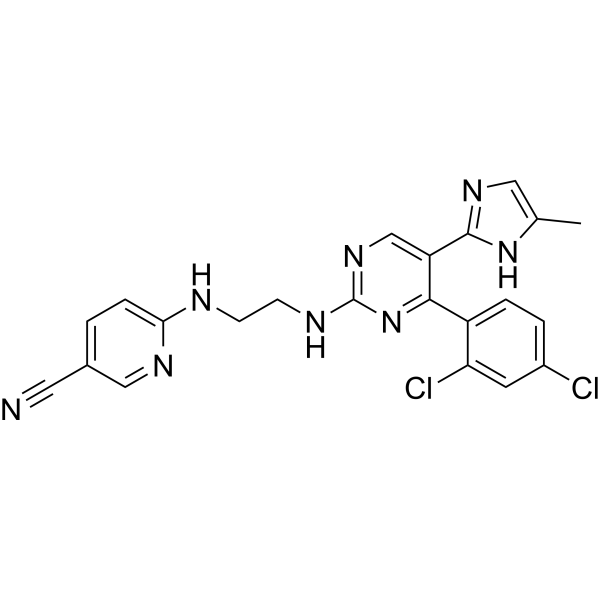
HY-10182
Laduviglusib -

HY-P7007
BMP-4 Protein, Human -
HY-P70311
Activin A Protein, Human/Mouse/Rat (HEK293) -
HY-P70781
SCF Protein, Human -
HY-P7004
FGF basic/bFGF Protein, Human (146a.a) -
HY-P7025
IFN-gamma Protein, Human -
HY-P7110A
VEGF165 Protein, Human (HEK293) -
HY-P7008
BMP-7 Protein, Human -
HY-P7182
GDNF Protein, Human -
HY-P70533
FGF-8b Protein, Human/Mouse -
HY-P7001
FGF-1 Protein, Human -
HY-P70440
FGF basic/bFGF Protein, Human (157a.a)


Biological Activity
Description
FGF-9 Protein, Human is a steroid-regulated mitogen and survival factor for nerve and mesenchymal cells.
Background
Fibroblast growth factor-9 (FGF-9) is a steroid-regulated mitogen and survival factor for nerve and mesenchymal cells. FGF-9, originally isolated from human glioma cells, has been found to be a potent mitogen and survival factor for numerous nerve cells, prostatic cells, and lung mesenchymal cells and is necessary for fetal testicular development[1].
Verified Bioactivity
Measured in a cell proliferation assay using Balb/3T3 cells. The ED50 for this effect is <20 ng/mL, corresponding to a specific activity is >5.0 × 10⁴ units/mg.
MCE Validation Data
-
Purity - SDS-PAGE
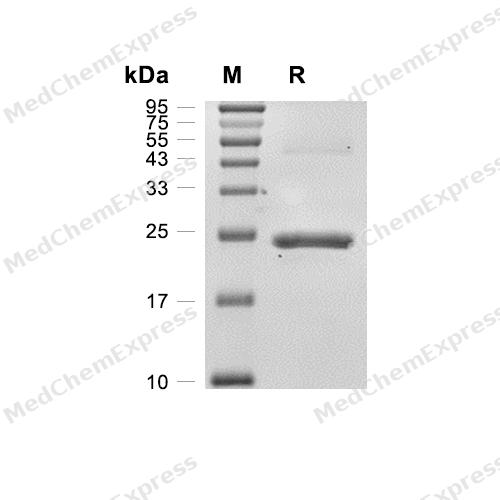
Purity - SDS-PAGE
-
Bioactivity - Cell-Based Assay
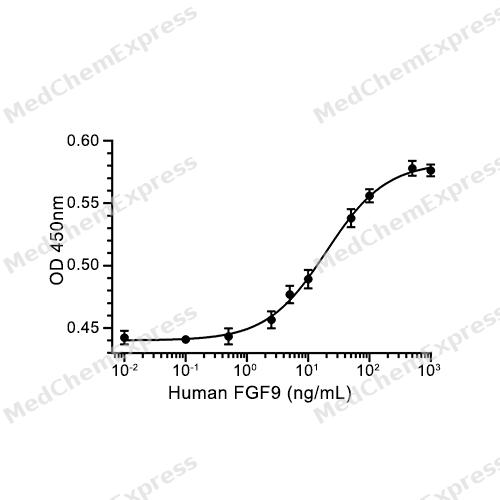
Bioactivity - Cell-Based Assay


Publications (1)
-
Journal Impact Factor
-
Most Recent
-
Cell Prolif
FGF9 promotes mouse spermatogonial stem cell proliferation mediated by p38 MAPK signalling. [Abstract]2021 Jan;54(1):e12933. PMID: 33107118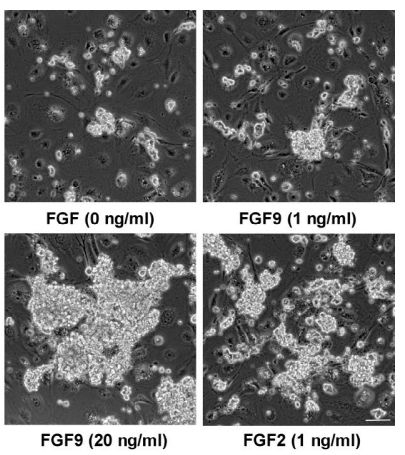
FGF-9 Protein, Human purchased from MedChemExpress. Usage Cited in: Cell Prolif. 2021 Jan;54(1):e12933. [Abstract]
Representative morphology of cultured THY‐1+ germ cell clumps after treatment for 7 days. The results showed that 20 ng/mL FGF-9 Protein, Human (FGF9) and 1 ng/mL FGF2 both induced larger colony formation in spermatogonial stem cells. Scale bar: 100 µm.
FGF-9 Protein, Human purchased from MedChemExpress. Usage Cited in: Cell Prolif. 2021 Jan;54(1):e12933. [Abstract]
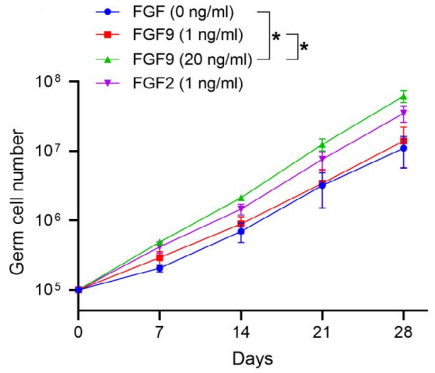
Effect of FGF-9 Protein, Human (FGF9) and FGF2 treatment on THY‐1+ germ cell number in culture. Cells were treated with GDNF, GFRα1 and listed concentration of FGF (n = 3).
FGF-9 Protein, Human purchased from MedChemExpress. Usage Cited in: Cell Prolif. 2021 Jan;54(1):e12933. [Abstract]
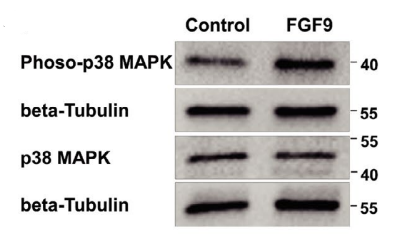
Protein expressions of phosphorylated‐p38 MAPK and p38 MAPK in germ cells with different treatments. Germ cells were cultured with FGF-9 Protein, Human (FGF9, 40 ng/mL) for 2 d and protein was extracted for detection. The results showed that the phosphorylated p38 MAPK protein significantly increased with FGF9 treatment while the total amount of p38 MAPK did not change.
FGF-9 Protein, Human purchased from MedChemExpress. Usage Cited in: Cell Prolif. 2021 Jan;54(1):e12933. [Abstract]
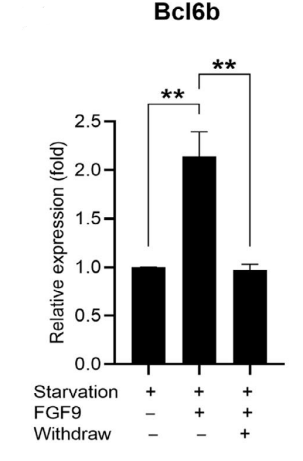
qPCR expression values of Bcl6b (n = 3). Starvation treatment: cells cultured in mSFM with no growth factors for 2 d. FGF-9 Protein, Human (FGF9) treatment: cells treated with mSFM containing 20 ng/mL of FGF9 for 2 d. Withdraw treatment: cells cultured in mSFM with no growth factors for 2 d. *P < .05, ANOVA.


Technical Parameters
-
Species Human
-
Source E. coli
-
Tag Tag Free
-
Accession
P31371 (M1-S208)
-
Molecular Construction
-
N-term
-
FGF-9 (M1-S208)
Accession # P31371 -
C-term
-
-
Protein Length
Full Length
-
Synonyms
FGF9; FGF-9; Fibroblast Growth Factor 9; GAF; Fibroblast Growth Factor 9 (Glia-Activating Factor); Fibroblast Growth Factor; Heparin-Binding Growth Factor 9; HBFG-9; Glia-Activating Factor; SYNS3; HBGF-9; FGF
-
AA Sequence
MAPLGEVGNYFGVQDAVPFGNVPVLPVDSPVLLSDHLGQSEAGGLPRGPAVTDLDHLKGILRRRQLYCRTGFHLEIFPNGTIQGTRKDHSRFGILEFISIAVGLVSIRGVDSGLYLGMNEKGELYGSEKLTQECVFREQFEENWYNTYSSNLYKHVDTGRRYYVALNKDGTPREGTRTKRHQKFTHFLPRPVDPDKVPELYKDILSQS
-
Predicted Molecular Mass
23.4 kDa
-
Molecular Weight
Approximately 23-25 kDa, based on SDS-PAGE under reducing conditions, due to the glycosylation.
-
Purity
≥ 95%, as determined by reducing SDS-PAGE.


Product Properties
Lyophilized powder
1.Lyophilized from a 0.22 μm filtered solution of PBS.
2.Lyophilized from a 0.22 μm filtered solution of PBS, pH 7.4.
3.Lyophilized from a 0.22 μm filtered solution of 20 mM PB, 500 mM NaCl, pH 8.0.
4.Lyophilized from a 0.22 μm filtered solution of 20 mM PB, 500 mM NaCl, 8% trehalose, pH 8.0.
5.Lyophilized from a 0.22 μm filtered solution of 20 mM PB, 500 mM NaCl, pH 8.0, 8% trehalose, 0.2 mM PMSF.
Please refer to the lot-specific COA for specific buffer information.
<0.2 EU/μg, determined by LAL method.
It is not recommended to reconstitute to a concentration less than 100 μg/mL in ddH2O. For long term storage it is recommended to add a carrier protein (0.1% BSA, 5% HSA, 10% FBS or 5% Trehalose).
Stored at -20°C for 2 years from date of receipt. After reconstitution, it is stable at 4°C for 1 week or -20°C for longer (with carrier protein). It is recommended to freeze aliquots at -20°C or -80°C for extended storage.
Room temperature in continental US; may vary elsewhere.


Documentation
-
Data Sheet (262 KB)
-
SDS (252 KB)
- English - EN (252 KB)
- Français - FR (252 KB)
- Deutsch - DE (252 KB)
- Norwegian - NO (252 KB)
- Español - ES (252 KB)
- Swedish - SV (252 KB)
- Italian - IT (252 KB)
- Korean - KR (252 KB)
- Portuguese - PT (252 KB)
-
Handling Instructions (2659 KB)


References

Calculators
Concentration (start) × Volume (start) = Concentration (final) × Volume (final)


 Powered by Bioz

