



FGF-9 Protein, Human (HEK293, Fc, solution)
Based on 1 Customer Validation
Activin AB protein is a member of the transforming growth factor-β (TGF-β) superfamily and plays a key role in various biological processes such as cell differentiation, proliferation, and apoptosis. It is involved in embryonic development, tissue repair and immune regulation. FGF-9 Protein, Human (HEK293, Fc, solution) is the recombinant human-derived FGF-9 protein, expressed by HEK293 , with N-hFc labeled tag.
- Species: Human
- Source: HEK293
-
Storage:Stored at -80°C for 1 year from date of receipt. It is stable at -20°C for 3 months after opening. It is recommended to freeze aliquots at -80°C for extended storage. Avoid repeated freeze-thaw cycles.


To place orders, for customer services and technical support, please contact: MedChemExpress USA
Tel: 609-228-6898 E-mail: [email protected] [email protected]


-
 Biological Activity
-
Technical Parameters
-
Product Properties
- Documentation
- Help & FAQs




Biological Activity
Description
Activin AB protein is a member of the transforming growth factor-β (TGF-β) superfamily and plays a key role in various biological processes such as cell differentiation, proliferation, and apoptosis. It is involved in embryonic development, tissue repair and immune regulation. FGF-9 Protein, Human (HEK293, Fc, solution) is the recombinant human-derived FGF-9 protein, expressed by HEK293 , with N-hFc labeled tag.
Background
The FGF-9 Protein, belonging to the fibroblast growth factor (FGF) family, exhibits broad mitogenic and cell survival activities, participating in various biological processes such as embryonic development, cell growth, morphogenesis, tissue repair, and tumor growth and invasion. Originally identified as a secreted factor with growth-stimulating effects on cultured glial cells, this protein is predominantly produced by neurons in the nervous system, suggesting its importance in glial cell development. The expression of the mouse homolog of FGF-9 is contingent on Sonic hedgehog (Shh) signaling, and its absence in mice led to a male-to-female sex reversal phenotype, indicating a role in testicular embryogenesis. Noteworthy is the biased expression of FGF-9, with elevated levels detected in the kidney (RPKM 6.4), adrenal (RPKM 2.1), and 10 other tissues, underscoring its potential significance in various physiological contexts across multiple organs.
Verified Bioactivity
Measured in a cell proliferation assay using Balb/c 3T3 mouse embryonic fibroblasts and the ED50 is typically 10-60 ng/mL.
MCE Validation Data
-
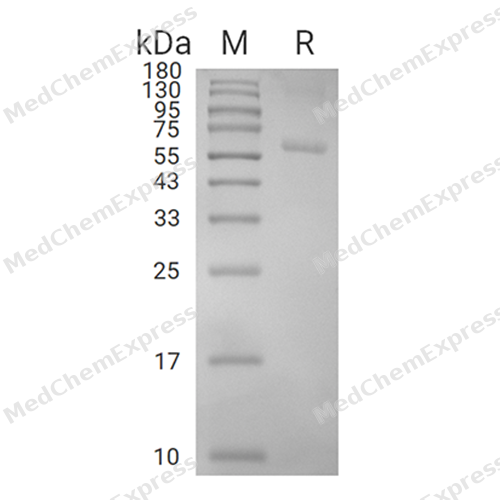
Purity - SDS-PAGE
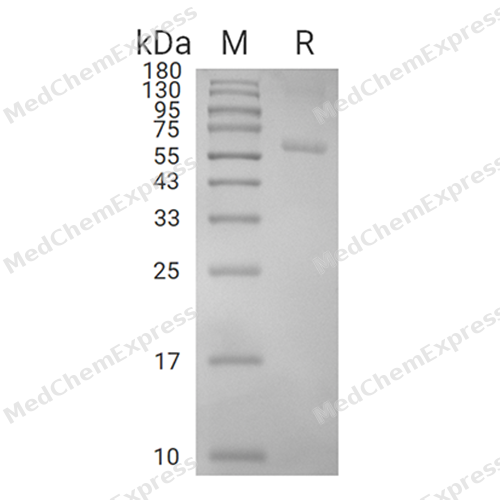
Purity - SDS-PAGE


Technical Parameters
-
Species Human
-
Source HEK293
-
Tag N-hFc
-
Accession
NP_002001.1 (L4-S208)
-
Molecular Construction
-
N-term
-
hFc
-
FGF-9 (L4-S208)
Accession # NP_002001.1 -
C-term
-
-
Protein Length
Full Length of Mature Protein
-
Synonyms
FGF9; FGF-9; Fibroblast Growth Factor 9; GAF; Fibroblast Growth Factor 9 (Glia-Activating Factor); Fibroblast Growth Factor; Heparin-Binding Growth Factor 9; HBFG-9; Glia-Activating Factor; SYNS3; HBGF-9; FGF
-
AA Sequence
LGEVGNYFGVQDAVPFGNVPVLPVDSPVLLSDHLGQSEAGGLPRGPAVTDLDHLKGILRRRQLYCRTGFHLEIFPNGTIQGTRKDHSRFGILEFISIAVGLVSIRGVDSGLYLGMNEKGELYGSEKLTQECVFREQFEENWYNTYSSNLYKHVDTGRRYYVALNKDGTPREGTRTKRHQKFTHFLPRPVDPDKVPELYKDILSQS
-
Predicted Molecular Mass
54 kDa
-
Molecular Weight
Approximately 54 kDa & 37 kDa, based on SDS-PAGE under reducing conditions, due to the glycosylation.
-
Glycosylation
Yes
-
Structure/Form
Disulfide-linked homodimer
-
Purity
≥ 85%, as determined by reducing SDS-PAGE.


Product Properties
Solution
Supplied as a 0.22 μm filtered solution of PBS, pH 7.4.
<1 EU/μg, determined by LAL method.
Stored at -80°C for 1 year from date of receipt. It is stable at -20°C for 3 months after opening. It is recommended to freeze aliquots at -80°C for extended storage. Avoid repeated freeze-thaw cycles.
Shipping with dry ice.


Documentation
-
Data Sheet (236 KB)
-
SDS (252 KB)
- English - EN (252 KB)
- Français - FR (252 KB)
- Deutsch - DE (252 KB)
- Norwegian - NO (252 KB)
- Español - ES (252 KB)
- Swedish - SV (252 KB)
- Italian - IT (252 KB)
- Korean - KR (252 KB)
- Portuguese - PT (252 KB)
-
Handling Instructions (2659 KB)

Calculators
Concentration (start) × Volume (start) = Concentration (final) × Volume (final)


 Powered by Bioz

