



Hepcidin/HAMP Protein, Mouse (GST)
Based on 1 publication(s) in Google Scholar
The hepcidin/HAMP protein is a liver-produced hormone that is a major regulator of iron absorption and distribution. It promotes endocytosis and degradation of SLC40A1, retaining iron within cells and reducing plasma iron flux. Hepcidin/HAMP Protein, Mouse (GST) is the recombinant mouse-derived Hepcidin/HAMP protein, expressed by E. coli , with N-GST labeled tag.
- Species: Mouse
- Source: E. coli
-
Storage:Stored at -20°C for 2 years from date of receipt. After reconstitution, it is stable at 4°C for 1 week or -20°C for longer (with carrier protein). It is recommended to freeze aliquots at -20°C or -80°C for extended storage.


To place orders, for customer services and technical support, please contact: MedChemExpress USA
Tel: 609-228-6898 E-mail: [email protected] [email protected]


-
 Biological Activity
-
Technical Parameters
-
Product Properties
- Documentation
- Help & FAQs




Biological Activity
Description
The hepcidin/HAMP protein is a liver-produced hormone that is a major regulator of iron absorption and distribution. It promotes endocytosis and degradation of SLC40A1, retaining iron within cells and reducing plasma iron flux. Hepcidin/HAMP Protein, Mouse (GST) is the recombinant mouse-derived Hepcidin/HAMP protein, expressed by E. coli , with N-GST labeled tag.
Background
Hepcidin, a liver-produced hormone, stands as the principal circulating regulator governing the absorption and distribution of iron throughout the body. Its regulatory mechanism involves the promotion of endocytosis and degradation of SLC40A1, resulting in the retention of iron within iron-exporting cells and a consequential reduction in iron flow into the plasma. Hepcidin orchestrates vital iron fluxes, including the absorption of dietary iron in the intestine, the recycling of iron by macrophages through phagocytosis of aging erythrocytes and other cells, and the mobilization of stored iron from hepatocytes. Its interaction with SLC40A1 triggers rapid ubiquitination of the latter, underscoring hepcidin's pivotal role in maintaining iron homeostasis.
Verified Bioactivity
Measured by its binding ability in a functional ELISA. Immobilized HAMP at 10μg/mL (100μL/well) can bind Anti-HAMP antibody. The ED50 for this effect is 1.303 μg/mL.
MCE Validation Data
-
Purity - SDS-PAGE
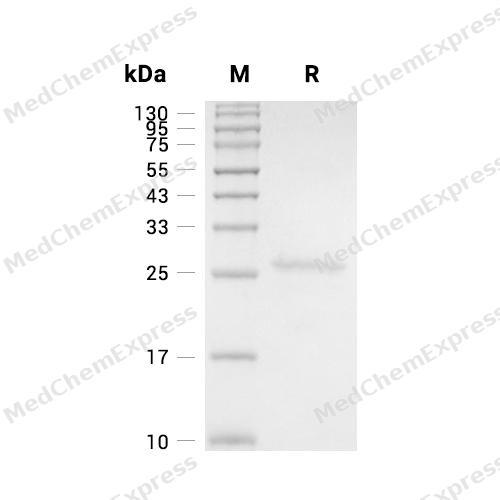
Purity - SDS-PAGE
-
Bioactivity - ELISA
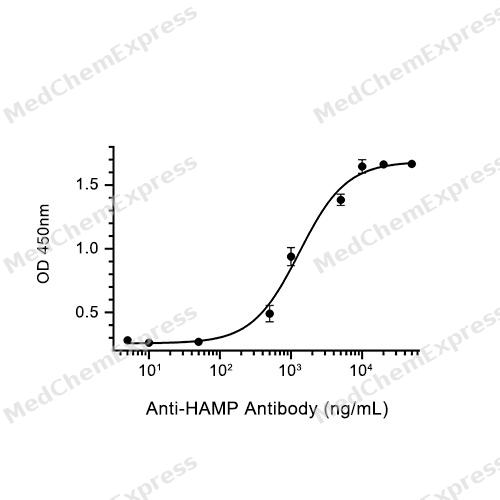
Bioactivity - ELISA


Publications (1)
-
Journal Impact Factor
-
Most Recent
-
Free Radic Biol Med
Astrocyte-derived hepcidin aggravates neuronal iron accumulation after subarachnoid hemorrhage by decreasing neuronal ferroportin1. [Abstract]2024 Jan:210:318-332. PMID: 38052274


Technical Parameters
-
Species Mouse
-
Source E. coli
-
Tag N-GST
-
Accession
Q9EQ21 (D59-T83)
-
Molecular Construction
-
N-term
-
GST
-
Hepcidin (D59-T83)
Accession # Q9EQ21 -
C-term
-
-
Protein Length
Full Length of Mature Protein
-
Synonyms
HAMP; Liver-Expressed Antimicrobial Peptide 1; Hepcidin Antimicrobial Peptide; Putative Liver Tumor Regressor; LEAP1; Hepcidin; HEPC; PLTR; LEAP-1; Hepcidin Preproprotein; HFE2B
-
AA Sequence
DTNFPICIFCCKCCNNSQCGICCKT
-
Molecular Weight
Approximately 29 kDa, based on SDS-PAGE under reducing conditions.
-
Purity
≥ 90%, as determined by reducing SDS-PAGE.


Product Properties
Lyophilized powder
Lyophilized from a 0.22 μm filtered solution of PBS, pH 7.4, 8% trehalose.
<1 EU/μg, determined by LAL method.
It is not recommended to reconstitute to a concentration less than 100 μg/mL in ddH2O.
Stored at -20°C for 2 years from date of receipt. After reconstitution, it is stable at 4°C for 1 week or -20°C for longer (with carrier protein). It is recommended to freeze aliquots at -20°C or -80°C for extended storage.
Room temperature in continental US; may vary elsewhere.


Documentation
-
Data Sheet (234 KB)
-
SDS (252 KB)
- English - EN (252 KB)
- Français - FR (252 KB)
- Deutsch - DE (252 KB)
- Norwegian - NO (252 KB)
- Español - ES (252 KB)
- Swedish - SV (252 KB)
- Italian - IT (252 KB)
- Korean - KR (252 KB)
- Portuguese - PT (252 KB)
-
Handling Instructions (2659 KB)

Calculators
Concentration (start) × Volume (start) = Concentration (final) × Volume (final)


 Powered by Bioz

