



IL-10 Protein, Human (HEK293, His)
Based on 1 publication(s) in Google Scholar
IL-10 protein is a major immunoregulatory cytokine with profound anti-inflammatory functions that limits excessive tissue destruction caused by inflammation. Mechanistically, IL10 binds to its heterotetrameric receptors IL10RA and IL10RB, leading to JAK1- and STAT2-mediated phosphorylation of STAT3, which translocates to the nucleus and drives the expression of anti-inflammatory mediators. IL-10 Protein, Human (HEK293, His) is the recombinant human-derived IL-10 protein, expressed by HEK293 , with N-His labeled tag.
- Species: Human
- Source: HEK293
-
Storage:Stored at -80°C for 1 year from date of receipt. It is stable at -20°C for 3 months after opening. It is recommended to freeze aliquots at -80°C for extended storage. Avoid repeated freeze-thaw cycles.


To place orders, for customer services and technical support, please contact: MedChemExpress USA
Tel: 609-228-6898 E-mail: [email protected] [email protected]


-
 Biological Activity
-
Technical Parameters
-
Product Properties
- Documentation
- Help & FAQs




Biological Activity
Description
IL-10 protein is a major immunoregulatory cytokine with profound anti-inflammatory functions that limits excessive tissue destruction caused by inflammation. Mechanistically, IL10 binds to its heterotetrameric receptors IL10RA and IL10RB, leading to JAK1- and STAT2-mediated phosphorylation of STAT3, which translocates to the nucleus and drives the expression of anti-inflammatory mediators. IL-10 Protein, Human (HEK293, His) is the recombinant human-derived IL-10 protein, expressed by HEK293 , with N-His labeled tag.
Background
IL-10 Protein, a key immune regulatory cytokine, exerts potent anti-inflammatory effects to prevent excessive tissue damage caused by inflammation. It engages its heterotetrameric receptor, composed of IL10RA and IL10RB, triggering JAK1 and STAT2-mediated phosphorylation of STAT3. This leads to STAT3 translocation into the nucleus, driving the expression of anti-inflammatory mediators. IL-10 Protein targets antigen-presenting cells like macrophages and monocytes, inhibiting the release of pro-inflammatory cytokines. It also hinders antigen presentation by reducing MHC-class II and co-stimulatory molecule expression, thereby dampening T cell activation. Additionally, it reprograms metabolic pathways, including mTOR signaling, to control the inflammatory response of macrophages. The protein forms homodimers and interacts with IL10RA and IL10RB.
Verified Bioactivity
1.Immobilized human IL10-His at 10 μg/mL (100 μL/well) can bind Cynomolgus IL10RA-Fc and the EC50 is 0.001-1.0 μg/mL.
2. Measured in a cell proliferation assay using MC/9-2 mouse mast cells and the ED50 is typically 1-20 ng/mL.
3. Immobilized Human IL-10 Protein at 2 μg/mL (100μL/well) can bind biotinylated Rhesus Macaque IL10RA Protein. The ED50 for this effect is 0.727 μg/mL.
MCE Validation Data
-
Purity - SDS-PAGE
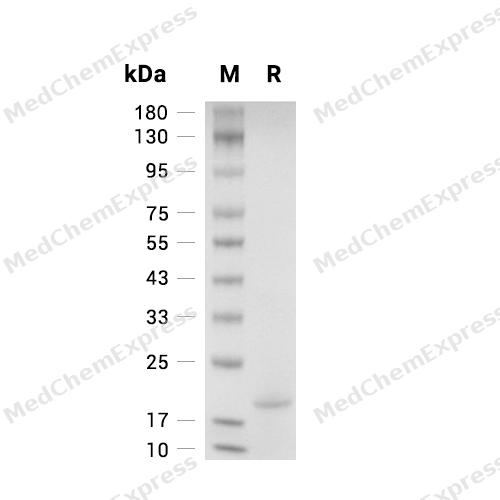
Purity - SDS-PAGE
-
Bioactivity - ELISA
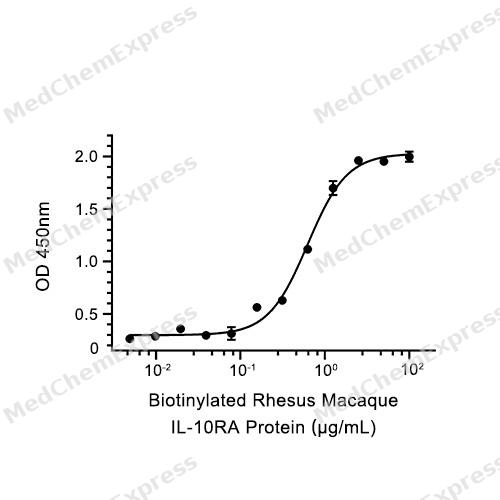
Bioactivity - ELISA


Publications (1)
-
Journal Impact Factor
-
Most Recent
-
Discov Oncol
Increased protein expression of interleukin-10 and its signalling molecules in colon cancer progression: potential prognostic and therapeutic targets. [Abstract]2025 Apr 29;16(1):637. PMID: 40299210


Technical Parameters
-
Species Human
-
Source HEK293
-
Tag N-His
-
Accession
P22301/NP_000563.1 (S19-N178)
-
Molecular Construction
-
N-term
-
His
-
IL-10 (S19-N178)
Accession # P22301/NP_000563.1 -
C-term
-
-
Protein Length
Full Length of Mature Protein
-
Synonyms
IL10; TGIF; Interleukin 10; T-Cell Growth Inhibitory Factor; IL-10; Interleukin-10; CSIF; Interleukin Family Protein; Cytokine Synthesis Inhibitory Factor; GVHDS; IL10A; IF2A
-
AA Sequence
SPGQGTQSENSCTHFPGNLPNMLRDLRDAFSRVKTFFQMKDQLDNLLLKESLLEDFKGYLGCQALSEMIQFYLEEVMPQAENQDPDIKAHVNSLGENLKTLRLRLRRCHRFLPCENKSKAVEQVKNAFNKLQEKGIYKAMSEFDIFINYIEAYMTMKIRN
-
Predicted Molecular Mass
20.9 kDa
-
Molecular Weight
Approximately 18-25 kDa, based on SDS-PAGE under reducing conditions, due to the glycosylation.
-
Glycosylation
Yes
-
Purity
≥ 85%, as determined by reducing SDS-PAGE.


Product Properties
Solution
1.Supplied as a 0.22 μm filtered solution of PBS, pH 7.4.
2.Supplied as a 0.22 μm filtered solution of 20 mM Tris, 150 mM NaCl, 0.1 M Arg, 0.02% Tween 20, pH 8.5.
Please refer to the lot-specific COA for specific buffer information.
Note: For SPR assay, please replace the buffer. Primary amine components (e.g., Tris, imidazole) can affect protein-coupled chips.
<1 EU/μg, determined by LAL method.
Stored at -80°C for 1 year from date of receipt. It is stable at -20°C for 3 months after opening. It is recommended to freeze aliquots at -80°C for extended storage. Avoid repeated freeze-thaw cycles.
Shipping with dry ice.


Documentation
-
Data Sheet (237 KB)
-
SDS (252 KB)
- English - EN (252 KB)
- Français - FR (252 KB)
- Deutsch - DE (252 KB)
- Norwegian - NO (252 KB)
- Español - ES (252 KB)
- Swedish - SV (252 KB)
- Italian - IT (252 KB)
- Korean - KR (252 KB)
- Portuguese - PT (252 KB)
-
Handling Instructions (2659 KB)

Calculators
Concentration (start) × Volume (start) = Concentration (final) × Volume (final)


 Powered by Bioz

