



IL-11R alpha Protein, Rat (HEK293, His)

Based on 1 Customer Validation
IL-11R alpha (IL-11RA) is the IL-11 receptor subunit α and also acts as an agonist of IL-11. IL-11R alpha binds to IL6ST/gp130 on cell surfaces and induces signal transduction. IL-11R alpha activates Jak family of tyrosine kinases, JAK1, JAK2, and TYK2. IL-11R alpha induces proliferation and/or differentiation of skeletogenic progenitor or other mesenchymal cells. IL-11R alpha plays an important role in the progression and the differentiation of human gastric carcinomas. IL-11R alpha Protein, Rat (HEK293, His) is a recombinant protein with a His label that consists of 366 amino acids (M1-Q366) and is produced by HEK293 cells.
- Species: Rat
- Source: HEK293
-
Storage:Stored at -20°C for 2 years from date of receipt. After reconstitution, it is stable at 4°C for 1 week or -20°C for longer (with carrier protein). It is recommended to freeze aliquots at -20°C or -80°C for extended storage.


To place orders, for customer services and technical support, please contact: MedChemExpress USA
Tel: 609-228-6898 E-mail: [email protected] [email protected]


-
 Biological Activity
-
Technical Parameters
-
Product Properties
- Documentation
- References
- Help & FAQs




Biological Activity
Description
IL-11R alpha (IL-11RA) is the IL-11 receptor subunit α and also acts as an agonist of IL-11. IL-11R alpha binds to IL6ST/gp130 on cell surfaces and induces signal transduction[1]. IL-11R alpha activates Jak family of tyrosine kinases, JAK1, JAK2, and TYK2[3]. IL-11R alpha induces proliferation and/or differentiation of skeletogenic progenitor or other mesenchymal cells[4]. IL-11R alpha plays an important role in the progression and the differentiation of human gastric carcinomas[5]. IL-11R alpha Protein, Rat (HEK293, His) is a recombinant protein with a His label that consists of 366 amino acids (M1-Q366) and is produced by HEK293 cells.
Background
IL-11RA is highly expressed on stromal cells, including fibroblasts, smooth muscle cells, adipocytes, and hepatic/pancreatic stellate cells or pericytes, and also on epithelial/polarized cells, such as hepatocytes, alveolar epithelial cells, and kidney tubular epithelial cells[1].
The amino acid sequence of human IL-11R alpha protein has low homology between mouse and rat IL-11R alpha protein.
IL-11R alpha is the receptor of IL-11, and signaling mechanism triggered by IL-11 is mediated through IL-11R alpha. IL-11R alpha can bind IL-11 and then the comples attracts gp130 leading to signal transduction. Besides, IL11RA has been demonstrated to activate IL-11-mediated gp130 signaling but not the naturally occurring form of the soluble IL-11 receptor. Binding of IL-11 to IL11RA triggers heterodimerization, tyrosine phosphorylation, and activation of gp130. The activated IL11RA–gp130 receptor complex further activates Jak family of tyrosine kinases, JAK1, JAK2, and TYK2[3].
IL-11R alpha also acts as IL-11 agonist in vitro[3]. IL-11R alpha induces proliferation and/or differentiation of skeletogenic progenitor or other mesenchymal cells[4][5].
Verified Bioactivity
Measured by its binding ability in a functional ELISA. When Recombinant Rat IL-11R alpha is coated at 2 µg/mL can bind Recombinant Human IL-11. The ED50 for this effect is 0.7710 nM.
MCE Validation Data
-
Purity - SDS-PAGE
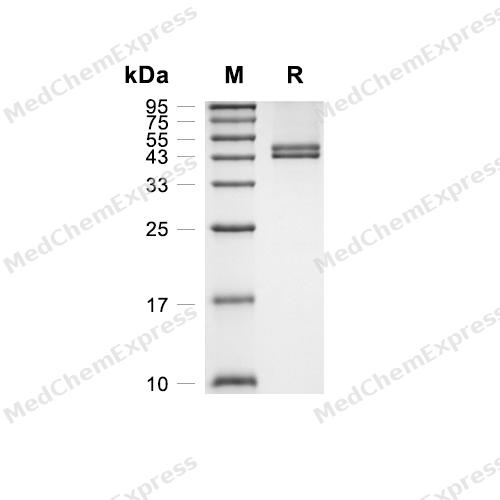
Purity - SDS-PAGE


Technical Parameters
-
Species Rat
-
Source HEK293
-
Tag C-6*His
-
Accession
Q99MF4 /NP_620816.1(T24-Q366)
-
Molecular Construction
-
N-term
-
IL-11Rα (T24-Q366)
Accession # Q99MF4/NP_620816.1 -
His
-
C-term
-
-
Protein Length
Partial Extracellular Domain
-
Synonyms
IL11RA; IL-11R Subunit Alpha; Interleukin 11 Receptor Subunit Alpha; Interleukin-11 Receptor Alpha Chain; Interleukin-11 Receptor Subunit Alpha; IL-11R-Alpha; Interleukin 11 Receptor, Alpha; IL-11RA; IL-11 Receptor Subunit Alpha; CRSDA
-
AA Sequence
TPCPQAWGPPGVQYGQPGRPVMLCCPGVNAGTPVSWFRDGDSRLLQGPDSGLGHRLVLAQVDSRDEGTYVCRTLDGVFGGMVTLKLGSPPARPEVSCQAVDYENFSCTWSPGRVSGLPTRYLTSYRKKTLPGAESQRESPSTGPWPCPQDPLEASRCVVHGAEFWSEYRINVTEVNPLGASTCLLDVRLQRILRPDPPQGLRVESVPGYPRRLHASWTYPASWRRQPHFLLKFRLQYRPAQHPAWSTVEPIGLEELITDAVAGLPHAVRVSARDFLDAGTWSAWSPEAWGTPSTGPLRDEVPDGSRGHEQKLEAAAQEDSPAPPSPSLQPDPRPLDHRDPLEQ
-
Molecular Weight
Approximately 43-50 kDa, based on SDS-PAGE under reducing conditions, due to the glycosylation.
-
Glycosylation
Yes
-
Purity
≥ 95%, as determined by reducing SDS-PAGE.


Product Properties
Lyophilized powder.
Lyophilized from a 0.2 μm filtered solution of PBS, pH 7.4. Normally 5 % - 8 % trehalose, mannitol and 0.01% Tween 80 are added as protectants before lyophilization.
<1 EU/μg, determined by LAL method.
It is not recommended to reconstitute to a concentration less than 100 μg/mL in ddH2O.
Stored at -20°C for 2 years from date of receipt. After reconstitution, it is stable at 4°C for 1 week or -20°C for longer (with carrier protein). It is recommended to freeze aliquots at -20°C or -80°C for extended storage.
Room temperature in continental US; may vary elsewhere.


Documentation
-
Data Sheet (265 KB)
-
SDS (251 KB)
- English - EN (251 KB)
- Français - FR (251 KB)
- Deutsch - DE (251 KB)
- Norwegian - NO (251 KB)
- Español - ES (251 KB)
- Swedish - SV (251 KB)
- Italian - IT (251 KB)
- Korean - KR (251 KB)
- Portuguese - PT (251 KB)
-
Handling Instructions (2659 KB)


References
[2]. [2]Cook SA, et al. Hiding in Plain Sight: Interleukin-11 Emerges as a Master Regulator of Fibrosis, Tissue Integrity, and Stromal Inflammation. Annu Rev Med. 2020 Jan 27;71:263-276. [Content Brief]
[3]. Balakrishnan L, et al. IL-11/IL11RA receptor mediated signaling: a web accessible knowledgebase. Cell Commun Adhes. 2013 Aug;20(3-4):81-6. [Content Brief]
[4]. Dams-Kozlowska H, et al. A designer hyper interleukin 11 (H11) is a biologically active cytokine. BMC Biotechnol. 2012 Mar 21;12:8. [Content Brief]
[5]. Nakayama T, et al. Expression of interleukin-11 (IL-11) and IL-11 receptor alpha in human gastric carcinoma and IL-11 upregulates the invasive activity of human gastric carcinoma cells. Int J Oncol. 2007 Apr;30(4):825-33. [Content Brief]

Calculators
Concentration (start) × Volume (start) = Concentration (final) × Volume (final)


 Powered by Bioz

