



IL-13 Protein, Human (CHO)
Based on 10 publication(s) in Google Scholar
IL-13 Protein, Human (CHO) is a CHO cell derived cytokine which affects the morphology, growth, and surface antigen expression and phenotype of monocytes and elicits B cell proliferation.
- Species: Human
- Source: CHO
-
Storage:Stored at -20°C for 2 years from date of receipt. After reconstitution, it is stable at 4°C for 1 week or -20°C for longer (with carrier protein). It is recommended to freeze aliquots at -20°C or -80°C for extended storage.


To place orders, for customer services and technical support, please contact: MedChemExpress USA
Tel: 609-228-6898 E-mail: [email protected] [email protected]


-
 Biological Activity
-
Technical Parameters
-
Product Properties
- Documentation
- References
- Help & FAQs


-

HY-P70445
IL-4 Protein, Human -
HY-18739
Phorbol 12-myristate 13-acetate -
HY-P7025
IFN-gamma Protein, Human -
HY-P7042
IL-4 Protein, Human (CHO) -
HY-P70750
IL-4 Protein, Human (HEK293) -
HY-P7025A
IFN-gamma Protein, Human (CHO) -
HY-P70764
IL-4 Protein, Human (HEK293, His) -

HY-D1056
Lipopolysaccharides, from E. coli O55:B5 -
HY-10219
Rapamycin -
HY-B2227
Lactic acid -
HY-P0018
Pepstatin -
HY-13740
Resiquimod


Biological Activity
Description
IL-13 Protein, Human (CHO) is a CHO cell derived cytokine which affects the morphology, growth, and surface antigen expression and phenotype of monocytes and elicits B cell proliferation.
Background
Interleukin-13 is a cytokine which is secreted by activated T lymphocytes and primarily impacts monocytes, macrophages, and B cells. The circular dichroism spectrum confirms that interleukin-13 belongs to the alpha-helical family of cytokines. Interleukin- 13 affects the morphology, growth, and surface antigen expression and phenotype of monocytes and elicits B cell proliferation, Ig class switching to IgE synthesis, and enhanced production of IgG4 and IgM. In human macrophages and monocytes,hIL-13 has been shown to inhibit HIV replication. Human IL-13 also inhibits proinflammatory cyto-kines induced by LPS exposure, indicating poten-tial therapeutic applicationsas an anti-inflammatory agent[1].
Verified Bioactivity
Measured in a cell proliferation assay using TF-1 human erythroleukemic cells. The ED50 for this effect is ≤24.04 ng/mL, corresponding to a specific activity is ≥4.20×10⁴ U/mg.
MCE Validation Data
-
Purity - SDS-PAGE
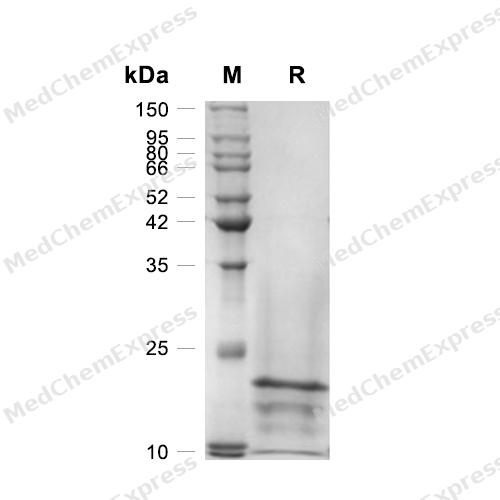
Purity - SDS-PAGE
-
Bioactivity - Cell-Based Assay
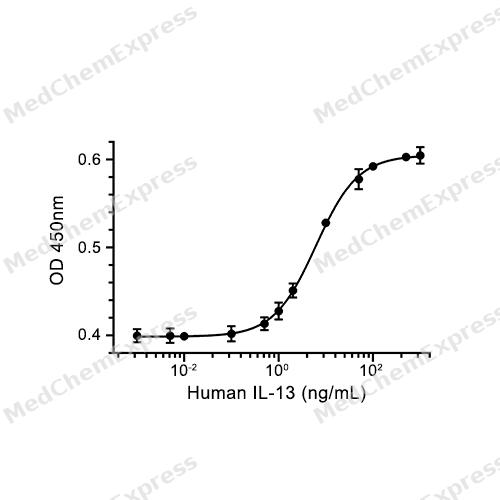
Bioactivity - Cell-Based Assay


Publications (10)
-
Journal Impact Factor
-
Most Recent
-
Cell
De novo assembly of nuclear stress bodies rearranges and enhances NFIL3 to restrain acute inflammatory responses. [Abstract]2025 Aug 21;188(17):4586-4603.e31. PMID: 40436014 -
Phytother Res
Panax notoginseng Saponins Prevents Atherosclerosis and Reverse Steroid-Resistance in Lupus Nephritis via Promoting the "M2-Polarization of Macrophages-PPARγ" Positive Regulation. [Abstract]2026 Mar;40(3):1274-1289. PMID: 41562282 -
-
Int J Mol Sci
BAMBI Is a Prognostic Biomarker Associated with Macrophage Polarization, Glycolysis, and Lipid Metabolism in Hepatocellular Carcinoma. [Abstract]2024 Nov 26;25(23):12713. PMID: 39684424 -
Mol Med Rep
Formononetin ameliorates IL‑13‑induced inflammation and mucus formation in human nasal epithelial cells by activating the SIRT1/Nrf2 signaling pathway. [Abstract]2021 Dec;24(6):832. PMID: 34590155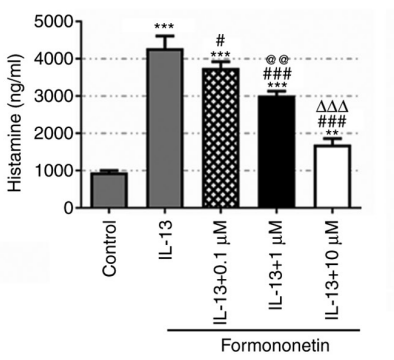
IL-13 Protein, Human (CHO) purchased from MedChemExpress. Usage Cited in: Mol Med Rep. 2021 Dec;24(6):832. [Abstract]
The concentration of histamine in JME/CF15 cells stimulated with IL-13 (10 ng/mL) treated with 0, 0.1, 1 or 10 µM mangiferin was detected by ELISA.
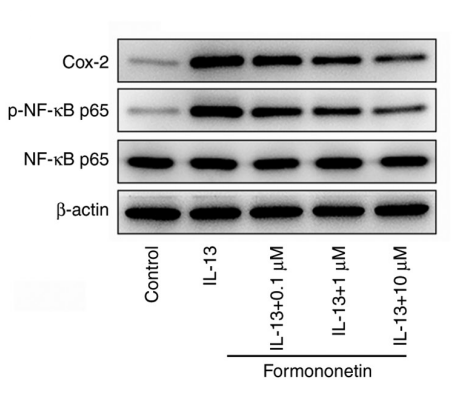
IL-13 Protein, Human (CHO) purchased from MedChemExpress. Usage Cited in: Mol Med Rep. 2021 Dec;24(6):832. [Abstract]
The relative expression levels of Cox-2 and p-NF-κB p65/NF-κB p65 in JME/CF15 cells stimulated with IL-13 (10 ng/mL) treated with 0, 0.1, 1 or 10 µM mangiferin were detected by Western blotting.
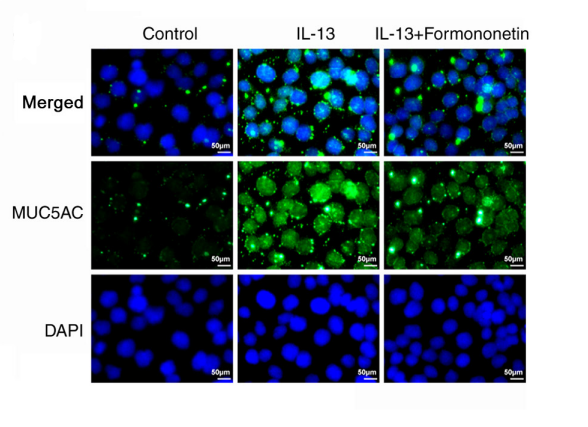
IL-13 Protein, Human (CHO) purchased from MedChemExpress. Usage Cited in: Mol Med Rep. 2021 Dec;24(6):832. [Abstract]
The fluorescence intensity of MUC5AC in JME/CF15 cells treated with the control group, IL-13 (10 ng/mL), or IL-13 + mangiferin (10 µM) was detected by immunofluorescence. MUC5AC was displayed as green fluorescence.
-
J Inflamm Res
M1-Type Macrophages Secrete TNF-α to Stimulate Vascular Calcification by Upregulating CA1 and CA2 Expression in VSMCs. [Abstract]2023 Jul 19;16:3019-3032. PMID: 37489150 -
Tissue Cell
Unraveling the role of HIF-1α in allergic rhinitis: A key regulator of epithelial barrier integrity via PI3K pathway. [Abstract]2025 Aug:95:102898. PMID: 40187003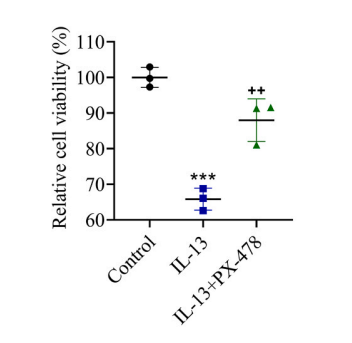
IL-13 Protein, Human (CHO) purchased from MedChemExpress. Usage Cited in: Tissue Cell. 2025 Aug:95:102898. [Abstract]
Cell viability of human nasal epithelial cell line (JME/CF15) in the control group, interleukin (IL)-13 group and IL-13 (10 ng/mL, 30 min) + PX-478 group (CCK-8 assay).
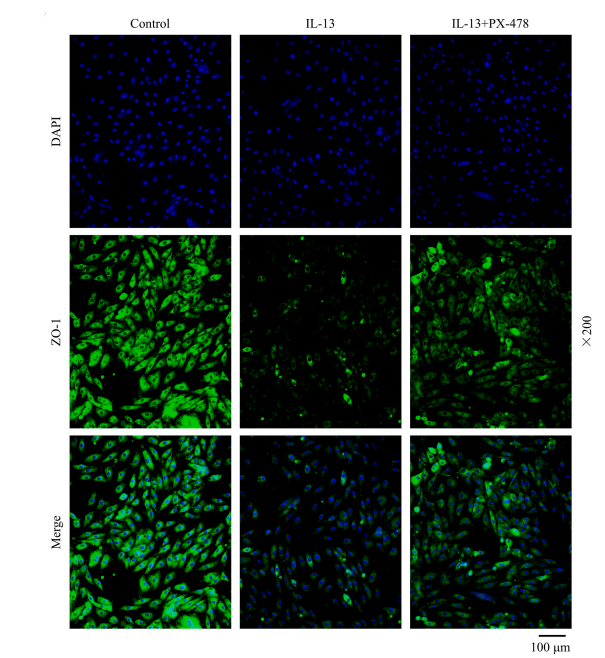
IL-13 Protein, Human (CHO) purchased from MedChemExpress. Usage Cited in: Tissue Cell. 2025 Aug:95:102898. [Abstract]
Expression of ZO-1 in JME/CF15 cells in the control group, IL-13 group and IL-13 (10 ng/mL, 30 min) + PX-478 group (immunofluorescence assay).
-
Tissue Cell
LPCAT1 reduces inflammatory response, apoptosis and barrier damage of nasal mucosal epithelial cells caused by allergic rhinitis through endoplasmic reticulum stress. [Abstract]2025 Apr:93:102712. PMID: 39837174 -
Oncol Lett
Tumor-associated macrophage-derived exosomes promote EGFR-TKI resistance in non-small cell lung cancer by regulating the AKT, ERK1/2 and STAT3 signaling pathways. [Abstract]2022 Aug 24;24(4):356. PMID: 36168315 -


Technical Parameters
-
Species Human
-
Source CHO
-
Tag Tag Free
-
Accession
P35225 (S33-N146)
-
Protein Length
Partial
-
Synonyms
IL13; MGC116789; Interleukin 13; ALRH; IL-13; BHR1; Interleukin-13; Bronchial Hyperresponsiveness-1 (Bronchial Asthma); P600; Allergic Rhinitis; MGC116786; NC30; MGC116788
-
AA Sequence
SPGPVPPSTALRELIEELVNITQNQKAPLCNGSMVWSINLTAGMYCAALESLINVSGCSAIEKTQRMLSGFCPHKVSAGQFSSLHVRDTKIEVAQFVKDLLLHLKKLFREGQFN
-
Molecular Weight
Approximately 10-25 kDa under reduced (R) conditions, 25-45 kDa under non reducing (N) conditions, based on SDS-PAGE, due to the glycosylation.
-
Glycosylation
Yes
-
Purity
≥ 90%, as determined by reducing SDS-PAGE.


Product Properties
Lyophilized powder
1.Lyophilized from a 0.22 μm filtered solution of PBS.
2.Lyophilized from a 0.22 μm filtered solution of 20 mM PB, 150 mM NaCl, pH 7.4.
3.Lyophilized from a 0.22 μm filtered solution of PBS, pH 7.4, 6% trehalose.
Please refer to the lot-specific COA for specific buffer information.
<1 EU/μg, determined by LAL method.
It is not recommended to reconstitute to a concentration less than 100 μg/mL in ddH2O. For long term storage it is recommended to add a carrier protein (0.1% BSA, 5% HSA, 10% FBS or 5% Trehalose).
Stored at -20°C for 2 years from date of receipt. After reconstitution, it is stable at 4°C for 1 week or -20°C for longer (with carrier protein). It is recommended to freeze aliquots at -20°C or -80°C for extended storage.
Room temperature in continental US; may vary elsewhere.


Documentation
-
Data Sheet (261 KB)
-
SDS (252 KB)
- English - EN (252 KB)
- Français - FR (252 KB)
- Deutsch - DE (252 KB)
- Norwegian - NO (252 KB)
- Español - ES (252 KB)
- Swedish - SV (252 KB)
- Italian - IT (252 KB)
- Korean - KR (252 KB)
- Portuguese - PT (252 KB)
-
Handling Instructions (2659 KB)


References

Calculators
Concentration (start) × Volume (start) = Concentration (final) × Volume (final)


 Powered by Bioz

