



IL-2 Protein, Human (HEK293, His)
Based on 5 publication(s) in Google Scholar
IL-2 protein is mainly produced by activated CD4-positive helper T cells and plays an important role in immune response and tolerance. Binding to IL-2R induces downstream signaling through JAK1 and JAK3 phosphorylation, thereby activating various pathways, including STAT, PI3K, and MAPK. IL-2 Protein, Human (HEK293, His) is the recombinant human-derived IL-2 protein, expressed by HEK293 , with C-6*His labeled tag.
- Species: Human
- Source: HEK293
-
Storage:Stored at -20°C for 2 years from date of receipt. After reconstitution, it is stable at 4°C for 1 week or -20°C for longer (with carrier protein). It is recommended to freeze aliquots at -20°C or -80°C for extended storage.


To place orders, for customer services and technical support, please contact: MedChemExpress USA
Tel: 609-228-6898 E-mail: [email protected] [email protected]


-
 Biological Activity
-
Technical Parameters
-
Product Properties
- Documentation
- Help & FAQs


-

HY-P70755
IL-7 Protein, Human (HEK293, His) -
HY-10583
Y-27632 dihydrochloride -

HY-N7038
Phytohemagglutinin -
HY-P7371
IL-15 Protein, Human (His) -
HY-P7044
IL-6 Protein, Human -
HY-P7016A
GM-CSF Protein, Human -
HY-P70781
SCF Protein, Human -
HY-P70610
IFN-gamma Protein, Human (HEK293) -
HY-P7032
IL-12 Protein, Human (HEK293) -
HY-P7034
IL-15 Protein, Human -
HY-P70544
FLT3LG Protein, Human (HEK293, His)


Biological Activity
Description
IL-2 protein is mainly produced by activated CD4-positive helper T cells and plays an important role in immune response and tolerance. Binding to IL-2R induces downstream signaling through JAK1 and JAK3 phosphorylation, thereby activating various pathways, including STAT, PI3K, and MAPK. IL-2 Protein, Human (HEK293, His) is the recombinant human-derived IL-2 protein, expressed by HEK293 , with C-6*His labeled tag.
Background
The cytokine interleukin-2 (IL-2), produced primarily by activated CD4-positive helper T-cells and, to a lesser extent, by activated CD8-positive T-cells and natural killer (NK) cells, plays pivotal roles in the immune response and tolerance. IL-2 binds to a receptor complex composed of either the high-affinity trimeric IL-2R (IL2RA/CD25, IL2RB/CD122, and IL2RG/CD132) or the low-affinity dimeric IL-2R (IL2RB and IL2RG). This interaction induces oligomerization and conformational changes in the IL-2R subunits, initiating downstream signaling with the phosphorylation of JAK1 and JAK3. Subsequently, JAK1 and JAK3 phosphorylate the receptor, creating a docking site for the phosphorylation of various substrates, including STAT5. This process activates multiple pathways, including STAT, phosphoinositide-3-kinase/PI3K, and mitogen-activated protein kinase/MAPK pathways. IL-2 functions as a T-cell growth factor, enhances NK-cell cytolytic activity, and promotes robust proliferation of activated B-cells, leading to increased immunoglobulin production. Furthermore, IL-2 plays a crucial role in regulating the adaptive immune system by controlling the survival and proliferation of regulatory T-cells, essential for maintaining immune tolerance. Additionally, IL-2 participates in the differentiation and homeostasis of various effector T-cell subsets, including Th1, Th2, Th17, as well as memory CD8-positive T-cells.
Verified Bioactivity
1.The cell proliferation assay using CTLL-2 mouse cytotoxic T cells has a specific activity of ≥4.5×10⁶ IU/mg.
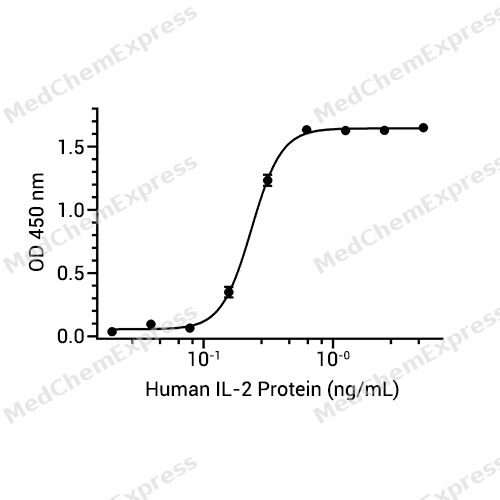
2.Measured in a cell proliferation assay using CTLL-2 mouse cytotoxic T cells. The ED50 for this effect is <0.5 ng/mL.
MCE Validation Data
-
Purity - SDS-PAGE
Purity - SDS-PAGE
-
Bioactivity - Cell-Based Assay
Bioactivity - Cell-Based Assay


Publications (5)
-
Journal Impact Factor
-
Most Recent
-
-
-
Cell Signal
N-α-Acetyltransferase 40 promotes oral squamous cell carcinoma progression by enhancing FEN1 transcription and suppressing CD8+ T cell antitumor immunity. [Abstract]2026 Mar:139:112335. PMID: 41423010 -
J Cell Commun Signal
JAK3/STAT5 signaling-triggered upregulation of PIK3CD contributes to gastric carcinoma development. [Abstract]2024 Feb 7;18(1):e12017. PMID: 38545256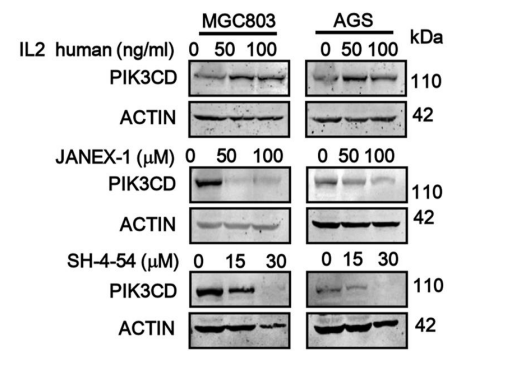
IL-2 Protein, Human (HEK293, His) purchased from MedChemExpress. Usage Cited in: J Cell Commun Signal. 2024 Feb 7;18(1):e12017. [Abstract]
Cells were treated with human IL-2 (0-100 ng/mL), JANEX-1 and STAT5 inhibitor (SH-4-54) as indicated concentrations. PIK3CD expression was examined by western blot analysis. JANEX-1, JAK3 inhibitor.
-


Technical Parameters
-
Species Human
-
Source HEK293
-
Tag C-6*His
-
Accession
P60568 (A21-T153)
-
Molecular Construction
-
N-term
-
IL-2 (A21-T153)
Accession # P60568 -
6*His
-
C-term
-
-
Protein Length
Full Length of Mature Protein
-
Synonyms
IL2; T Cell Growth Factor; Interleukin 2; Aldesleukin; IL-2; Involved In Regulation Of T-Cell Clonal Expansion; TCGF; T-Cell Growth Factor; Interleukin-2; Lymphokine
-
AA Sequence
APTSSSTKKTQLQLEHLLLDLQMILNGINNYKNPKLTRMLTFKFYMPKKATELKHLQCLEEELKPLEEVLNLAQSKNFHLRPRDLISNINVIVLELKGSETTFMCEYADETATIVEFLNRWITFCQSIISTLT
-
Predicted Molecular Mass
16.4 kDa
-
Molecular Weight
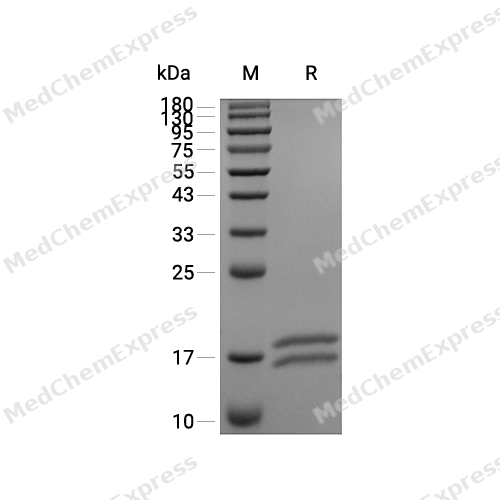
Approximately 14-18 kDa, based on SDS-PAGE under reducing conditions, due to the glycosylation.
-
Glycosylation
Yes
-
Purity
≥ 95%, as determined by reducing SDS-PAGE.


Product Properties
Lyophilized powder
1.Lyophilized from a 0.22 μm filtered solution of 20 mM PB, 150 mM NaCl, pH 7.4.
2.Lyophilized from a 0.22 μm filtered solution of 10 mM Sodium citrate, pH 4.0, 5% trehalose, 5% mannitol and 0.01% Tween 80.
3.Lyophilized from a 0.22 μm filtered solution of 20 mM PB, 150 mM NaCl, pH 7.4, 8% trehalose.
Please refer to the lot-specific COA for specific buffer information.
<1 EU/μg, determined by LAL method.
It is not recommended to reconstitute to a concentration less than 100 μg/mL in ddH2O. For long term storage it is recommended to add a carrier protein (0.1% BSA, 5% HSA, 10% FBS or 5% Trehalose).
Stored at -20°C for 2 years from date of receipt. After reconstitution, it is stable at 4°C for 1 week or -20°C for longer (with carrier protein). It is recommended to freeze aliquots at -20°C or -80°C for extended storage.
Room temperature in continental US; may vary elsewhere.


Documentation
-
Data Sheet (237 KB)
-
SDS (252 KB)
- English - EN (252 KB)
- Français - FR (252 KB)
- Deutsch - DE (252 KB)
- Norwegian - NO (252 KB)
- Español - ES (252 KB)
- Swedish - SV (252 KB)
- Italian - IT (252 KB)
- Korean - KR (252 KB)
- Portuguese - PT (252 KB)
-
Handling Instructions (2659 KB)

Calculators
Concentration (start) × Volume (start) = Concentration (final) × Volume (final)


 Powered by Bioz

