



IL-7 Protein, Mouse
Based on 2 publication(s) in Google Scholar
IL-7 protein regulates lymphocyte population and maintains lymphoid homeostasis by developing, expanding, and supporting survival of T-cells and B-cells. It interacts with IL7R and CSF2RG receptors to exert its effects. IL-7 Protein, Mouse is the recombinant mouse-derived IL-7 protein, expressed by E. coli , with tag free.
- Species: Mouse
- Source: E. coli
-
Storage:Stored at -20°C for 2 years from date of receipt. After reconstitution, it is stable at 4°C for 1 week or -20°C for longer (with carrier protein). It is recommended to freeze aliquots at -20°C or -80°C for extended storage.


To place orders, for customer services and technical support, please contact: MedChemExpress USA
Tel: 609-228-6898 E-mail: [email protected] [email protected]


-
 Biological Activity
-
Technical Parameters
-
Product Properties
- Documentation
- Help & FAQs


-

HY-P7077
IL-2 Protein, Mouse -
HY-P700193AF
Animal-Free IL-15 Protein, Mouse (His) -
HY-P78719
IL-15 Protein, Mouse (HEK293, Fc) -
HY-P7218
IL-33 Protein, Mouse -
HY-10583
Y-27632 dihydrochloride -
HY-P7361
GM-CSF Protein, Mouse -
HY-P7073
IL-1 beta Protein, Mouse -
HY-P70528
SCF Protein, Mouse -
HY-P70666
IL-12 Protein, Mouse (HEK293) -
HY-P7080
IL-4 Protein, Mouse (CHO) -
HY-P7034
IL-15 Protein, Human -
HY-P7071
IFN-gamma Protein, Mouse


Biological Activity
Description
IL-7 protein regulates lymphocyte population and maintains lymphoid homeostasis by developing, expanding, and supporting survival of T-cells and B-cells. It interacts with IL7R and CSF2RG receptors to exert its effects. IL-7 Protein, Mouse is the recombinant mouse-derived IL-7 protein, expressed by E. coli , with tag free.
Background
The IL-7 protein is a hematopoietic cytokine that plays a vital role in the development, expansion, and survival of naive and memory T-cells and B-cells, thus regulating the population of mature lymphocytes and maintaining lymphoid homeostasis. It interacts with IL7R and CSF2RG receptors to exert its effects.
Verified Bioactivity
1.Measured in a cell proliferation assay using antibody against CD3-activated human peripheral blood lymphocytes (PBL) and the ED50 is typically 0.4-5.2 ng/mL.
2.Measured in a cell proliferation assay using antibody against CD3-activated human peripheral blood mononuclear cell (PBMC). The ED50 for this effect is typically 0.4-4 ng/mL.
3.Measured by its binding ability in a functional ELISA. When Recombinant Mouse IL-7 is immobilized at 2 µg/mL (100 µL/well) can bind Biotinylated Recombinant Human IL-7 R alpha. The ED50 for this effect is 1.814 ng/mL.
MCE Validation Data
-
Purity - SDS-PAGE
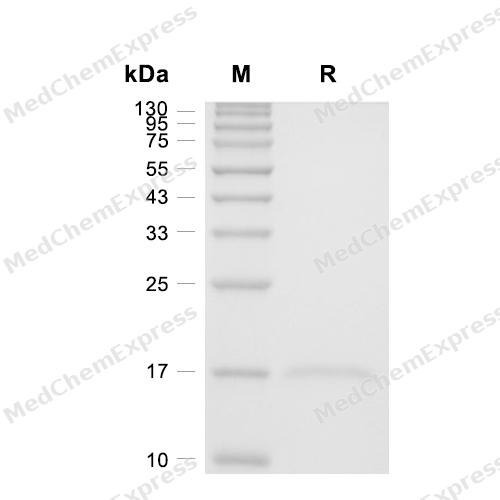
Purity - SDS-PAGE
-
Bioactivity - ELISA
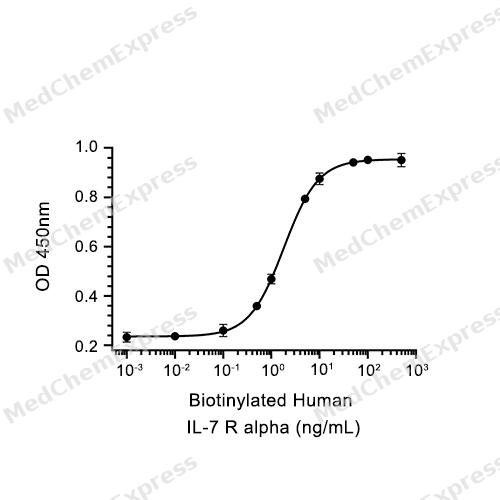
Bioactivity - ELISA


Publications (2)
-
Journal Impact Factor
-
Most Recent
-
Cell Stem Cell
2026 Apr 2;33(4):660-675.e5. PMID: 41895281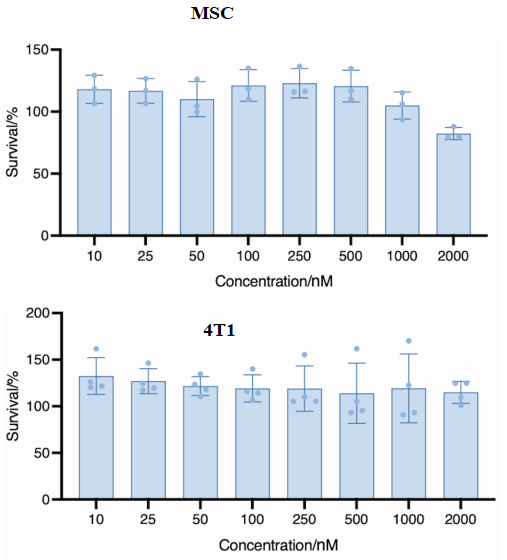
IL-7 Protein, Mouse purchased from MedChemExpress. Usage Cited in: Cell Stem Cell. 2026 Apr 2;33(4):660-675.e5. [Abstract]
IL-7 Protein, Mouse (IL-7, 10-2000 nM; 48 h) promoted proliferation of both MSCs and tumor cells (4T1 cells) at concentrations <100 nM.
-
Mol Med
Deficiency of IL-7R attenuates abdominal aortic aneurysms in mice by inhibiting macrophage polarization towards M1 phenotype through the NF-κB pathway. [Abstract]2025 Apr 16;31(1):138. PMID: 40240976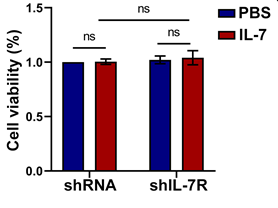
IL-7 Protein, Mouse purchased from MedChemExpress. Usage Cited in: Mol Med. 2025 Apr 16;31(1):138. [Abstract]
The viability of RAW264.7 cells was detected by CCK-8 assay. The results showed that IL-7 Protein, Mouse (IL-7, 10 ng/mL; 24 h) treatment had no effect on cell viability in RAW264.7 macrophages transfected with shIL-7R or control shRNA.
IL-7 Protein, Mouse purchased from MedChemExpress. Usage Cited in: Mol Med. 2025 Apr 16;31(1):138. [Abstract]
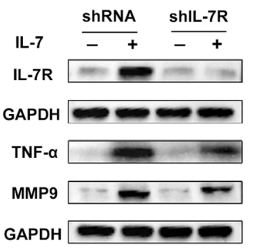
IL-7 Protein, Mouse (IL-7, 10 ng/mL; 24 h) stimulation upregulated IL-7R protein expression in RAW264.7 cells, whereas shIL-7R transfection reduced IL-7R levels.
IL-7 Protein, Mouse purchased from MedChemExpress. Usage Cited in: Mol Med. 2025 Apr 16;31(1):138. [Abstract]
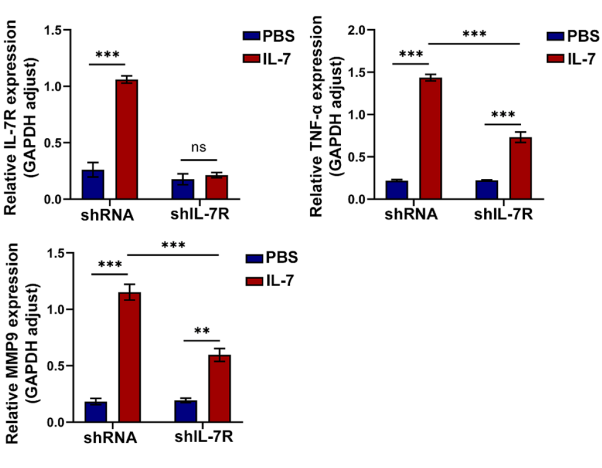
IL-7 Protein, Mouse (IL-7, 10 ng/mL; 24 h) stimulation upregulated IL-7R expression in RAW264.7 cells, whereas shIL-7R transfection reduced IL-7R levels.
IL-7 Protein, Mouse purchased from MedChemExpress. Usage Cited in: Mol Med. 2025 Apr 16;31(1):138. [Abstract]
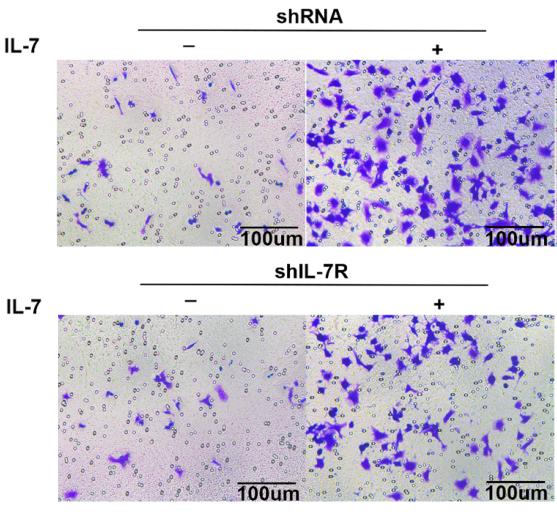
Transwell assay was performed to assess the migration of RAW264.7 cells in each group. The results displayed that the migratory ability of the shIL-7R group was weaker than that of the shRNA group after stimulation with IL-7 Protein, Mouse (IL-7, 10 ng/mL; 24 h). scale bar = 100 µm


Technical Parameters
-
Species Mouse
-
Source E. coli
-
Tag Tag Free
-
Accession
P10168/Q544C8/NP_032397.1 (E26-I154)
-
Molecular Construction
-
N-term
-
IL-7 (E26-I154)
Accession # P10168/Q544C8/NP_032397.1 -
C-term
-
-
Protein Length
Full Length of Mature Protein
-
Synonyms
IL7; IL7 Nirs Variant 5; Interleukin 7; IL7 Nirs Variant 3; IL-7; IMD130; Interleukin-7
-
AA Sequence
ECHIKDKEGKAYESVLMISIDELDKMTGTDSNCPNNEPNFFRKHVCDDTKEAAFLNRAARKLKQFLKMNISEEFNVHLLTVSQGTQTLVNCTSKEEKNVKEQKKNDACFLKRLLREIKTCWNKILKGSI
-
Predicted Molecular Mass
15 kDa
-
Molecular Weight
Approximately 18 kDa, based on SDS-PAGE under reducing conditions.
-
Purity
≥ 90%, as determined by reducing SDS-PAGE.


Product Properties
Lyophilized powder
1.Lyophilized from a 0.22 μm filtered solution of PBS, 5% trehalose, 5% mannitol, 0.01% Tween 80.
2.Lyophilized from a 0.22 μm filtered solution of PBS.
3.Lyophilized from a 0.22 μm filtered solution of PBS, pH 7.4, 8% trehalose.
Please refer to the lot-specific COA for specific buffer information.
<1 EU/μg, determined by LAL method.
It is not recommended to reconstitute to a concentration less than 100 μg/mL in ddH2O.
Stored at -20°C for 2 years from date of receipt. After reconstitution, it is stable at 4°C for 1 week or -20°C for longer (with carrier protein). It is recommended to freeze aliquots at -20°C or -80°C for extended storage.
Room temperature in continental US; may vary elsewhere.


Documentation
-
Data Sheet (235 KB)
-
SDS (251 KB)
- English - EN (251 KB)
- Français - FR (251 KB)
- Deutsch - DE (251 KB)
- Norwegian - NO (251 KB)
- Español - ES (251 KB)
- Swedish - SV (251 KB)
- Italian - IT (251 KB)
- Korean - KR (251 KB)
- Portuguese - PT (251 KB)
-
Handling Instructions (2659 KB)

Calculators
Concentration (start) × Volume (start) = Concentration (final) × Volume (final)


 Powered by Bioz

