



Animal-Free IL-15 Protein, Mouse (His)
Based on 3 publication(s) in Google Scholar
The IL-15 protein is a cytokine that crucially shapes inflammatory and protective immune responses by regulating innate and adaptive immune cells. It stimulates the proliferation and activation of natural killer cells, T cells and B cells, and promotes the secretion of cytokines. Animal-Free IL-15 Protein, Mouse (His) is the recombinant mouse-derived animal-FreeIL-15 protein, expressed by E. coli , with N-His labeled tag. This product is for cell culture use only.
- Species: Mouse
- Source: E. coli
-
Storage:Stored at -20°C for 2 years from date of receipt. After reconstitution, it is stable at 4°C for 1 week or -20°C for longer (with carrier protein). It is recommended to freeze aliquots at -20°C or -80°C for extended storage.

To place orders, for customer services and technical support, please contact: MedChemExpress USA
Tel: 609-228-6898 E-mail: [email protected] [email protected]


-
 Biological Activity
-
Technical Parameters
-
Product Properties
- Documentation
- Help & FAQs


-

HY-P7077
IL-2 Protein, Mouse -
HY-P73226
IL-7 Protein, Mouse -
HY-P700217AF
Animal-Free IL-7 Protein, Mouse (His) -
HY-P7082
IL-7 Protein, Mouse (CHO, His) -
HY-17026
Gemcitabine -
HY-P70666
IL-12 Protein, Mouse (HEK293) -
HY-P7080
IL-4 Protein, Mouse (CHO) -
HY-P7037
IL-2 Protein, Human -
HY-P7361
GM-CSF Protein, Mouse -
HY-P7078
IL-21 Protein, Mouse -
HY-P7034
IL-15 Protein, Human -
HY-P7045
IL-7 Protein, Human


Biological Activity
Description
The IL-15 protein is a cytokine that crucially shapes inflammatory and protective immune responses by regulating innate and adaptive immune cells. It stimulates the proliferation and activation of natural killer cells, T cells and B cells, and promotes the secretion of cytokines. Animal-Free IL-15 Protein, Mouse (His) is the recombinant mouse-derived animal-FreeIL-15 protein, expressed by E. coli , with N-His labeled tag. This product is for cell culture use only.
Background
The IL-15 protein is a cytokine that plays a crucial role in the development of both inflammatory and protective immune responses against microbial invaders and parasites. It achieves this by modulating immune cells from both the innate and adaptive immune systems. IL-15 stimulates the proliferation and activation of natural killer cells, T-cells, and B-cells, while also promoting the secretion of various cytokines. In monocytes, IL-15 induces the production of chemokines IL8 and monocyte chemotactic protein 1/CCL2, which attract neutrophils and monocytes to sites of infection. Unlike most cytokines, IL-15 is expressed on the surface of IL-15-producing cells in association with its high affinity IL15RA, delivering signals to target cells expressing IL2RB and IL2RG receptor subunits. This binding triggers phosphorylation of JAK1 and JAK3, recruiting and subsequently phosphorylating signal transducer and activator of transcription-3/STAT3 and STAT5. Additionally, in mast cells, IL-15 rapidly phosphorylates STAT6, consequently controlling mast cell survival and the release of cytokines like IL4.
Verified Bioactivity
Measure by its abilit to induce CTLL-2 cells proliferation. The ED50 for this effect is < 10 ng/mL, corresponding to a specific activity is > 1x10⁵ IU/mg.


Publications (3)
-
Journal Impact Factor
-
Most Recent
-
Mater Today Bio
Injectable tert-butylphenylacetic acid/acrylated β-cyclodextrin-based hydrogels for co-delivery of CAR-T cells and IL-15 in solid tumor therapy. [Abstract]2025 Oct 14:35:102421. PMID: 41209697 -
iScience
AF6 regulates intestinal IgA via crosstalk between intestinal epithelial cells and immune cells in inflammatory bowel disease. [Abstract]2025 May 13;28(7):112658. PMID: 40687779 -
Cytokine
Characterizing the mechanisms underpinning interleukin-15Rα-mediated protection against sepsis and candidiasis. [Abstract]2025 Sep 17:196:157026. PMID: 40967153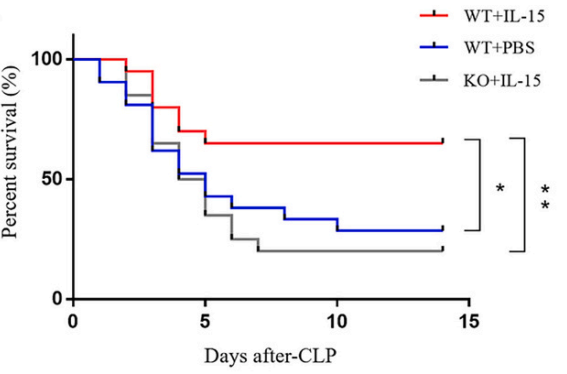
Animal-Free IL-15 Protein, Mouse (His) purchased from MedChemExpress. Usage Cited in: Cytokine. 2025 Sep 17:196:157026. [Abstract]
Survival curve showing sepsis mice treated with/without recombinant IL-15 (Animal-Free IL-15 protein, Mouse (His)) (1.5 μg/kg; i.v.), and IL-15α−/− sepsis mice receiving the same treatment (30 ng, n = 20/group). The results showed that within a sepsis context, Animal-Free IL-15 protein, Mouse (His) administration significantly decreased mortality induced by sepsis in mice (p < 0.05); however, these protective effects were diminished in IL-15Rα−/− mice (p < 0.005).
Animal-Free IL-15 Protein, Mouse (His) purchased from MedChemExpress. Usage Cited in: Cytokine. 2025 Sep 17:196:157026. [Abstract]
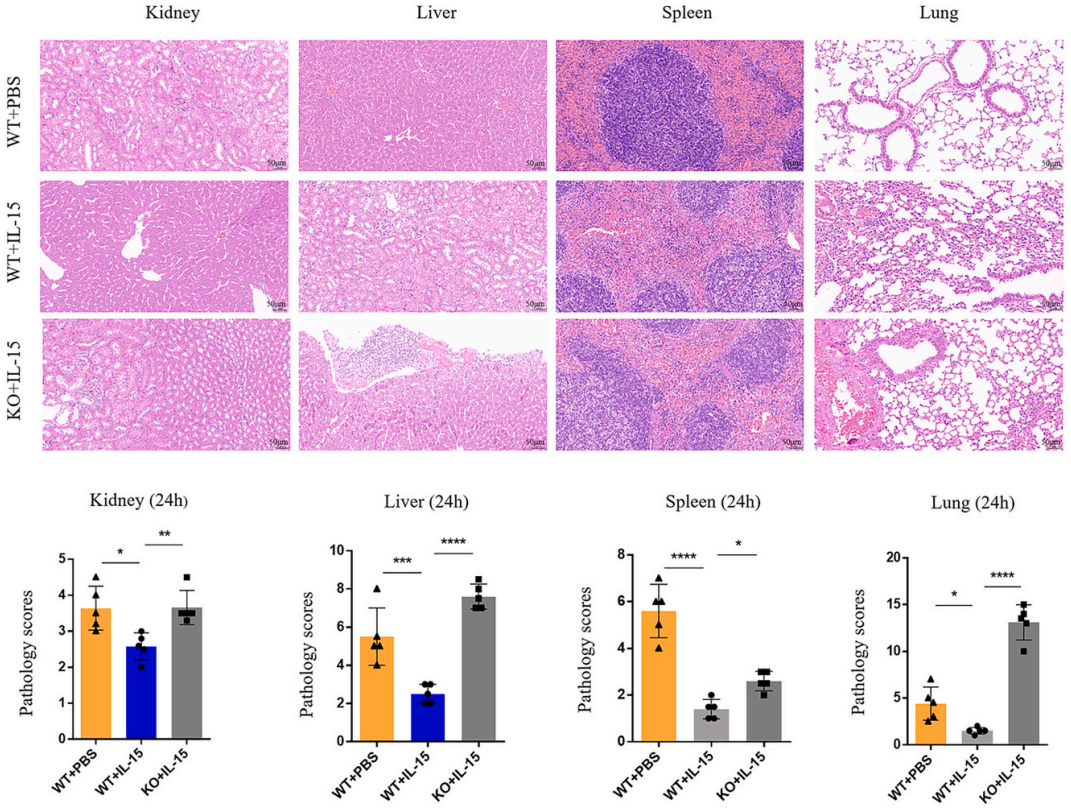
Organ damage (kidney, liver, spleen, and lung) in sepsis mice treated with/without mouse recombinant IL-15 (Animal-Free IL-15 protein, Mouse (His)) (1.5 μg/kg; i.v.) after 24 h, along with IL-15α−/− sepsis mice receiving the same treatment (n = 5/group).
Animal-Free IL-15 Protein, Mouse (His) purchased from MedChemExpress. Usage Cited in: Cytokine. 2025 Sep 17:196:157026. [Abstract]
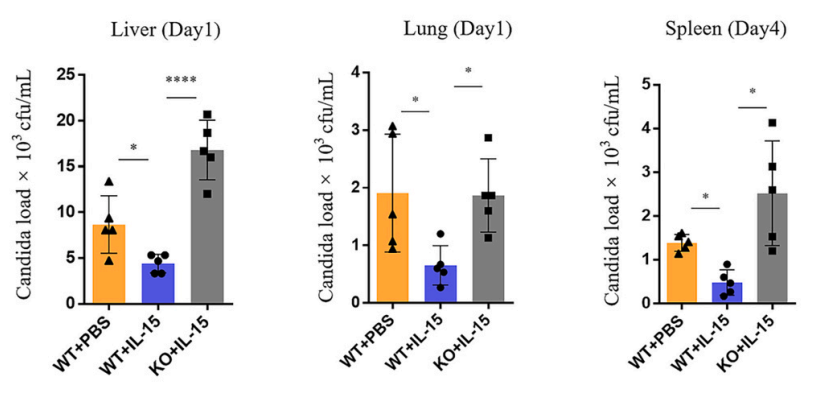
Microbial loads in liver, spleen, and lung in candidiasis mice treated with/without mouse recombinant IL-15 (Animal-Free IL-15 protein, Mouse (His)) (1.5 μg/kg; i.v.) after 1 day, along with IL-15α−/− candidiasis mice receiving the same treatment (n = 5/group). The results showed that Animal-Free IL-15 protein, Mouse (His) inhibited bacterial growth in the liver, spleen, lungs, and kidneys.
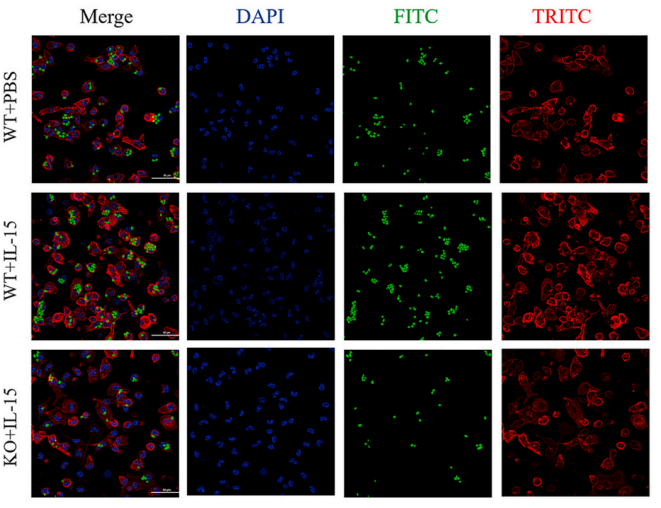
Animal-Free IL-15 Protein, Mouse (His) purchased from MedChemExpress. Usage Cited in: Cytokine. 2025 Sep 17:196:157026. [Abstract]
Confocal laser microscopy was used to observe macrophages (green fluorescence) phagocytosing fungi (red fluorescence) in candidiasis mice treated with/without mouse recombinant IL-15 (Animal-Free IL-15 protein, Mouse (His)) (1.5 μg/kg; i.v.) after 2 h, along with IL-15α−/− candidiasis mice receiving the same treatment (n = 5/group). The results showed that Animal-Free IL-15 protein, Mouse (His) significantly improved phagocytic activity (p < 0.005).
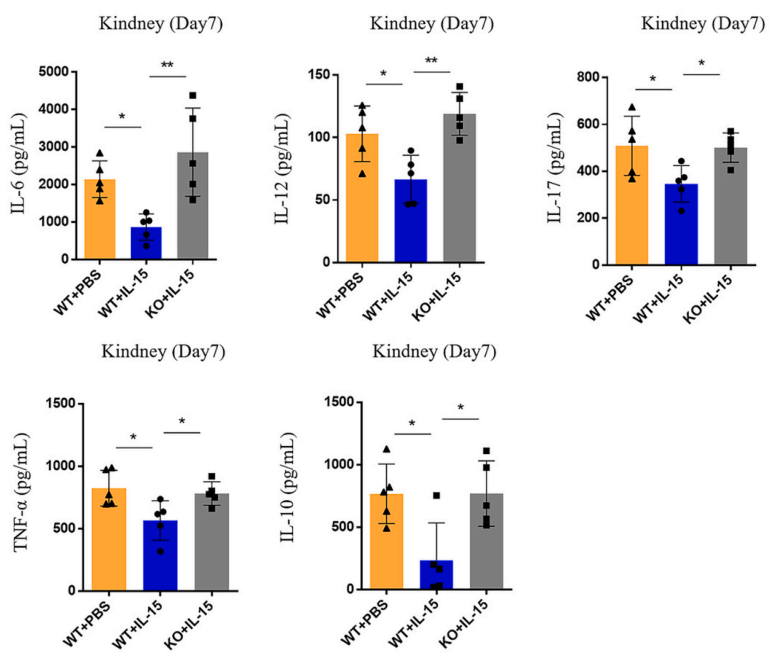
Animal-Free IL-15 Protein, Mouse (His) purchased from MedChemExpress. Usage Cited in: Cytokine. 2025 Sep 17:196:157026. [Abstract]
Serum IL-6, IL-12, IL-17, TNF-α, and IL-10 levels in candidiasis mice treated with/without mouse recombinant IL-15 (Animal-Free IL-15 protein, Mouse (His)) (1.5 μg/kg; i.v.) after 4 days, along with IL-15α−/− candidiasis mice receiving the same treatment (n = 5/group). Animal-Free IL-15 protein, Mouse (His) inhibited an increase in the anti-inflammatory cytokine IL-10; this phenomenon was possibly attributed to immunosuppression during advanced candidiasis stages in mice.


Technical Parameters
-
Species Mouse
-
Source E. coli
-
Tag N-6*His
-
Accession
P48346 (N49-S162)
-
Molecular Construction
-
N-term
-
6*His
-
IL-15 (N49-S162)
Accession # P48346 -
C-term
-
-
Protein Length
Full Length of Mature Protein
-
Synonyms
IL15; Interleukin-15; Interleukin 15; MGC9721; IL-15
-
AA Sequence
NWIDVRYDLEKIESLIQSIHIDTTLYTDSDFHPSCKVTAMNCFLLELQVILHEYSNMTLNETVRNVLYLANSTLSSNKNVAESGCKECEELEEKTFTEFLQSFIRIVQMFINTS
-
Predicted Molecular Mass
14.2 kDa
-
Molecular Weight
Approximately 17 kDa, based on SDS-PAGE under reducing conditions.
-
Purity
≥ 95%, as determined by reducing SDS-PAGE.


Product Properties
Lyophilized powder
1.Lyophilized from a 0.22 μm filtered solution of PBS, pH 7.4.
2.Lyophilized from a 0.22 μm filtered solution of Proleukin buffer, pH 7.5.
Please refer to the lot-specific COA for specific buffer information.
<0.1 EU/μg of the protein by the LAL method.
It is recommended to reconstitute to a concentration of 100-200 μg/mL in ddH2O. For long term storage it is recommended to add a carrier protein (0.1% BSA, 5% HSA, 10% FBS or 5% Trehalose).
Stored at -20°C for 2 years from date of receipt. After reconstitution, it is stable at 4°C for 1 week or -20°C for longer (with carrier protein). It is recommended to freeze aliquots at -20°C or -80°C for extended storage.
Room temperature in continental US; may vary elsewhere.


Documentation
-
Data Sheet (236 KB)
-
SDS (251 KB)
- English - EN (251 KB)
- Français - FR (251 KB)
- Deutsch - DE (251 KB)
- Norwegian - NO (251 KB)
- Español - ES (251 KB)
- Swedish - SV (251 KB)
- Italian - IT (251 KB)
- Korean - KR (251 KB)
- Portuguese - PT (251 KB)
-
Handling Instructions (2659 KB)

Calculators
Concentration (start) × Volume (start) = Concentration (final) × Volume (final)


 Powered by Bioz

