



SCF Protein, Mouse
Based on 3 publication(s) in Google Scholar
SCF proteins are ligands for the KIT receptor-type protein tyrosine kinase and are critical for multiple cellular processes, including survival, proliferation, hematopoiesis, stem cell maintenance, gametogenesis, mast cell development, migration, and melanogenesis.Binding to KIT activates multiple signaling pathways involving PIK3R1, AKT1, GRB2, RAS, RAF1, MAP kinase, STAT family members and PLCG1, producing signaling molecules.SCF Protein, Mouse is the recombinant mouse-derived SCF protein, expressed by E.coli , with tag free.
- Species: Mouse
- Source: E. coli
-
Storage:Stored at -20°C for 2 years from date of receipt. After reconstitution, it is stable at 4°C for 1 week or -20°C for longer (with carrier protein). It is recommended to freeze aliquots at -20°C or -80°C for extended storage.


To place orders, for customer services and technical support, please contact: MedChemExpress USA
Tel: 609-228-6898 E-mail: [email protected] [email protected]


-
 Biological Activity
-
Technical Parameters
-
Product Properties
- Documentation
- Help & FAQs


-

HY-P7062
IL-3 Protein, Mouse -
HY-P7088
TPO/Thrombopoietin Protein, Mouse (CHO) -
HY-P70685
IL-3 Protein, Mouse (HEK293, His) -
HY-P70563
FLT3LG Protein, Mouse (HEK293, His) -
HY-P7063
IL-6 Protein, Mouse -
HY-B0141
Estradiol -
HY-P7088A
TPO/Thrombopoietin Protein, Mouse (HEK293) -
HY-10431
SB-431542 -
HY-P70781
SCF Protein, Human -
HY-10182
Laduviglusib -

HY-N6782
Oligomycin -
HY-P7068
G-CSF Protein, Mouse (CHO)


Biological Activity
Description
SCF proteins are ligands for the KIT receptor-type protein tyrosine kinase and are critical for multiple cellular processes, including survival, proliferation, hematopoiesis, stem cell maintenance, gametogenesis, mast cell development, migration, and melanogenesis.Binding to KIT activates multiple signaling pathways involving PIK3R1, AKT1, GRB2, RAS, RAF1, MAP kinase, STAT family members and PLCG1, producing signaling molecules.SCF Protein, Mouse is the recombinant mouse-derived SCF protein, expressed by E.coli , with tag free.
Background
The stem cell factor (SCF) protein serves as a ligand for the receptor-type protein-tyrosine kinase KIT, playing a crucial role in the regulation of various cellular processes. Its functions encompass the control of cell survival and proliferation, hematopoiesis, stem cell maintenance, gametogenesis, mast cell development, migration, and melanogenesis. Upon binding with KIT, SCF activates multiple signaling pathways, including the phosphorylation of PIK3R1 and subsequent activation of AKT1. The interaction also triggers signaling cascades involving GRB2, RAS, RAF1, and the MAP kinases MAPK1/ERK2 and/or MAPK3/ERK1. Furthermore, SCF and KIT promote the activation of STAT family members (STAT1, STAT3, and STAT5), as well as PLCG1, leading to the production of diacylglycerol and inositol 1,4,5-trisphosphate as cellular signaling molecules. Acting synergistically with other cytokines, likely interleukins, SCF forms a homodimer non-covalently linked and a heterotetramer with KIT, facilitating KIT dimerization and subsequent activation through autophosphorylation.
Verified Bioactivity
Measured in a cell proliferation assay using TF-1 human erythroleukemic cells.The ED50 for this effect is 0.5-12 ng/mL.
MCE Validation Data
-
Purity - SDS-PAGE
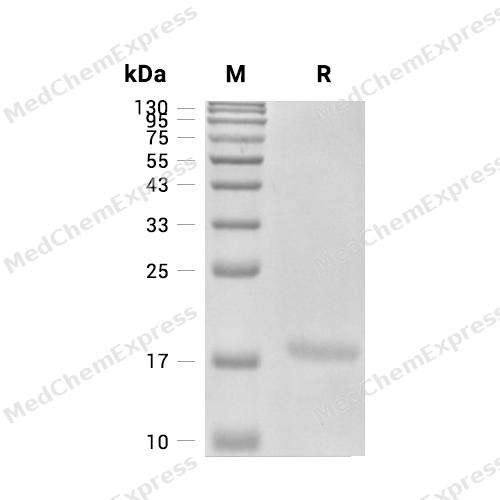
Purity - SDS-PAGE
-
Bioactivity - Cell-Based Assay
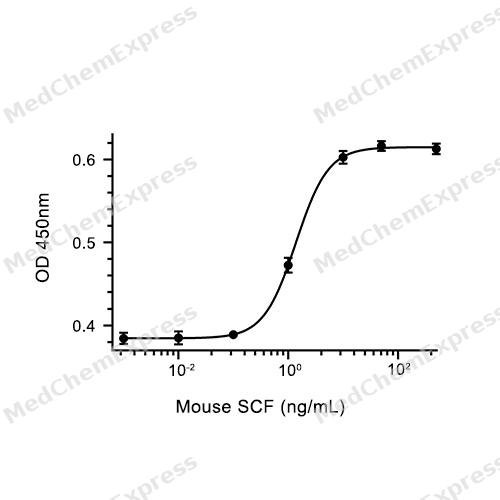
Bioactivity - Cell-Based Assay


Publications (3)
-
Journal Impact Factor
-
Most Recent
-
Cell Mol Gastroenterol Hepatol
Mast Cells Inhibit Stem Cell-driven Epithelial Repair in Inflammatory Bowel Disease via Suppressing Wnt/lrp6/β-Catenin Signaling Pathway. [Abstract]2026;20(5):101741. PMID: 41616821 -
Commun Biol
Endothelial senescence drives intrinsic skin aging via the neuroimmune CGRP-mast cell axis in mice. [Abstract]2025 Nov 26;8(1):1696. PMID: 41299075 -
Int Immunopharmacol
BoNT-A amelliorates itch sensitization in atopic dermatitis mice by inhibiting histamine release. [Abstract]2026 Aug 1:182:116774. PMID: 42102607


Technical Parameters
-
Species Mouse
-
Source E. coli
-
Tag Tag Free
-
Accession
P20826 (K26-A189)
-
Molecular Construction
-
N-term
-
SCF (K26-A189)
Accession # P20826 -
C-term
-
-
Protein Length
Full Length of Soluble KIT ligand Chain
-
Synonyms
KITLG; SLF; Prev. MGF; Familial Progressive Hyperpigmentation 2; SCF; Steel Factor; Mast Cell Growth Factor; C-Kit Ligand; Stem Cell Factor; Kit Ligand; DFNA69; SHEP7; Kitl; DCUA; KL-1; FPHH; FPH2; WS2F; KIT Ligand; SF
-
AA Sequence
KEICGNPVTDNVKDITKLVANLPNDYMITLNYVAGMDVLPSHCWLRDMVIQLSLSLTTLLDKFSNISEGLSNYSIIDKLGKIVDDLVLCMEENAPKNIKESPKRPETRSFTPEEFFSIFNRSIDAFKDFMVASDTSDCVLSSTLGPEKDSRVSVTKPFMLPPVA
-
Predicted Molecular Mass
18.3 kDa
-
Molecular Weight
Approximately 16 kDa, based on SDS-PAGE under reducing conditions.
-
Purity
≥ 95%, as determined by reducing SDS-PAGE.


Product Properties
Lyophilized powder
1.Lyophilized from a 0.22 μm filtered solution of PBS, pH 7.4.
2.Lyophilized from a 0.22 μm filtered solution of 20 mM PB, 150 mM NaCl, pH 7.4.
3.Lyophilized from a 0.22 μm filtered solution of PBS, pH 7.4, 8% trehalose.
Please refer to the lot-specific COA for specific buffer information.
<0.01 EU/μg, determined by LAL method.
It is not recommended to reconstitute to a concentration less than 100 μg/mL in ddH2O. For long term storage it is recommended to add a carrier protein (0.1% BSA, 5% HSA, 10% FBS or 5% Trehalose).
Stored at -20°C for 2 years from date of receipt. After reconstitution, it is stable at 4°C for 1 week or -20°C for longer (with carrier protein). It is recommended to freeze aliquots at -20°C or -80°C for extended storage.
Room temperature in continental US; may vary elsewhere.


Documentation
-
Data Sheet (236 KB)
-
SDS (252 KB)
- English - EN (252 KB)
- Français - FR (252 KB)
- Deutsch - DE (252 KB)
- Norwegian - NO (252 KB)
- Español - ES (252 KB)
- Swedish - SV (252 KB)
- Italian - IT (252 KB)
- Korean - KR (252 KB)
- Portuguese - PT (252 KB)
-
Handling Instructions (2659 KB)

Calculators
Concentration (start) × Volume (start) = Concentration (final) × Volume (final)


 Powered by Bioz

