



IL-15 Protein, Mouse (HEK293, Fc)
Based on 1 publication(s) in Google Scholar
The IL-15 protein is a cytokine that crucially shapes inflammatory and protective immune responses by regulating innate and adaptive immune cells. It stimulates the proliferation and activation of natural killer cells, T cells and B cells, and promotes the secretion of cytokines. IL-15 Protein, Mouse (HEK293, Fc) is the recombinant mouse-derived IL-15 protein, expressed by HEK293 , with C-hFc labeled tag.
- Species: Mouse
- Source: HEK293
-
Storage:Stored at -20°C for 2 years from date of receipt. After reconstitution, it is stable at 4°C for 1 week or -20°C for longer (with carrier protein). It is recommended to freeze aliquots at -20°C or -80°C for extended storage.


To place orders, for customer services and technical support, please contact: MedChemExpress USA
Tel: 609-228-6898 E-mail: [email protected] [email protected]


-
 Biological Activity
-
Technical Parameters
-
Product Properties
- Documentation
- Help & FAQs


-

HY-P7077
IL-2 Protein, Mouse -
HY-P73226
IL-7 Protein, Mouse -
HY-P70666
IL-12 Protein, Mouse (HEK293) -
HY-P70648
TGF beta 1/TGFB1 Protein, Mouse/Rat (HEK293) -
HY-P7361
GM-CSF Protein, Mouse -
HY-P73181
IL-18 Protein, Mouse (solution) -
HY-P7764
MCP-1/CCL2 Protein, Mouse -
HY-P70591
IL-18 Protein, Human -
HY-P7032
IL-12 Protein, Human (HEK293) -
HY-P70685
IL-3 Protein, Mouse (HEK293, His) -
HY-P70642
IL-18 Protein, Mouse (His) -
HY-P71978
IL-15R alpha Protein, Mouse (HEK293, hFc)


Biological Activity
Description
The IL-15 protein is a cytokine that crucially shapes inflammatory and protective immune responses by regulating innate and adaptive immune cells. It stimulates the proliferation and activation of natural killer cells, T cells and B cells, and promotes the secretion of cytokines. IL-15 Protein, Mouse (HEK293, Fc) is the recombinant mouse-derived IL-15 protein, expressed by HEK293 , with C-hFc labeled tag.
Background
The IL-15 protein is a cytokine that plays a crucial role in the development of both inflammatory and protective immune responses against microbial invaders and parasites. It achieves this by modulating immune cells from both the innate and adaptive immune systems. IL-15 stimulates the proliferation and activation of natural killer cells, T-cells, and B-cells, while also promoting the secretion of various cytokines. In monocytes, IL-15 induces the production of chemokines IL8 and monocyte chemotactic protein 1/CCL2, which attract neutrophils and monocytes to sites of infection. Unlike most cytokines, IL-15 is expressed on the surface of IL-15-producing cells in association with its high affinity IL15RA, delivering signals to target cells expressing IL2RB and IL2RG receptor subunits. This binding triggers phosphorylation of JAK1 and JAK3, recruiting and subsequently phosphorylating signal transducer and activator of transcription-3/STAT3 and STAT5. Additionally, in mast cells, IL-15 rapidly phosphorylates STAT6, consequently controlling mast cell survival and the release of cytokines like IL4.
Verified Bioactivity
Measured by its binding ability in a functional ELISA. Immobilized Mouse IL-15 at 2 μg/mL (100 μL/well) can bind biotinylated Human IL-15R alpha, the ED50 for this effect is 10-160 ng/mL.
MCE Validation Data
-
Purity - SDS-PAGE
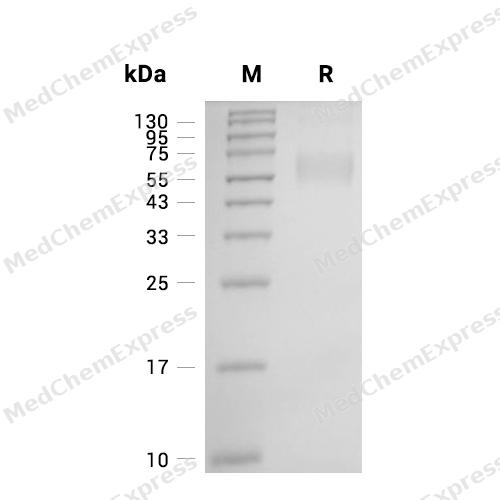
Purity - SDS-PAGE
-
Bioactivity - ELISA
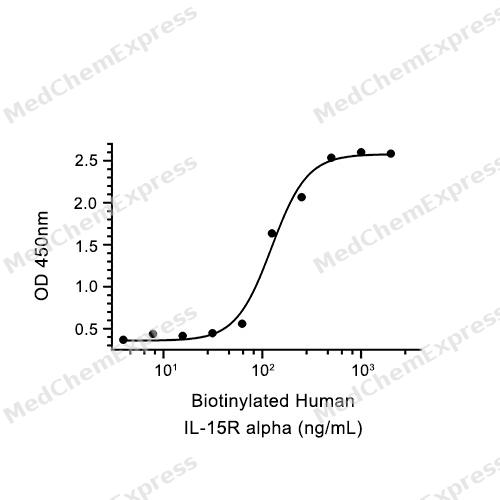
Bioactivity - ELISA


Publications (1)
-
Journal Impact Factor
-
Most Recent


Technical Parameters
-
Species Mouse
-
Source HEK293
-
Tag C-hFc
-
Accession
P48346 (N49-S162)
-
Molecular Construction
-
N-term
-
IL-15 (N49-S162)
Accession # P48346 -
hFc
-
C-term
-
-
Protein Length
Full Length of Mature Protein
-
Synonyms
IL15; Interleukin-15; Interleukin 15; MGC9721; IL-15
-
AA Sequence
NWIDVRYDLEKIESLIQSIHIDTTLYTDSDFHPSCKVTAMNCFLLELQVILHEYSNMTLNETVRNVLYLANSTLSSNKNVAESGCKECEELEEKTFTEFLQSFIRIVQMFINTS
-
Predicted Molecular Mass
39.3 kDa
-
Molecular Weight
Approximately 50-70 kDa, based on SDS-PAGE under reducing conditions, due to the glycosylation.
-
Glycosylation
Yes
-
Purity
≥ 95%, as determined by reducing SDS-PAGE.


Product Properties
Lyophilized powder
Lyophilized a 0.22 μm filtered solution of PBS, pH 7.4, 8% trehalose.
<1 EU/μg, determined by LAL method.
It is not recommended to reconstitute to a concentration less than 100 μg/mL in ddH2O.
Stored at -20°C for 2 years from date of receipt. After reconstitution, it is stable at 4°C for 1 week or -20°C for longer (with carrier protein). It is recommended to freeze aliquots at -20°C or -80°C for extended storage.
Room temperature in continental US; may vary elsewhere.


Documentation
-
Data Sheet (236 KB)
-
SDS (252 KB)
- English - EN (252 KB)
- Français - FR (252 KB)
- Deutsch - DE (252 KB)
- Norwegian - NO (252 KB)
- Español - ES (252 KB)
- Swedish - SV (252 KB)
- Italian - IT (252 KB)
- Korean - KR (252 KB)
- Portuguese - PT (252 KB)
-
Handling Instructions (2659 KB)

Calculators
Concentration (start) × Volume (start) = Concentration (final) × Volume (final)


 Powered by Bioz

