



MIP-3 alpha/CCL20 Protein, Human
Based on 1 publication(s) in Google Scholar
MIP-3 alpha/CCL20 Protein, Human is a CC chemokine that attracts lymphocytes and mild neutrophils by binding to and acting on the chemokine receptor CCR6. It induces intracellular calcium mobilization and mediates cancer, various autoimmune diseases, and antimicrobial effects. MIP-3 alpha/CCL20 Protein, Human is a recombinant human CCL20 (A27-M96) expressed by E. coli.
- Species: Human
- Source: E. coli
-
Storage:Stored at -20°C for 2 years from date of receipt. After reconstitution, it is stable at 4°C for 1 week or -20°C for longer (with carrier protein). It is recommended to freeze aliquots at -20°C or -80°C for extended storage.


To place orders, for customer services and technical support, please contact: MedChemExpress USA
Tel: 609-228-6898 E-mail: [email protected] [email protected]


-
 Biological Activity
-
Technical Parameters
-
Product Properties
- Documentation
- References
- Help & FAQs




Biological Activity
Description
MIP-3 alpha/CCL20 Protein, Human is a CC chemokine that attracts lymphocytes and mild neutrophils by binding to and acting on the chemokine receptor CCR6. It induces intracellular calcium mobilization and mediates cancer, various autoimmune diseases, and antimicrobial effects. MIP-3 alpha/CCL20 Protein, Human is a recombinant human CCL20 (A27-M96) expressed by E. coli[1].
Background
CCL20, also known as macrophage inflammatory protein 3 alpha (MIP-3-alpha) and liver-activated regulatory chemokine (LARC), is a small cytokine belonging to the CC chemokine family and is located on chromosome 2 in the human genome. It is expressed at lower levels in the thymus, testis, prostate and intestine. CCL20 binds to and acts as a chemokine receptor CCR6 and synergistically inhibits the function of CD8 T cells with CCR6. CCL20 has antimicrobial activity and has been implicated in autoimmune diseases such as inflammatory bowel disease, rheumatoid arthritis, and psoriasis, as well as oncological diseases. It can induce Tregs to invade tumor tissue, recruit dendritic cells to promote immunosuppression, and induce endothelial cell proliferation and neointima formation[1][2].
In Vitro
CCL20 (human, 0-50 μg/mL) inhibits B. abortus 2308 with the LD50 (the dose that achieves 50% reduction of CFU) > 50 μg/mL, effects on B. abortus RB51 in a dose-dependent manner with a LD50 of 8.7 μg/mL and demonstrates anti-E. coli activity with a LD50 of 1.5 μg/mL[3].
CCL20 is up-regulated in human colon adenocarcinoma cell lines stimulated by pro-inflammatory cytokines IL-1α and TNF-α and can function as an NF-κB target gene[4].
Verified Bioactivity
1.Fully biologically active when compared to standard. The biological activity determined by a chemotaxis bioassay using human T-lymphocytes is in a concentration range of 10.0-50.0 ng/mL.
2.Measured by its ability to chemoattract THP-1 human acute monocytic leukemia cells. The ED50 for this effect is ≤10.35 ng/mL, corresponding to a specific activity is ≥9.662×10⁴ U/mg.
3.Measured by its ability to chemoattract BaF3 mouse pro-B cells transfected with human CCR6. The ED50 for this effect is <2 ng/mL, corresponding to a specific activity is >5×10⁵ U/mg.
MCE Validation Data
-
Purity - SDS-PAGE
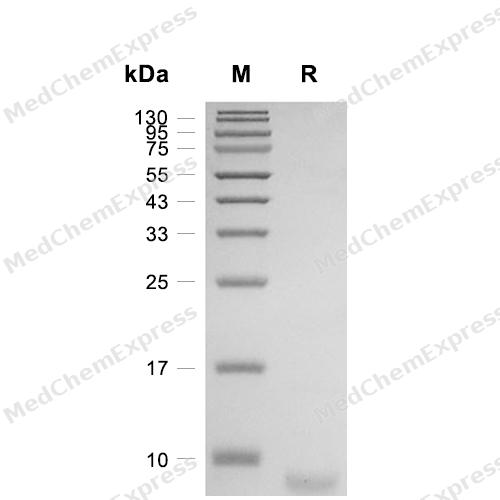
Purity - SDS-PAGE
-
Bioactivity - Cell-Based Assay
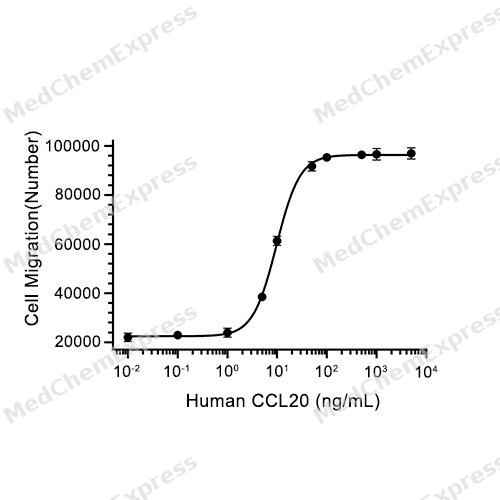
Bioactivity - Cell-Based Assay


Publications (1)
-
Journal Impact Factor
-
Most Recent


Technical Parameters
-
Species Human
-
Source E. coli
-
Tag Tag Free
-
Accession
P78556-1 (A27-M96)
-
Molecular Construction
-
N-term
-
CCL20 (A27-M96)
Accession # P78556-1 -
C-term
-
-
Protein Length
Full Length of Isoform-1
-
Synonyms
CCL20; Chemokine (C-C Motif) Ligand 20; Prev. SCYA20; C-C Motif Chemokine 20; LARC; CC Chemokine LARC; MIP-3a; MIP-3-Alpha; ST38; Exodus-1; CKb4; MIP3A; Small Inducible Cytokine Subfamily A (Cys-Cys), Member 20; Beta Chemokine Exodus-1; Liver And Activati
-
AA Sequence
ASNFDCCLGYTDRILHPKFIVGFTRQLANEGCDINAIIFHTKKKLSVCANPKQTWVKYIVRLLSKKVKNM
-
Predicted Molecular Mass
8 kDa
-
Molecular Weight
Approximately 9 kDa, based on SDS-PAGE under reducing conditions.
-
Purity
≥ 95%, as determined by reducing SDS-PAGE.


Product Properties
Lyophilized powder
1.Lyophilized from a 0.22 μm filtered solution of 20 mM PB, 100 mM NaCl, pH 7.4.
2.Lyophilized from a 0.22 μm filtered solution of PBS, pH 7.4.
Please refer to the lot-specific COA for specific buffer information.
<1 EU/μg, determined by LAL method.
It is not recommended to reconstitute to a concentration less than 100 μg/mL in ddH2O. For long term storage it is recommended to add a carrier protein (0.1% BSA, 5% HSA, 10% FBS or 5% Trehalose).
Stored at -20°C for 2 years from date of receipt. After reconstitution, it is stable at 4°C for 1 week or -20°C for longer (with carrier protein). It is recommended to freeze aliquots at -20°C or -80°C for extended storage.
Room temperature in continental US; may vary elsewhere.


Documentation
-
Data Sheet (264 KB)
-
SDS (252 KB)
- English - EN (252 KB)
- Français - FR (252 KB)
- Deutsch - DE (252 KB)
- Norwegian - NO (252 KB)
- Español - ES (252 KB)
- Swedish - SV (252 KB)
- Italian - IT (252 KB)
- Korean - KR (252 KB)
- Portuguese - PT (252 KB)
-
Handling Instructions (2659 KB)


References
[1]. Louis Boafo Kwantwi, et al. Multifaceted roles of CCL20 (C-C motif chemokine ligand 20): mechanisms and communication networks in breast cancer progression. Bioengineered. 2021 Dec;12(1):6923-6934. [Content Brief]
[2]. Skovdahl HK, et al. C-C Motif Ligand 20 (CCL20) and C-C Motif Chemokine Receptor 6 (CCR6) in Human Peripheral Blood Mononuclear Cells: Dysregulated in Ulcerative Colitis and a Potential Role for CCL20 in IL-1β Release. Int J Mol Sci. 2018 Oct 20;19(10). [Content Brief]
[3]. M Baba, et al. Identification of CCR6, the specific receptor for a novel lymphocyte-directed CC chemokine LARC. J Biol Chem. 1997 Jun 6;272(23):14893-8. [Content Brief]
[4]. Benkheil M, et al. CCL20, a direct-acting pro-angiogenic chemokine induced by hepatitis C virus (HCV): Potential role in HCV-related liver cancer. Exp Cell Res. 2018 Nov 15;372(2):168-177. [Content Brief]
[5]. M Soledad Hielpos, et al. CCL20 and Beta-Defensin 2 Production by Human Lung Epithelial Cells and Macrophages in Response to Brucella abortus Infection. PLoS One. 2015 Oct 8;10(10):e0140408. [Content Brief]
[6]. A Izadpanah, et al. Regulated MIP-3alpha/CCL20 production by human intestinal epithelium: mechanism for modulating mucosal immunity. Am J Physiol Gastrointest Liver Physiol. 2001 Apr;280(4):G710-9. [Content Brief]

Calculators
Concentration (start) × Volume (start) = Concentration (final) × Volume (final)


 Powered by Bioz

