



TIGAR Protein, Human (TAT)
Based on 1 Customer Validation
TIGAR is a protein that helps cells survive stress by regulating glycolysis and promoting cell survival. It reduces reactive oxygen species (ROS) levels and protects against oxidative damage. TIGAR also plays a role in promoting tissue regeneration and has neuroprotective effects. In cancer cells, TIGAR promotes DNA repair and is involved in tumor progression. TIGAR Protein, Human (TAT) is the recombinant human-derived TIGAR protein, expressed by E. coli , with C-TAT labeled tag.
- Species: Human
- Source: E. coli
-
Storage:Stored at -80°C for 1 year from date of receipt. It is stable at -20°C for 3 months after opening. It is recommended to freeze aliquots at -80°C for extended storage. Avoid repeated freeze-thaw cycles.


To place orders, for customer services and technical support, please contact: MedChemExpress USA
Tel: 609-228-6898 E-mail: [email protected] [email protected]


-
 Biological Activity
-
Technical Parameters
-
Product Properties
- Documentation
- Help & FAQs




Biological Activity
Description
TIGAR is a protein that helps cells survive stress by regulating glycolysis and promoting cell survival. It reduces reactive oxygen species (ROS) levels and protects against oxidative damage. TIGAR also plays a role in promoting tissue regeneration and has neuroprotective effects. In cancer cells, TIGAR promotes DNA repair and is involved in tumor progression. TIGAR Protein, Human (TAT) is the recombinant human-derived TIGAR protein, expressed by E. coli , with C-TAT labeled tag.
Background
TIGAR (TP53-induced glycolysis and apoptosis regulator) functions as a fructose-bisphosphatase, hydrolyzing fructose-2,6-bisphosphate and fructose-1,6-bisphosphate. Operating as a negative regulator of glycolysis, TIGAR reduces intracellular levels of fructose-2,6-bisphosphate in a p53/TP53-dependent manner, thereby activating the pentose phosphate pathway (PPP) and promoting NADPH production. This regulatory activity contributes to the cellular defense against oxidative or metabolic stress-induced cell death by decreasing reactive oxygen species (ROS) content. TIGAR's role extends to protecting cells during hypoxia, where it lowers mitochondria ROS levels independently of its fructose-bisphosphatase activity through a mechanism involving hexokinase 2 (HK2). In contexts such as cardiac damage stress, TIGAR mediates p53-induced inhibition of myocyte mitophagy, influencing ROS levels and exacerbating apoptotic myocyte cell death. Additionally, TIGAR plays vital roles in adult intestinal regeneration, neuroprotection against ischemic brain damage, and promoting cancer cell survival by enhancing DNA repair through PPP activation in response to hypoxia and/or genome stress-induced DNA damage.
Verified Bioactivity
Measured by its ability to cleave a substrate, p-Nitrophenyl phosphate (pNPP). The specific activity is 19.321 pmol/min/µg that incubate at 37°C for 3h.
MCE Validation Data
-
Purity - SDS-PAGE
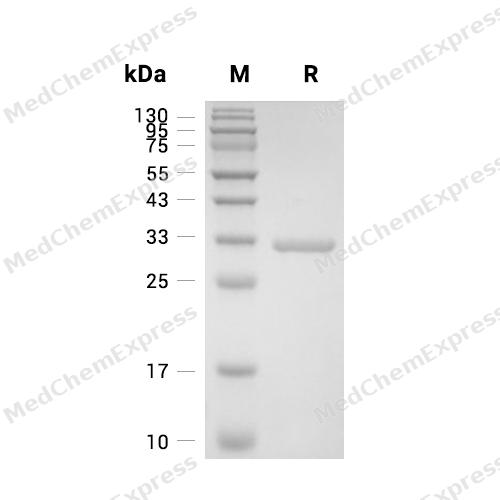
Purity - SDS-PAGE


Technical Parameters
-
Species Human
-
Source E. coli
-
Tag C-TAT
-
Accession
Q9NQ88 (M1-R270)
-
Molecular Construction
-
N-term
-
TIGAR (M1-R270)
Accession # Q9NQ88 -
TAT
-
C-term
-
-
Protein Length
Full length
-
Synonyms
TIGAR; Probable Fructose-2,6-Bisphosphatase TIGAR; Prev. C12orf5; Chromosome 12 Open Reading Frame 5; TP53-Induced Glycolysis And Apoptosis Regulator; Transactivated By NS3TP2 Protein; Fructose-2,6-Bisphosphatase TIGAR; FR2BP; TP53-Induced Glycolysis Regu
-
AA Sequence
MARFALTVVRHGETRFNKEKIIQGQGVDEPLSETGFKQAAAAGIFLNNVKFTHAFSSDLMRTKQTMHGILERSKFCKDMTVKYDSRLRERKYGVVEGKALSELRAMAKAAREECPVFTPPGGETLDQVKMRGIDFFEFLCQLILKEADQKEQFSQGSPSNCLETSLAEIFPLGKNHSSKVNSDSGIPGLAASVLVVSHGAYMRSLFDYFLTDLKCSLPATLSRSELMSVTPNTGMSLFIINFEEGREVKPTVQCICMNLQDHLNGLTETR
-
Predicted Molecular Mass
31.6 kDa
-
Molecular Weight
Approximately 32 kDa, based on SDS-PAGE under reducing conditions.
-
Purity
≥ 95%, as determined by reducing SDS-PAGE.


Product Properties
Solution
Supplied as a 0.22 μm filtered solution in 50 mM Tris-HCl, 300 mM NaCl, pH 8.0, 10% Glycerol.
Note: For SPR assay, please replace the buffer. Primary amine components (e.g., Tris, imidazole) can affect protein-coupled chips.
<1 EU/μg, determined by LAL method.
Stored at -80°C for 1 year from date of receipt. It is stable at -20°C for 3 months after opening. It is recommended to freeze aliquots at -80°C for extended storage. Avoid repeated freeze-thaw cycles.
Shipping with dry ice.


Documentation
-
Data Sheet (237 KB)
-
SDS (254 KB)
- English - EN (254 KB)
- Français - FR (254 KB)
- Deutsch - DE (254 KB)
- Norwegian - NO (254 KB)
- Español - ES (254 KB)
- Swedish - SV (254 KB)
- Italian - IT (254 KB)
- Korean - KR (254 KB)
- Portuguese - PT (254 KB)
-
Handling Instructions (2659 KB)

Calculators
Concentration (start) × Volume (start) = Concentration (final) × Volume (final)


 Powered by Bioz

