



Repaglinide-d5

Based on 1 Customer Validation
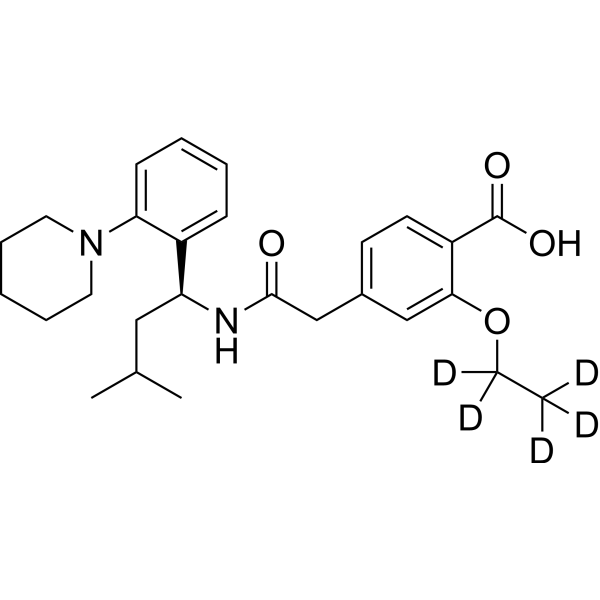
Repaglinide-d5 is deuterium labeled Repaglinide. Repaglinide is an insulin secretagogue for the treatment of type-2 diabetes mellitus.
For research use only. We do not sell to patients.
- Purity : 98.67%
- CAS No.: 1217709-85-7
- Formula: C27H31D5N2O4
- Molecular Weight:457.62
-
Storage:Powder -20°C, 3 years , 4°C, 2 years ; In solvent -80°C, 6 months , -20°C, 1 month

To place orders, for customer services and technical support, please contact: MedChemExpress USA
Tel: 609-228-6898 E-mail: [email protected] [email protected]


-
 Biological Activity
-
Chemical Information
-
Solvent & Solubility
- Protocols
- Purity & Documentation
- References
-
 Help & FAQs




Biological Activity
Description
In Vitro
Repaglinide reduces postprandial glucose levels by enhancing the early phase of insulin secretion and increasing the total amount of insulin secreted[1].
MedChemExpress (MCE) has not independently confirmed the accuracy of these methods. They are for reference only. Further protocols information, click here.
Application
1. This compound can be used as a tracer
2. This compound can be used as an internal standard for quantitative analysis by NMR, GC-MS, or LC-MS.


Chemical Information
-
CAS No. 1217709-85-7
-
Unlabeled CAS 135062-02-1
-
Appearance Solid
-
Molecular Weight 457.62
-
Formula C27H31D5N2O4
-
Color White to off-white
-
SMILES
O=C(O)C1=CC=C(CC(N[C@H](C2=CC=CC=C2N3CCCCC3)CC(C)C)=O)C=C1OC([2H])([2H])C([2H])([2H])[2H]
-
Synonyms
AG-EE 623ZW d5
-
Shipping
Room temperature in continental US; may vary elsewhere.
-
Storage
Powder -20°C 3 years 4°C 2 years In solvent -80°C 6 months -20°C 1 month


Solvent & Solubility
In Vitro:
DMSO : ≥ 50 mg/mL (109.26 mM; Hygroscopic DMSO has a significant impact on the solubility of product, please use newly opened DMSO)
* "≥" means soluble, but saturation unknown.
Please refer to the solubility information to select the appropriate solvent. Once prepared, please aliquot and store the solution to prevent product inactivation from repeated freeze-thaw cycles.
Storage method and period of stock solution: -80°C, 6 months; -20°C, 1 month. When stored at -80°C, please use it within 6 months. When stored at -20°C, please use it within 1 month.
Please refer to the solubility information to select the appropriate solvent. Once prepared, please aliquot and store the solution to prevent product inactivation from repeated freeze-thaw cycles.
Storage method and period of stock solution: -80°C, 6 months; -20°C, 1 month. When stored at -80°C, please use it within 6 months. When stored at -20°C, please use it within 1 month.
Concentration (start) × Volume (start) = Concentration (final) × Volume (final)

Protocols
-
Research Protocol for Endocrine Diseases
Endocrine diseases often arise from disrupted hormone production, hormone signaling, or target-tissue responsiveness; for diabetes-focused endocrine disease models, insulin signaling regulates glucose uptake, hepatic glucose output, lipid metabolism, and β-cell compensation. Type 2 diabetes develops through interacting defects in insulin resistance, β-cell dysfunction, adipose inflammation, hepatic glucose overproduction, altered incretin signaling, and ectopic lipid metabolism. A major unresolved question is whether endocrine dysfunction is driven primarily by target-tissue insulin resistance, intrinsic β-cell failure, immune/inflammatory stress, or combined multi-organ failure that differs by disease stage.
-
Research Protocol for Metabolic Diseases
AMP-activated protein kinase, AMPK, is a conserved cellular energy sensor that responds to reduced cellular energy status and coordinates metabolism by increasing ATP-generating catabolic pathways while suppressing ATP-consuming anabolic processes. In metabolic disease research, the AMPK pathway is experimentally relevant because it regulates hepatic lipid synthesis, fatty acid oxidation, glucose production, skeletal-muscle glucose disposal, mTORC1-linked biosynthesis, autophagy, mitochondrial homeostasis, and whole-body energy balance. The central pathway logic is that energy stress, metformin, exercise-like stimulation, or direct AMPK activators increase AMPKα Thr172 phosphorylation and downstream substrate phosphorylation, including ACC and RAPTOR. Phosphorylation of ACC suppresses lipogenesis and supports fatty acid oxidation, whereas phosphorylation of RAPTOR suppresses mTORC1 signaling and links cellular energy status to growth and protein synthesis control. The pathway is linked


Purity & Documentation
-
Data Sheet (273 KB)
-
SDS (393 KB)
- English - EN (393 KB)
- Français - FR (393 KB)
- Deutsch - DE (393 KB)
- Norwegian - NO (393 KB)
- Español - ES (393 KB)
- Swedish - SV (393 KB)
- Italian - IT (393 KB)
- Korean - KR (393 KB)
- Portuguese - PT (393 KB)
-
Handling Instructions (2659 KB)
References


Complete Stock Solution Preparation Table
Please refer to the solubility information to select the appropriate solvent. Once prepared, please aliquot and store the solution to prevent product inactivation from repeated freeze-thaw cycles.
Storage method and period of stock solution: -80°C, 6 months; -20°C, 1 month. When stored at -80°C, please use it within 6 months. When stored at -20°C, please use it within 1 month.
| Optional Solvent | Concentration Solvent Mass | 1 mg | 5 mg | 10 mg | 25 mg |
|---|---|---|---|---|---|
| DMSO | 1 mM | 2.1852 mL | 10.9261 mL | 21.8522 mL | 54.6305 mL |
| 5 mM | 0.4370 mL | 2.1852 mL | 4.3704 mL | 10.9261 mL | |
| 10 mM | 0.2185 mL | 1.0926 mL | 2.1852 mL | 5.4630 mL | |
| 15 mM | 0.1457 mL | 0.7284 mL | 1.4568 mL | 3.6420 mL | |
| 20 mM | 0.1093 mL | 0.5463 mL | 1.0926 mL | 2.7315 mL | |
| 25 mM | 0.0874 mL | 0.4370 mL | 0.8741 mL | 2.1852 mL | |
| 30 mM | 0.0728 mL | 0.3642 mL | 0.7284 mL | 1.8210 mL | |
| 40 mM | 0.0546 mL | 0.2732 mL | 0.5463 mL | 1.3658 mL | |
| 50 mM | 0.0437 mL | 0.2185 mL | 0.4370 mL | 1.0926 mL | |
| 60 mM | 0.0364 mL | 0.1821 mL | 0.3642 mL | 0.9105 mL | |
| 80 mM | 0.0273 mL | 0.1366 mL | 0.2732 mL | 0.6829 mL | |
| 100 mM | 0.0219 mL | 0.1093 mL | 0.2185 mL | 0.5463 mL |


Repaglinide-d5 Related Classifications
HY-15209S Related Classifications
 Powered by Bioz