



S1P1 agonist III

Based on 1 Customer Validation
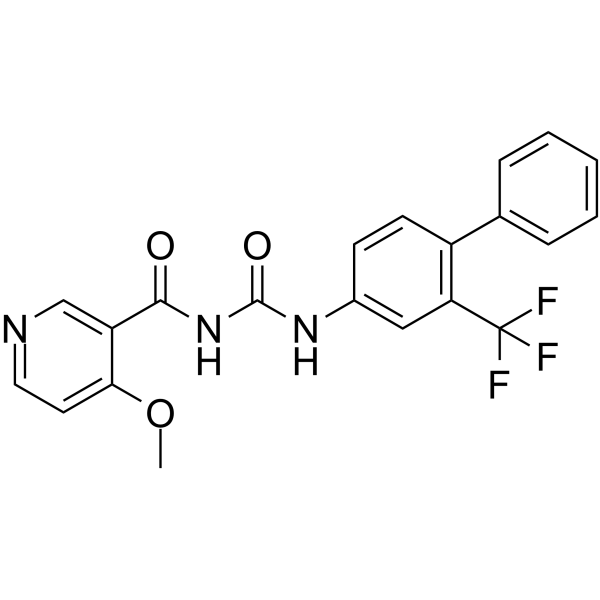
S1P1 agonist III is an orally active hS1P1 agonist with an EC50 value of 18 nM. S1P1 agonist III shows limited activity against hS1P3. S1P1 agonist III can be used in the research of multiple sclerosis.
For research use only. We do not sell to patients.
- Purity : 99.64%
- CAS No.: 1324003-64-6
- Formula: C21H16F3N3O3
- Molecular Weight:415.37
-
Storage:Powder -20°C, 3 years , 4°C, 2 years ; In solvent -80°C, 2 years , -20°C, 1 year

To place orders, for customer services and technical support, please contact: MedChemExpress USA
Tel: 609-228-6898 E-mail: [email protected] [email protected]


-
 Biological Activity
-
Chemical Information
-
Solvent & Solubility
- Purity & Documentation
- References
-
 Help & FAQs


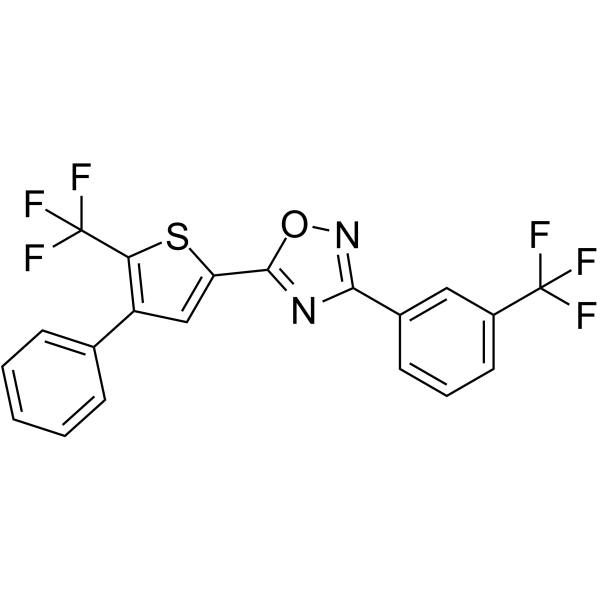
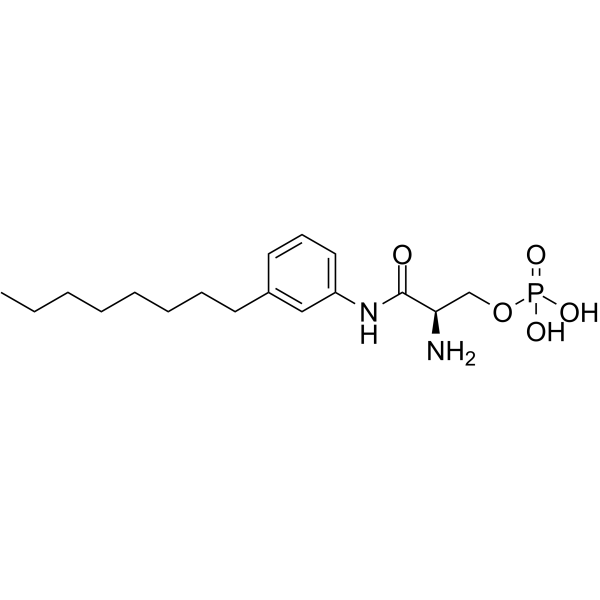
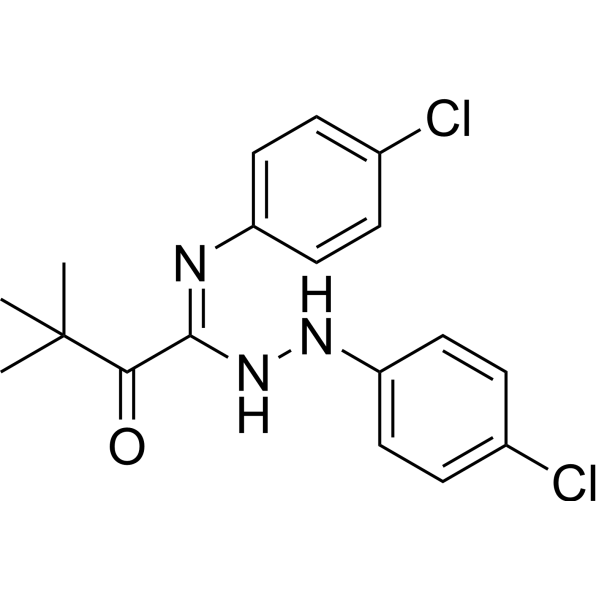
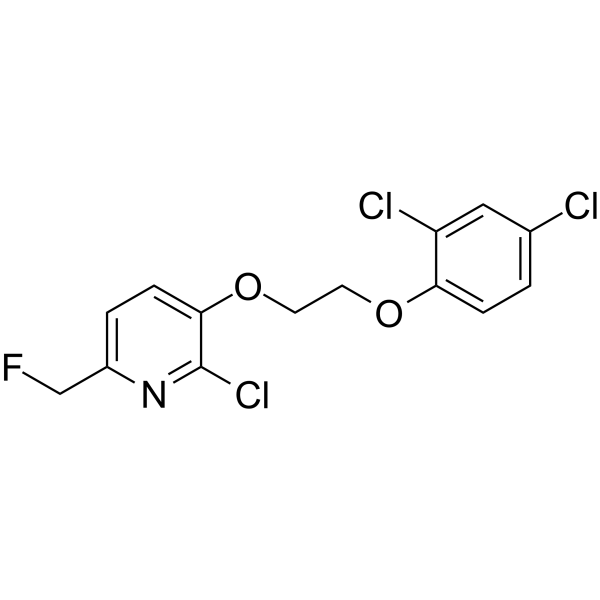


Biological Activity
Description
Cellular Effect
|
Cell Line

|
Type | Value | Description | References |
|---|---|---|---|---|
| CHO-K1 | EC50 |
>25 μM
Compound: 4
|
Agonist activity at human S1P3 receptor expressed in CHO-K1 cells co-expressing Gq/i5 G-protein assessed as calcium mobilization by FLIPR assay
Agonist activity at human S1P3 receptor expressed in CHO-K1 cells co-expressing Gq/i5 G-protein assessed as calcium mobilization by FLIPR assay
|
[PMID: 22104144] |
| CHO-K1 | EC50 |
>25 μM
Compound: 8
|
Agonist activity at human S1P2 expressed in CHO-K1 cells coexpressing Gq/i5 assessed as intracellular calcium release by fluorimetry
Agonist activity at human S1P2 expressed in CHO-K1 cells coexpressing Gq/i5 assessed as intracellular calcium release by fluorimetry
|
[PMID: 24900263] |
| CHO-K1 | EC50 |
>25 μM
Compound: 8
|
Agonist activity at human S1P3 expressed in CHO-K1 cells coexpressing Gq/i5 assessed as intracellular calcium release by fluorimetry
Agonist activity at human S1P3 expressed in CHO-K1 cells coexpressing Gq/i5 assessed as intracellular calcium release by fluorimetry
|
[PMID: 24900263] |
| CHO-K1 | EC50 |
>50 μM
Compound: 8
|
Agonist activity at human S1P4 expressed in CHO-K1 cells coexpressing Gq/i5 assessed as calcium mobilization-induced bioluminescence change after measured for 90 secs by fluorimetry
Agonist activity at human S1P4 expressed in CHO-K1 cells coexpressing Gq/i5 assessed as calcium mobilization-induced bioluminescence change after measured for 90 secs by fluorimetry
|
[PMID: 24900263] |
| CHO-K1 | EC50 |
4.3 μM
Compound: 8
|
Agonist activity at human S1P5 expressed in CHO-K1 cells coexpressing Gq/i5 assessed as calcium mobilization-induced bioluminescence change measured for 90 secs by fluorimetry
Agonist activity at human S1P5 expressed in CHO-K1 cells coexpressing Gq/i5 assessed as calcium mobilization-induced bioluminescence change measured for 90 secs by fluorimetry
|
[PMID: 24900263] |
| U2OS | EC50 |
0.035 μM
Compound: 4
|
Agonist activity at human S1P1 receptor expressed in human U2OS cells co-expressing eGFP assessed as receptor internalization into cytoplasm using Hoechst dye staining
Agonist activity at human S1P1 receptor expressed in human U2OS cells co-expressing eGFP assessed as receptor internalization into cytoplasm using Hoechst dye staining
|
[PMID: 22104144] |
| U2OS | EC50 |
0.035 μM
Compound: 8
|
Agonist activity at human S1P1 expressed in U2OS cells coexpressing eGFP assessed as receptor internalization after 1 hr by microscopic analysis
Agonist activity at human S1P1 expressed in U2OS cells coexpressing eGFP assessed as receptor internalization after 1 hr by microscopic analysis
|
[PMID: 24900263] |
In Vitro
S1P1 agonist III (Compound 22) induces potent internalization of hS1P1 receptors in U2OS cells with an EC50 of 0.018 μM[1].
S1P1 agonist III shows minimal agonist activity at hS1P3 receptors in transfected CHO-K1 cells, with an EC50 greater than 25 μM[1].
S1P1 agonist III exhibits moderate permeability across LLC-PK1 porcine proximal tubule cells with no significant efflux, as shown by a Papp of 2.5 × 10⁻⁶ cm/s and an efflux ratio of 1.0[1].
S1P1 agonist III binds to 91.7% of rat plasma proteins under equilibrium conditions[1].
S1P1 agonist III is highly stable in rat liver microsomes, with an intrinsic clearance of less than 14 μL/min/mg microsomal protein[1].
MedChemExpress (MCE) has not independently confirmed the accuracy of these methods. They are for reference only.
Parmacokinetics
In Vivo
MedChemExpress (MCE) has not independently confirmed the accuracy of these methods. They are for reference only.
-
Animal Model:Lewis rats (female)[1]
-
Dosage:1 mg/kg; 3 mg/kg
-
Administration:p.o.; single dose
-
Result:Achieved statistically significant reduction of circulating blood lymphocytes at 24 hours postdose.
Caused an 88% reduction in lymphocytes relative to vehicle at 3 mg/kg dose.


Chemical Information
-
CAS No. 1324003-64-6
-
Appearance Solid
-
Molecular Weight 415.37
-
Formula C21H16F3N3O3
-
Color White to off-white
-
SMILES
COC1=CC=NC=C1C(NC(NC2=CC(C(F)(F)F)=C(C3=CC=CC=C3)C=C2)=O)=O
-
Shipping
Room temperature in continental US; may vary elsewhere.
-
Storage
Powder -20°C 3 years 4°C 2 years In solvent -80°C 2 years -20°C 1 year


Solvent & Solubility
In Vitro:
DMSO : 62.5 mg/mL (150.47 mM; Need ultrasonic; Hygroscopic DMSO has a significant impact on the solubility of product, please use newly opened DMSO)
Please refer to the solubility information to select the appropriate solvent. Once prepared, please aliquot and store the solution to prevent product inactivation from repeated freeze-thaw cycles.
Storage method and period of stock solution: -80°C, 2 years; -20°C, 1 year. When stored at -80°C, please use it within 2 years. When stored at -20°C, please use it within 1 year.
Please refer to the solubility information to select the appropriate solvent. Once prepared, please aliquot and store the solution to prevent product inactivation from repeated freeze-thaw cycles.
Storage method and period of stock solution: -80°C, 2 years; -20°C, 1 year. When stored at -80°C, please use it within 2 years. When stored at -20°C, please use it within 1 year.
Concentration (start) × Volume (start) = Concentration (final) × Volume (final)
In Vivo:
Select the appropriate dissolution method based on your experimental animal and administration route.
- For the following dissolution methods, please ensure to first prepare a clear stock solution using an In Vitro approach and then sequentially add co-solvents:
- To ensure reliable experimental results, the clarified stock solution can be appropriately stored based on storage conditions. As for the working solution for In Vivo experiments, it is recommended to prepare freshly and use it on the same day.
- The percentages shown for the solvents indicate their volumetric ratio in the final prepared solution. If precipitation or phase separation occurs during preparation, heat and/or sonication can be used to aid dissolution.
Add each solvent one by one: 10% DMSO 40% PEG300 5% Tween-80 45% Saline
Solubility: ≥ 2.08 mg/mL (5.01 mM); Clear solution
This protocol yields a clear solution of ≥ 2.08 mg/mL (saturation unknown).
Taking 1 mL working solution as an example, add 100 μL DMSO stock solution (20.8 mg/mL) to 400 μL PEG300, and mix evenly; then add 50 μL Tween-80 and mix evenly; then add 450 μL Saline to adjust the volume to 1 mL.
Preparation of Saline: Dissolve 0.9 g sodium chloride in ddH₂O and dilute to 100 mL to obtain a clear Saline solution.
Add each solvent one by one: 10% DMSO 90% (20% SBE-β-CD in Saline)
Solubility: ≥ 2.08 mg/mL (5.01 mM); Clear solution
This protocol yields a clear solution of ≥ 2.08 mg/mL (saturation unknown).
Taking 1 mL working solution as an example, add 100 μL DMSO stock solution (20.8 mg/mL) to 900 μL 20% SBE-β-CD in Saline, and mix evenly.
Preparation of 20% SBE-β-CD in Saline (4°C, storage for one week): 2 g SBE-β-CD powder is dissolved in 10 mL Saline, completely dissolve until clear.
In Vivo Dissolution Calculator
Please enter the basic information of animal experiments:
-
-
-
-
Recommended: Prepare an additional quantity of animals to account for potential losses during experiments.
Please enter your animal formula composition:
-
%DMSO +
Recommended: Keep the proportion of DMSO in working solution below 2% if your animal is weak.
-
%+
-
+%Tween-80 + +
-
%Saline +
The co-solvents required include: DMSO, . All of co-solvents are available by MedChemExpress (MCE). , Tween 80. All of co-solvents are available by MedChemExpress (MCE).
Working solution concentration: 0.22 mg/mL
Method for preparing stock solution: mg drug dissolved in μL DMSO. Stock solution concentration: mg/mL.
1. Take μL DMSO stock solution;
2. Add μL .
μL , mix evenly;
3. Then add μL Tween 80, mix evenly;
4. Then add μL
Please ensure that the stock solution in the first step is dissolved to a clear state, and add co-solvents in sequence. You can use ultrasonic heating (ultrasonic cleaner, recommended frequency 20-40 kHz), vortexing, etc. to assist dissolution.


Purity & Documentation
-
Data Sheet (274 KB)
-
SDS (251 KB)
- English - EN (251 KB)
- Français - FR (251 KB)
- Deutsch - DE (251 KB)
- Norwegian - NO (251 KB)
- Español - ES (251 KB)
- Swedish - SV (251 KB)
- Italian - IT (251 KB)
- Korean - KR (251 KB)
- Portuguese - PT (251 KB)
-
Handling Instructions (2659 KB)
References


Complete Stock Solution Preparation Table
Please refer to the solubility information to select the appropriate solvent. Once prepared, please aliquot and store the solution to prevent product inactivation from repeated freeze-thaw cycles.
Storage method and period of stock solution: -80°C, 2 years; -20°C, 1 year. When stored at -80°C, please use it within 2 years. When stored at -20°C, please use it within 1 year.
| Optional Solvent | Concentration Solvent Mass | 1 mg | 5 mg | 10 mg | 25 mg |
|---|---|---|---|---|---|
| DMSO | 1 mM | 2.4075 mL | 12.0375 mL | 24.0749 mL | 60.1873 mL |
| 5 mM | 0.4815 mL | 2.4075 mL | 4.8150 mL | 12.0375 mL | |
| 10 mM | 0.2407 mL | 1.2037 mL | 2.4075 mL | 6.0187 mL | |
| 15 mM | 0.1605 mL | 0.8025 mL | 1.6050 mL | 4.0125 mL | |
| 20 mM | 0.1204 mL | 0.6019 mL | 1.2037 mL | 3.0094 mL | |
| 25 mM | 0.0963 mL | 0.4815 mL | 0.9630 mL | 2.4075 mL | |
| 30 mM | 0.0802 mL | 0.4012 mL | 0.8025 mL | 2.0062 mL | |
| 40 mM | 0.0602 mL | 0.3009 mL | 0.6019 mL | 1.5047 mL | |
| 50 mM | 0.0481 mL | 0.2407 mL | 0.4815 mL | 1.2037 mL | |
| 60 mM | 0.0401 mL | 0.2006 mL | 0.4012 mL | 1.0031 mL | |
| 80 mM | 0.0301 mL | 0.1505 mL | 0.3009 mL | 0.7523 mL | |
| 100 mM | 0.0241 mL | 0.1204 mL | 0.2407 mL | 0.6019 mL |


S1P1 agonist III Related Classifications
HY-12835 Related Classifications
 Powered by Bioz