317 Results for "

ternary complex

" in MedChemExpress (MCE) Product Catalog:
Products (317)

317 Results for "ternary complex" in MCE Product Catalog:

Cat. No.: HY-154860
CAS No.: 2642231-19-2
Purity:  97.38%
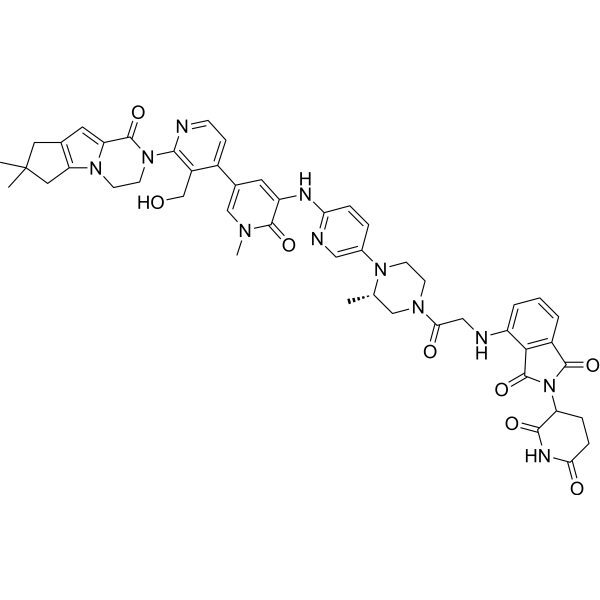
PTD10 is a selective and potent BTK PROTAC degrader (DC50 = 0.5 nM, KD = 2.28 nM). PTD10 can recruit cereblon (CRBN) E3 ligase and form a ternary complex with BTK, thereby mediating the ubiquitination and proteasome-dependent degradation of BTK. PTD10 inhibits cancer cells proliferation, and induces cell apoptosis via activation of the caspase-dependent pathway and mitochondrial pathway. PTD10 potently inhibits the BCR, AKT and NF-κB signaling pathway. PTD10 can be used for researches of B-cell malignancies and autoimmune disease .
loading...
    loading...
Cat. No.: HY-156671A
Purity:  99.02%
Target:  

Ras PI3K ERK mTOR Apoptosis

Research Areas:  

Cancer

RMC-4998 formic is an orally active inhibitor targeting the active or GTP-bound state of the KRAS G12C mutant. RMC-4998 formic can form a ternary complex with intracellular CYPA and the activated KRAS G12C mutant, with an IC50 value of 28 nM. RMC-4998 formic can inhibit ERK signaling in KRAS G12C mutant cancer cells and induce apoptosis. RMC-4998 formic can be used for non-small cell lung cancer (NSCLC) research .
loading...
    loading...
Cat. No.: HY-156671B
Target:  

Ras PI3K ERK mTOR Apoptosis

Research Areas:  

Cancer

RMC-4998 TFA is an orally active inhibitor targeting the active or GTP-bound state of the KRAS G12C mutant. RMC-4998 TFA can form a ternary complex with intracellular CYPA and the activated KRAS G12C mutant, with an IC50 value of 28 nM. RMC-4998 TFA can inhibit ERK signaling in KRAS G12C mutant cancer cells and induce apoptosis. RMC-4998 TFA can be used for for non-small cell lung cancer (NSCLC) research .
loading...
    loading...
Cat. No.: HY-159846S
Synonyms: FCN-159-d
Luvometinib-d (FCN-159-d) is the deuterated-labeled Luvometinib (HY-159846). Luvometinib is an orally potent MEK1/2 inhibitor. Luvometinib selectively blocks the MAPK signaling pathway by forming a ternary complex with MEKase and ATP, thereby reducing the phosphorylation level of ERK. Luvometinib induces cell cycle arrest and apoptosis, and inhibits cancer cell proliferation. Luvometinib can be used in relevant research on various solid tumors including melanoma, non-small cell lung cancer, colon cancer, and acute myeloid leukemia .
loading...
    loading...
Cat. No.: HY-162106
CAS No.: 3035509-76-0
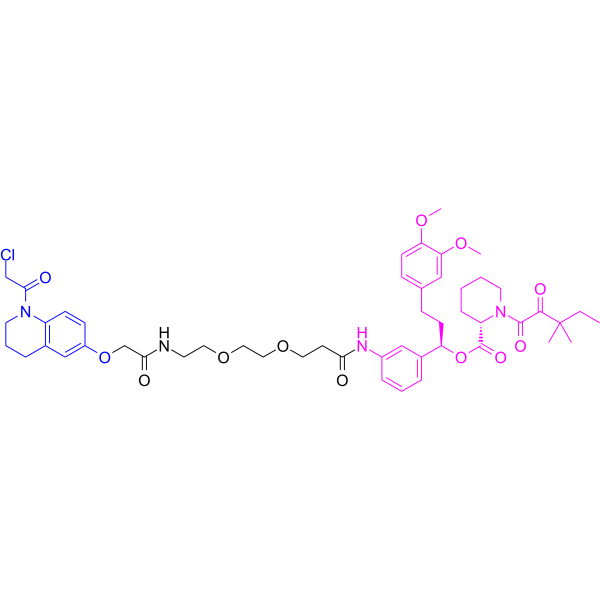
PROTAC GPX4 degrader-2 is a cIAP-recruiting GPX4 PROTAC degrader with a DC50 of 1.68 μM. PROTAC GPX4 degrader-2 forms a ternary complex with GPX4 and cIAP, and induces GPX4 degradation via the ubiquitin-proteasome system pathway. PROTAC GPX4 degrader-2 induces Mitochondrial depolarization and Ferroptosis. PROTAC GPX4 degrader-2 exhibits antiproliferative effects in cancer cells. PROTAC GPX4 degrader-2 can be used for the research of fibrosarcoma .
loading...
    loading...
Cat. No.: HY-162730R
CAS No.: 2131210-15-4
OPB-171775 (Standard) is the analytical standard of OPB-171775 (HY-162730). This product is intended for research and analytical applications. OPB-171775 is an orally active molecular glue. OPB-171775 forms ternary complex with phosphodiesterase 3A (PDE3A) and schlafen family member 12 (SLFN12). OPB-171775 causes SLFN12 RNase-mediated cell death, activates SLFN12 RNase-associated GCN2 signaling pathway. OPB-171775 exhibits significant efficacy against gastrointestinal stromal tumor.
loading...
    loading...
Cat. No.: HY-162749
CAS No.: 3097803-96-5
Research Areas:  

Cancer

G9D-4 is a G9a PROTAC degrader. G9D-4 induces G9a degradation, reduces H3K9me2 levels, and prevents GLP interference via the CRBN ternary complex, proteasome and ubiquitin-like modification-dependent pathways. G9D-4 exerts antiproliferative activity and induces Apoptosis in pancreatic cancer cells. G9D-4 can be used for research on pancreatic cancer .
loading...
    loading...
Cat. No.: HY-164891
CAS No.: 2839138-44-0
Target:  

Molecular Glues

Research Areas:  

Others

EM12‑FS is a selective covalent molecular glue degrader of NTAQ1 that binds to CRBN with an IC50 of 256 nM. EM12‑FS covalently modifies the His353 residue of CRBN via chemical modification, reshapes the surface conformation of CRBN protein, selectively recruits NTAQ1 to form a ternary complex, and mediates the degradation of NTAQ1 protein in a CRL4 CRBN E3 ubiquitin-proteasome pathway-dependent manner. EM12‑FS can be used in cancer-related research .
loading...
    loading...
Cat. No.: HY-172615
CAS No.: 3033019-04-1
Research Areas:  

Cancer

AMPTX-1 is a selective, orally active, covalent reversible BRD9 molecular glue degrader with a DC50 of 0.05 nM. AMPTX-1 selectively recruits BRD9 to the E3 ligase DCAF16. AMPTX-1 forms a ternary complex with BRD9 and a reversible covalent adduct with Cys58 on the surface of DCAF16. AMPTX-1 mediates BRD9 degradation via the proteasome and Cullin RING E3 ligase pathways. AMPTX-1 can be used in the research of solid tumors and hematological malignancies .
loading...
    loading...
Cat. No.: HY-175435
CAS No.: 3094183-98-6
Target:  

PROTACs Raf ERK

Research Areas:  

Neurological Disease Cancer

CST905 is a potent BRAF-V600E PROTAC degrader with a DC50 of 18 nM. CST905 recruits the VHL E3 ligase to form a ternary complex, mediating the degradation of BRAF-V600E via the ubiquitin-proteasome pathway. The ligand of CST905 disrupts the RAF dimerization interface, thereby preventing the aberrant activation of the harmful MAPK/ERK pathway in RAS-mutated cells while degrading the target protein. CST905 can be used in studies related to malignant melanoma and neuroblastoma .
loading...
    loading...
Cat. No.: HY-176521
CAS No.: 3083307-42-7
Research Areas:  

Cancer

AR/BRD4 RIPTAC-1 (Compound II-5) is an orally active Regulatory-inducible proximity-targeting chimera (RIPTAC). AR/BRD4 RIPTAC-1 induces the formation of a stable ternary complex between the androgen receptor (AR) and BRD4, thereby blocking BRD4 function. AR/BRD4 RIPTAC-1 inhibits the growth and proliferation of tumor cells. AR/BRD4 RIPTAC-1 holds promise for use in prostate cancer research .
loading...
    loading...
Cat. No.: HY-180907
Target:  

PROTACs Deubiquitinase

Research Areas:  

Cancer

PROTAC USP39 Degrader-1 is a USP39 PROTAC degrader with Kd values of 136 nM and 232 nM, and a DC50 value of 1.06 nM (24 h). PROTAC USP39 Degrader-1 binds to the VHL E3 ubiquitin ligase, forms a ternary complex with USP39, mediates USP39 ubiquitination and proteasomal degradation dependent on VHL recruitment, modulates splicing activity and induces 5' splice site-specific splicing patterns. PROTAC USP39 Degrader-1 can be used in the research of cervical cancer .
loading...
    loading...
Cat. No.: HY-183007
Target:  

PROTACs SWI/SNF Complex

Research Areas:  

Cancer

LJM133 is a SMARCA2/PBRM1/SMARCA4 PROTAC degrader with DC50 values of 3.5 nM, 7 nM, and 6.4 nM. LJM133 induces ternary complex formation with VHL E3 ligase to drive proteasome-mediated degradation of target proteins. LJM133 suppresses cell proliferation and exhibits significant antitumor efficacy in a SMARCA4 mutant cancer xenograft model. LJM133 can be used for the research of cancer, such as SMARCA4 mutant non-small cell lung cancer .
loading...
    loading...
Cat. No.: HY-184896
CAS No.: 3032314-99-8
XYD113 is an orally active, selective GSPT1 Molecular glue degrader. XYD113 promotes the formation of the CRBN-GSPT1 ternary complex and mediates GSPT1 degradation in a CRBN-dependent manner via the ubiquitin-proteasome system. XYD113 downregulates genes associated with the occurrence and progression of prostate cancer (c-Myc, AR, AR-V7, KLK3, KLK2, TMPRSS2). XYD113 exhibits anticancer activity against prostate cancer. XYD113 can be used in the research of prostate cancer .
loading...
    loading...
Cat. No.: HY-187169
Research Areas:  

Cancer

KAT2A degrader-2 is a selective molecular glue degrader targeting KAT2A, with a DC50 of 22 nM in Kelly cells. KAT2A degrader-2 acts as a molecular glue to recruit KAT2A to CRBN, forming a ternary complex that drives the polyubiquitination and proteasome-dependent degradation of KAT2A. KAT2A degrader-2 reduces the acetylation level of histone H3 lysine 9 via the ubiquitin-like and proteasome-dependent pathway. KAT2A degrader-2 can be used for the research of acute myeloid leukemia .
loading...
    loading...
Cat. No.: HY-187225
Research Areas:  

Cancer

NCP07 is a PROTAC degrader targeting the coactivator-binding site (CBS) of ERα. NCP07 induces the formation of the ERα-NCP07-VHL ternary complex and promotes ERα degradation via the ubiquitin-proteasome system. NCP07 induces apoptosis and cell cycle arrest in endocrine therapy-resistant breast cancer cells. NCP07 inhibits the proliferation of wild-type and ESR1-mutant breast cancer cells. NCP07 is applicable to breast cancer-related research .
loading...
    loading...
Cat. No.: HY-174920
CAS No.: 1797406-70-2
Research Areas:  

Cancer

PROTAC BRD4 Degrader-34 (1797406-70-2) is a VHL-recruiting PROTAC BRD4 degrader. PROTAC BRD4 Degrader-34 induces degradation of the short isoform of BRD4 and can be used in studies of BRD4-related diseases and targeted protein degradation .
loading...
    loading...
Cat. No.: HY-129610
CAS No.: 2384184-40-9
Purity:  99.25%
Target:  

PROTACs FKBP

Research Areas:  

Cancer

KB02-SLF is a nuclear FKBP12 covalent PROTAC degrader. KB02-SLF covalently modifies cysteine residues in DCAF16, forms a ternary complex with nuclear FKBP12, and mediates degradation via the CUL4-DDB1 E3 ubiquitin ligase pathway. KB02-SLF promotes polyubiquitination and proteasomal degradation of nucleus-localized FKBP12. KB02-SLF can be used in breast cancer research .
loading...
    loading...
Cat. No.: HY-143904
CAS No.: 2953426-43-0
Purity:  98.01%
Target:  

PROTACs Mps1

Research Areas:  

Cancer

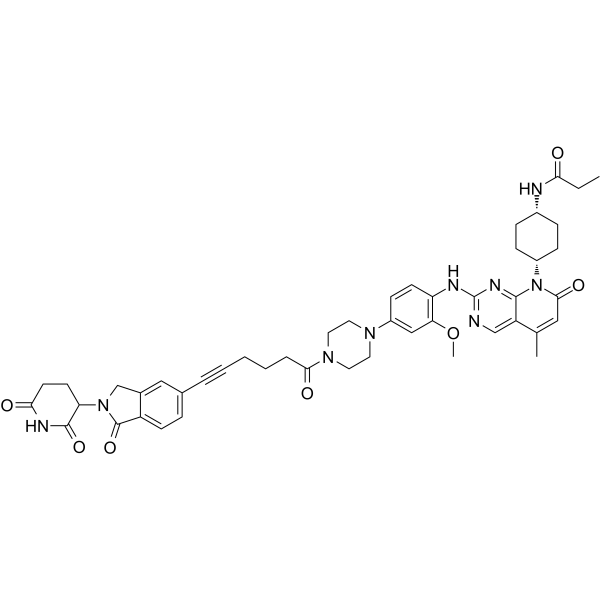
PROTAC TTK degrader-1 is a PROTAC degrader targeting Threonine Tyrosine Kinase (TTK), with a DC50 of 5.8 nM in HCT-116 cells and 1.7 nM in COLO-205 cells. PROTAC TTK degrader-1 induces the formation of a ternary complex with TTK and the CRBN E3 ubiquitin ligase, triggering proteasome-mediated degradation. PROTAC TTK degrader-1 exhibits activity against colon cancer cells and shows anti-tumor activity in a colon cancer xenograft mouse model. It can be used in colon cancer-related research .
loading...
    loading...
Cat. No.: HY-161710
XYD129 is a CBP/p300 PROTAC degrader. XYD129 potently binds to CBP, p300 and CRBN proteins, with IC50 values of 0.021 μM, 0.03 μM and 0.18 μM, respectively. XYD129 forms a ternary CRBN-CBP/p300 complex and induces CBP/p300 degradation via the ubiquitin-proteasome system. XYD129 inhibits tumor growth and suppresses the proliferation of acute myeloid leukemia cells. XYD129 can be used in studies related to acute myeloid leukemia .
loading...
    loading...

