
269 Results for "

brain function

" in MedChemExpress (MCE) Product Catalog:
Products (269)

269 Results for "brain function" in MCE Product Catalog:

Cat. No.: HY-14197AR
CAS No.: 17780-75-5
Synonyms: M&B 9302 hydrochloride (Standard)
Clorgyline hydrochloride (Standard) (M&B 9302 hydrochloride (Standard)) is the analytical standard of Clorgyline hydrochloride (HY-14197A). This product is intended for research and analytical applications. Clorgyline hydrochloride (M&B 9302 hydrochloride) is a selective, irreversible monoamine oxidase A (MAO-A) inhibitor that can cross the blood-brain barrier and exhibits activity against the 5-HT Receptor at very high doses. Clorgyline hydrochloride regulates monoamine neurotransmitter levels, the release of dopamine and acetylcholine, the uptake and effects of Tyramine (HY-W007606), noradrenergic function, circadian locomotor activity rhythms, feeding behavior, and body weight. Clorgyline hydrochloride induces tumor-suppressive transcriptional programs, secretory differentiation, androgen signaling regulation, Bcl-2 expression, and radioprotective effects in non-malignant cells. Clorgyline hydrochloride is used in the research of high-grade prostate cancer, Huntington's disease, major affective disorder, radiation-induced normal tissue toxicity, and obesity .
loading...
    loading...
Cat. No.: HY-N0440R
CAS No.: 6902-91-6
Germacrone (Standard) is an analytical standard of Gemmacrone (HY-N0440). This product is intended for research and analytical applications. Germacrone (Standard) is a sesquiterpene compound with multiple biological activities. Germacrone (Standard) inhibits the H1N1 and H3N2 influenza A viruses and the influenza B virus. Germacrone (Standard) blocks the progressionof arthritis by regulating Th1/Th2 balance and inhibiting NF-κB signaling. Germacrone (Standard) can arrest the cell cycle at G0/G1 and G2/M phases and induce apoptosis in breast cancer cells. Germacrone (Standard) inhibits 5α-reductase and has anti-androgenic effect. Germacrone (Standard) has neuroprotective functions and can be used for the study of traumatic brain injury (TBI). Germacrone (Standard) also has antioxidant activity .
loading...
    loading...
Cat. No.: HY-N0570R
CAS No.: 10597-60-1
Synonyms: DOPET (Standard); 3,4-Dihydroxyphenethyl alcohol (Standard); 3-Hydroxytyrosol (Standard)
Hydroxytyrosol (Standard) (DOPET (Standard)) is the analytical standard of Hydroxytyrosol (HY-N0570). This product is intended for research and analytical applications. Hydroxytyrosol is an orally active, blood-brain barrier-permeable multi-active compound with multiple effects including antibacterial, antioxidant, anti-platelet aggregation, and neuroprotective activities. Hydroxytyrosol not only inhibits the growth of Vibrio by increasing bacterial membrane permeability, but also interacts with DNA and mediates supercoiled DNA relaxation. Meanwhile, Hydroxytyrosol effectively reduces thrombosis and inhibits lipid oxidation by inhibiting COX activity and promoting vascular nitric oxide production. In terms of neuroprotection, Hydroxytyrosol significantly alleviates neuronal apoptosis and inflammatory responses by up-regulating the expression level of ERβ, thereby improving cognitive function in Alzheimer's disease models. Hydroxytyrosol has been widely used in scientific research related to Vibrio infection, arterial thrombosis, Alzheimer's disease and other related fields .
loading...
    loading...
Cat. No.: HY-W027553S1
Synonyms: NIK-247-d9 free base
Ipidacrine-d9 (NIK-247-d9 (free base)) is the deuterium labeled Ipidacrine (HY-W027553). Ipidacrine is orally active and brain-penetrant AChE and BuChE inhibitors with IC50 values of 1 μM and 1.9 μM, respectively, which is also a partial agonist of M2-cholinergic receptors and a reversible cholinesterase inhibitor. Ipidacrine has a stimulating effect on neuromuscular transmission and excitation along the nerve fibres with a moderately anti-pain effect. Ipidacrine is an aminopyridines and is structurally similar to Tacrine (HY-111338). Ipidacrine is effective in various amnesia models, improves erectile function and inhibits K+ and Na+-channels in the neuronal membrane in diabetic rats. Ipidacrine is promising for research of Alzheimer’s disease, ischaemic stroke, idiopathic neuropathy of the facial nerve, diabetes mellitus-induced erectile dysfunction and other deficits in central or peripheral cholinergic deseases .
loading...
    loading...
Cat. No.: HY-N12060
CAS No.: 90045-36-6
Ginkgo biloba extract is a natural product that can be isolated from Ginkgo biloba leaves . Ginkgo biloba extract alleviates oxidative stress-induced neuronal apoptosis (Apoptosis) by stabilizing mitochondrial function, regulating Bcl-2 family proteins and inhibiting caspase activation. Ginkgo biloba extract alleviates testicular injury by upregulating SKP2 and inhibiting Beclin1-independent autophagy (Autophagy) . Ginkgo biloba extract alleviates various types of neuronal damage in animal models. Ginkgo biloba extract reduces behavioral sensitization in rats. Ginkgo biloba extract counteracts Aβ-induced neurotoxicity by blocking a series of Aβ-triggered events, including glucose uptake, ROS accumulation, AKT activation, mitochondrial dysfunction, JNK and ERK 1/2 pathways, and apoptosis, and also interferes with the formation of Aβ oligomers. Ginkgo biloba extract is applicable to research related to cerebral hypoperfusion, testicular injury, Alzheimer's disease, Parkinson's disease, multi-infarct dementia, stroke, traumatic brain injury and amyotrophic lateral sclerosis .
loading...
    loading...
Cat. No.: HY-183805
Target:  

5-HT Receptor FAAH

Research Areas:  

Neurological Disease

5-HT6R/FAAH modulator 2 is a dual 5-HT6R antagonist and FAAH inhibitor with human 5-HT6R pKi 7.24, human FAAH pIC50 5.47, and blood-brain barrier penetration.5-HT6R/FAAH modulator 2 modulates serotonergic signaling, blocks 5-HT6R function, inhibits endocannabinoid degradation via FAAH catalytic activity suppression.5-HT6R/FAAH modulator 2 exhibits neuroprotective effects against mitochondrial dysfunction, amyloid-β, and glutamate-induced toxicity, reverses memory deficits.5-HT6R/FAAH modulator 2 shows reduced cytotoxicity relative to oxygen-containing lead compounds.5-HT6R/FAAH modulator 2 can be used for the research of Alzheimer's disease .
loading...
    loading...
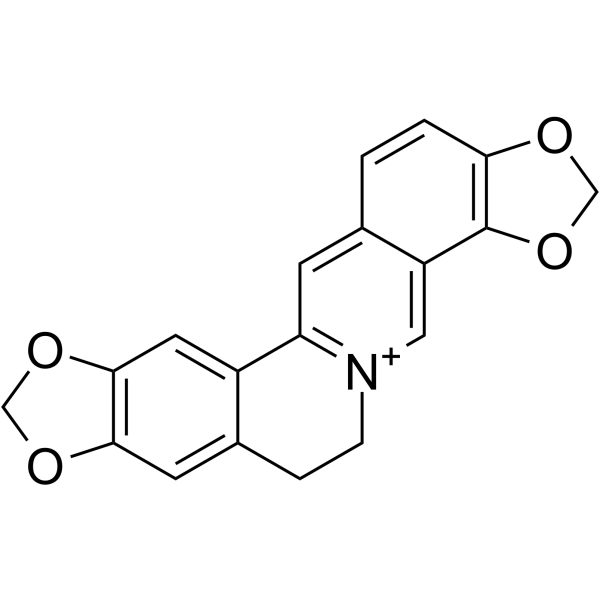
Cat. No.: HY-N0430
CAS No.: 3486-66-6
Synonyms: Coptisin
Coptisine is an orally active and brain-penetrant alkaloid found in Coptis chinensis. Coptisine is a reversible, uncompetitive IDO inhibitor with a Ki of 5.8 μM and an IC50 of 6.3 μM. Coptisine suppresses neuroinflammation, reduces Aβ plaque burden and shows neuroprotective activity. Coptisine shows anti-inflammation activity by blocking NF-κB, MAPK, and PI3K/Akt activation. Coptisine inhibits cancer cells proliferation, induces DNA damage, G2/M phase cell cycle arrest, apoptosis, ROS production and mitochondrial dysfunction. Coptisine inhibits Rho/ROCK pathway activation, reduces arrhythmia, limits cardiac injury marker release, reduces infarct size, and preserves cardiac function in rat myocardial ischemia/reperfusion models. Coptisine downregulates HMGCR and upregulates LDLR and CYP7A1 to modulate cholesterol metabolism, reduces abnormal serum lipid levels, and promotes fecal bile acid excretion. Coptisine can be used for the research of cancer, hypercholesterolemia, Alzheimer’s disease, inflammatory disorders and cardiovascular disease .
loading...
    loading...
Cat. No.: HY-N8693
CAS No.: 362472-81-9
Withanoside IV is an orally active, blood-brain barrier-permeable withanolide derivative. Withanoside IV specifically binds to the Sudlow I site of HSA, induces secondary structural changes in HSA, and forms stable HSA complexes. Withanoside IV inhibits the enzymatic activity of COX-2. Withanoside IV induces axonal regeneration, peripheral nervous system myelination and increased axonal density in spinal cord tissue, reduces reactive gliosis-related changes, and improves hindlimb motor function. Withanoside IV binds to amyloid-β 1-42 to inhibit its aggregation, induces neurite outgrowth and synapse reconstruction, repairs damaged axons and dendrites, enhances mitochondrial biogenesis, exerts neuroprotective effects via the BDNF and SIRT1 signaling pathways, reduces ROS production and neuronal apoptosis, and ameliorates memory deficits. Withanoside IV inhibits the activity of the SARS-CoV-2 main protease. Withanoside IV can be used in research related to spinal cord injury, Alzheimer's disease, and coronavirus disease 2019 (COVID-19) .
loading...
    loading...
Cat. No.: HY-13443S
Synonyms: Exenatide (Leu-13C6,15N) TFA
Exendin-4 (Leu- 13C6, 15N) TFA (Exenatide (Leu- 13C6, 15N) TFA) is the 13C, 15N-labeled Exendin-4 (HY-13443). Exendin‑4 (Exenatide) is an orally active, blood-brain barrier-permeable glucagon-like peptide-1 receptor (GLP‑1 receptor) agonist that resists degradation mediated by dipeptidyl peptidase IV. Exendin‑4 mediates multiple glucose-regulating effects, including stimulation of glucose-dependent insulin secretion, inhibition of glucagon production, increase in β-cell mass, delay of gastric emptying, reduction of food intake, improvement of peripheral insulin sensitivity, and restoration of normal islet structure. Exendin‑4 inhibits oxidative stress, alleviates inflammatory responses, and reduces neuronal apoptosis. Exendin‑4 reduces the aggregation level of mutant huntingtin, improves motor function, prolongs survival time, and regulates the expression levels of leptin and ghrelin. Exendin‑4 can be used in research related to type 2 diabetes, acute ischemic stroke, and Huntington's disease .
loading...
    loading...

