28 Results for "

Fluor-488

" in MedChemExpress (MCE) Product Catalog:
Products (28)

28 Results for "Fluor-488" in MCE Product Catalog:

Cat. No.: HY-D1824
Synonyms: VF 488 Carboxylic acid(free acid)
Vari Fluor 488 Carboxylic acid (VF 488 Carboxylic acid) free acid is a carboxylic acid derivative of Vari Fluor. Vari Fluor carboxylic acid derivatives are unactivated labeled fluorescent dyes for protein, antibody, and polysaccharide labeling that require carboxylic acid activation for use .
loading...
    loading...
Cat. No.: HY-160271
Target:  

Fluorescent Dye

Research Areas:  

Others

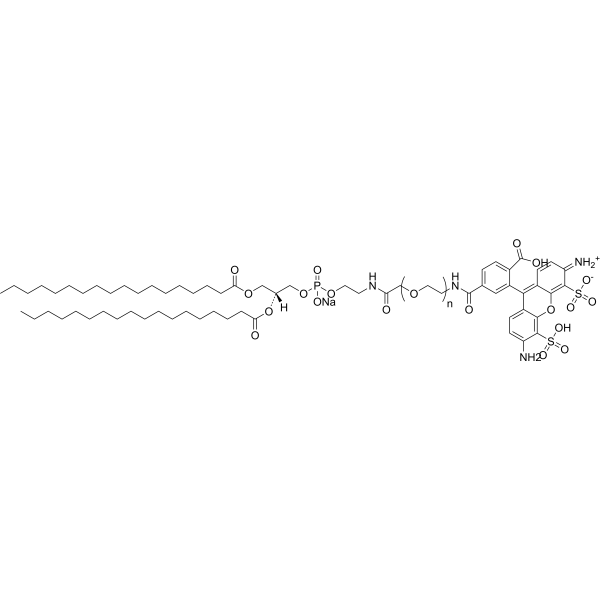
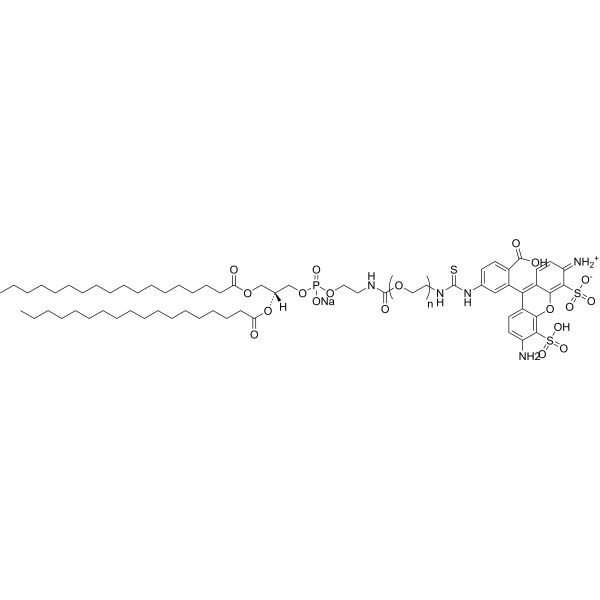
DSPE-CH2-PEG2000-Fluor 488 is a PEG lipid conjugate with a DSPE group and a Fluor 488 dye. DSPE is a phosphoethanolamine (PE) lipid that can be used in the synthesis of liposomes. And Fluor 488 is a fluorescent dye .
loading...
    loading...
Cat. No.: HY-160270
Target:  

Liposome

Research Areas:  

Others

DSPE-PEG5000-Fluor 488 is a PEG-dye-lipid conjugate consists of a DSPE phospholipid which is an unsaturated phospholipid, a Fluor 488 dye which is a cyanine dye that is prominently used in fluorescence microscopy with excitation and emission maxima at 499 nm and 520 nm and a large PEG spacer which links the former substance together.
loading...
    loading...
Cat. No.: HY-D2757
CAS No.: 135926-06-6
5(6)-Carboxyrhodamine 110 NHS Ester is the nonsulfonated analog of the BP Fluor 488 dye. The amine-reactive 5(6)-Carboxyrhodamine 110 NHS ester can be used to create bright and photostable green-fluorescent bioconjugates with excitation/emission maxima ~502/527 nm. The conjugates of this dye often used for Fluorescence Correlation Spectroscopy (FCS).
loading...
    loading...
Cat. No.: HY-D2773
CAS No.: 219729-26-7
5-Carboxyrhodamine 110 NHS Ester is the nonsulfonated analog of the BP Fluor 488 dye. The amine-reactive 5(6)-Carboxyrhodamine 110 NHS Ester can be used to create bright and photostable green-fluorescent bioconjugates with excitation/emission maxima ~502/527 nm. For many applications, the dye is preferred over 5-(6)-carboxyfluorescein NHS ester or FITC because of its exceptional photostability and fluorescence insensitivity to pH (4-9). Although the mixed isomers of Carboxyrhodamine 110 NHS Ester preferred, routinely used fluorescent dye for labeling proteins, peptides and nucleotides, purification of peptide and nucleotides labeled with 5(6) isomers might be troublesome due to significant signal broadening in HPLC purification. Peptides and nucleotides labeled with a single isomer usually give better resolution in HPLC purification that is often required in the conjugation processes.
loading...
    loading...
Cat. No.: HY-D2774
CAS No.: 105237-27-2
BP Fluor 488 Alkyne is a fluorophore. Its absorption and emission spectra are similar to fluorescein, but it is fluorescent in acidic media, and it is much more stable against photobleaching and oxidation.
loading...
    loading...
Cat. No.: HY-D3575
AF488-PEG12-DBCO is a derivative of Alexa Fluor 488 featuring a DBCO (dibenzocyclooctyne) group for copper-free click chemistry (SPAAC). It incorporates a PEG12 linker to enhance hydrophilicity and provide increased spacer length. AF488-PEG12-DBCO is primarily used for copper-free click chemistry (SPAAC) bioconjugation (Ex/Em = 495/519 nm).
loading...
    loading...
Cat. No.: HY-W416298
CAS No.: 55520-64-4
Research Areas:  

Cancer

5-Vinyl-uridine is a fluorescent probe that can be used for intracellular RNA imaging, cell division stage imaging, and in vivo tumor imaging in mice. The detection mechanism of 5-Vinyl-uridine relies on metabolic incorporation into cellular RNA during RNA synthesis; after incorporation, it undergoes a bioorthogonal Diels-Alder reaction with Biotin (HY-B0511)-tetrazine. When paired with Streptavidin (HY-P3152)-Alexa Fluor 488, 5-Vinyl-uridine has an Ex/Em = 488/500-550 nm; when using Biotin-tetrazine, the emission peak is at approximately 510 nm, with the excitation/emission filter settings of 450-490/500-550 nm. 5-Vinyl-uridine can be used in tumor-related research .
loading...
    loading...

