51 Results for "

hypoglycemic effects

" in MedChemExpress (MCE) Product Catalog:
Products (51)

51 Results for "hypoglycemic effects" in MCE Product Catalog:

Cat. No.: HY-N5086
CAS No.: 211567-04-3
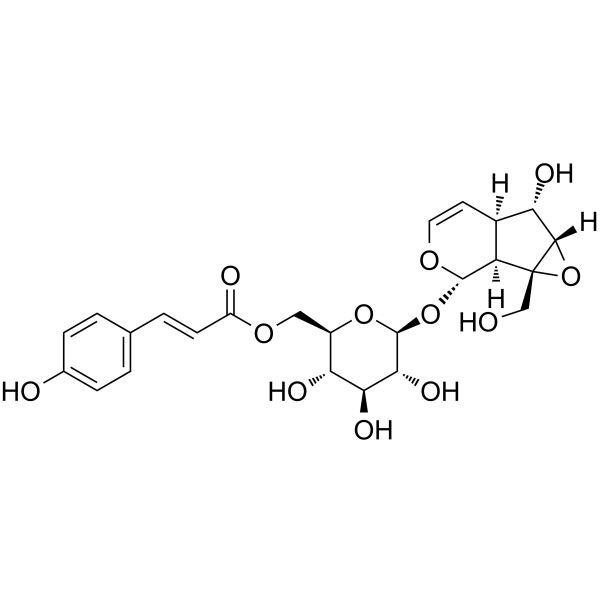
Picroside IV is an iridoid glycoside found in the underground parts of Picrorhiza scrophulariiflora. Picroside IV is a derivative of Catalpol (HY-N0820) . Catalpol has neuroprotective, hypoglycemic, anti-inflammatory, anti-cancer, anti-spasmodic, anti-oxidant effects and anti-HBV effects .
loading...
    loading...
Cat. No.: HY-B0089R
CAS No.: 56180-94-0
Synonyms: BAY g 5421 (Standard)
Acarbose (Standard) is the analytical standard of Acarbose. This product is intended for research and analytical applications. Acarbose (BAY g 5421), antihyperglycemic agent, is an orally active alpha-glucosidase inhibitor (IC50=11 nM). Acarbose can potentiate the hypoglycemic effects of sulfonylureas or insulin .
loading...
    loading...
Cat. No.: HY-W1113135
CAS No.: 2828447-14-7
Research Areas:  

Others

Carboxymethyl-β-cyclodextrin sodium salt is a negatively charged β-cyclodextrin derivative, as well as a metal ion chelator and solubilizing reagent. Carboxymethyl-β-cyclodextrin sodium salt forms stable aqueous complexes with Ba 2+, Ca 2+, Cd 2+, Ni 2+, Pb 2+, Sr 2+, and Zn 2+ ions. Carboxymethyl-β-cyclodextrin sodium salt derived hydrogel carriers support oral insulin delivery via paracellular permeation across Caco-2 monolayers and produce sustained hypoglycemic effects in diabetic mice. Carboxymethyl-β-cyclodextrin sodium salt can be conjugated onto folate-modified BSA nanoparticles to boost folate receptor-mediated endocytosis, elevate intracellular anticancer drug uptake and trigger cell apoptosis. Carboxymethyl-β-cyclodextrin sodium salt can be utilized for chiral separation in capillary electrophoresis, development of nanoscale drug carriers and nucleic acid transfection research .
loading...
    loading...
Cat. No.: HY-N0820R
CAS No.: 2415-24-9
Synonyms: Catalpinoside (Standard)
Catalpol (Standard) is the analytical standard of Catalpol. This product is intended for research and analytical applications. Catalpol (Catalpinoside), an iridoid glycoside found in Rehmannia glutinosa. Catalpol has neuroprotective, hypoglycemic, anti-inflammatory, anti-cancer, anti-spasmodic, anti-oxidant effects and anti-HBV effects .
loading...
    loading...
Cat. No.: HY-105935R
CAS No.: 18719-76-1
Synonyms: Cyanidin 3-rutinoside chloride (Standard); Cyanidin 3-O-rutinoside chloride (Standard); Sambucin chloride (Standard)
Keracyanin (chloride) (Standard) is the analytical standard of Keracyanin (chloride). This product is intended for research and analytical applications. Keracyanin chloride inhibits NF-κB/FAK/MAPK signaling pathway. Keracyanin chloride exhibits antioxidant, anti-inflammatory and hypoglycemic effects, and is orally active .
loading...
    loading...
Cat. No.: HY-172120
CAS No.: 2097502-14-0
Target:  

GPR119

Research Areas:  

Metabolic Disease

GPR119 agonist 3 (Compound 21b) is an orally active agonist of GPR119 with an EC50 value of 3.8 nM for hGPR119. Additionally, GPR119 agonist 3 exhibits hypoglycemic effects and can be used in research on type 2 diabetes and obesity .
loading...
    loading...
Cat. No.: HY-170692
Target:  

Akt PI3K NF-κB

Research Areas:  

Metabolic Disease

Hypoglycemic agent 3 (Compound H26), a derivative of corosolic acid, exhibits lipid-lowering and significant hypoglycemic effects and can be used as a hypoglycemic agent. Hypoglycemic agent 3 inhibits insulin resistance by targeting MCCC1 and can be used in the study of type 2 diabetes .
loading...
    loading...
Cat. No.: HY-N12647
CAS No.: 230292-85-0
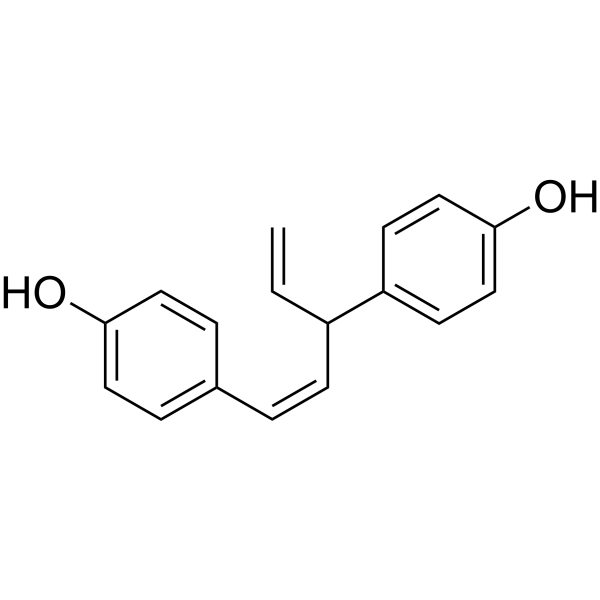
cis-Hinkiresinol is a bioactive constituent of Rhizoma anemarrhenae. Rhizoma anemarrhenae is reprted to have anti-pathogenic microorganism, hypoglycemic effects, anti-inflammatory, antipyretic effects and anti-platelet aggregation .
loading...
    loading...
Cat. No.: HY-B0089A
CAS No.: 1221158-13-9
Synonyms: Bay-g 5421 sulfate
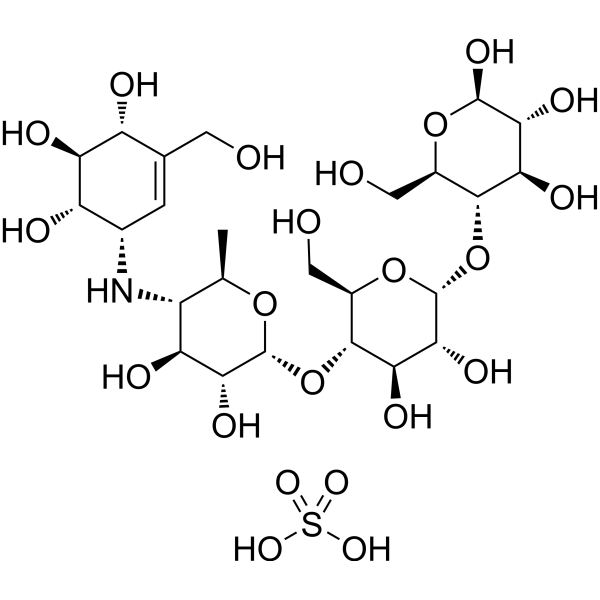
Acarbose (BAY g 5421) sulfate, antihyperglycemic agent, is an orally active alpha-glucosidase inhibitor (IC50=11 nM). Acarbose sulfate can potentiate the hypoglycemic effects of sulfonylureas or insulin .
loading...
    loading...
Cat. No.: HY-162758
Target:  

Aldose Reductase

Research Areas:  

Metabolic Disease

ALR2-IN-5 (Compound 10a) is an inhibitor of ALR2 with an IC50 value of 99.29 nM. ALR2-IN-5 exhibits hypoglycemic effects and can be utilized in research related to diabetes .
loading...
    loading...
Cat. No.: HY-N12543
CAS No.: 27539-32-8
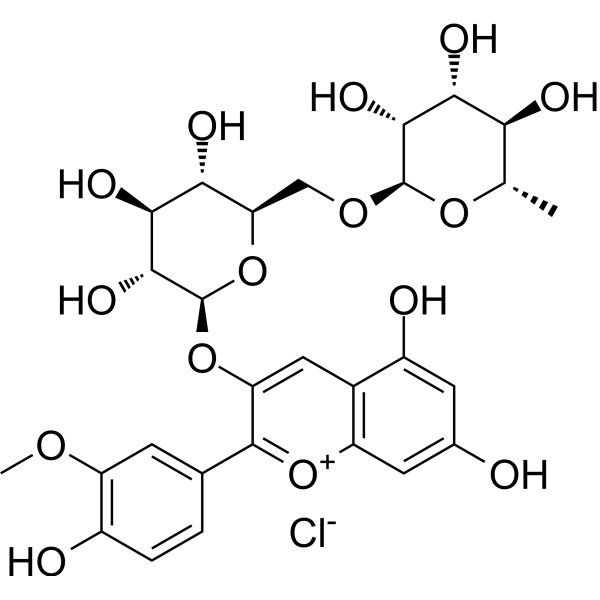
Peonidin 3-rutinoside is an anthocyanin. Peonidin 3-rutinoside is isolated from Lonicera caerulea berries, blackcurrant ethanol extracts, sweet cherry extracts, Berberis boliviana Lechler fruits, blue wheat, sweet and sour cherries, and strawberries. Anthocyanins exert multiple effects, including free radical scavenging activity, anti-inflammatory effects, anticancer effects, and hypoglycemic effects .
loading...
    loading...
Cat. No.: HY-121323R
CAS No.: 4430-36-8
Acarbose (Standard) is the analytical standard of Acarbose. This product is intended for research and analytical applications. Acarbose (BAY g 5421), antihyperglycemic agent, is an orally active alpha-glucosidase inhibitor (IC50=11 nM). Acarbose can potentiate the hypoglycemic effects of sulfonylureas or insulin .
loading...
    loading...
Cat. No.: HY-117985A
CAS No.: 1246960-27-9
Synonyms: DA-1229 hydrochloride
Target:  

Dipeptidyl Peptidase

Research Areas:  

Metabolic Disease Endocrinology

Evogliptin hydrochloride (DA-1229 hydrochloride) is an orally available DPP4 inhibitor with significant and durable hypoglycemic effects in mouse models. Evogliptin hydrochloride also inhibits the generation of inflammatory and fibrotic signals in hepatocytes by inducing autophagy. Evogliptin hydrochloride can be used in the research of type 2 diabetes, osteoporosis, renal impairment and chronic liver inflammation .
loading...
    loading...
Cat. No.: HY-B0089S
CAS No.: 1260619-60-0
Synonyms: BAY g 5421-d4
Acarbose-d4 (BAY g 5421-d4) is deuterium labeled Acarbose. Acarbose (BAY g 5421), antihyperglycemic agent, is an orally active alpha-glucosidase inhibitor (IC50=11 nM). Acarbose can potentiate the hypoglycemic effects of sulfonylureas or insulin .
loading...
    loading...
Cat. No.: HY-N0655R
CAS No.: 10284-63-6
Synonyms: 3-O-Methyl-D-chiro-inositol (Standard)
D-Pinitol (Standard) is the analytical standard of D-Pinitol. This product is intended for research and analytical applications. D-pinitol (3-O-Methyl-D-chiro-inositol) is a natural compound presented in several plants, like Pinaceae and Leguminosae plants. D-pinitol exerts hypoglycemic activity and protective effects in the cardiovascular system . D-pinitol has antiviral and larvicidal activities .
loading...
    loading...
Cat. No.: HY-173503
CAS No.: 1598439-44-1
Target:  

GLUT

Research Areas:  

Metabolic Disease

DS-1150b is an orally active GLUT4 activator. DS-1150b has the activity of activating GLUT4 transport and can promote the translocation of GLUT4 to the cell membrane in skeletal muscle cells. DS-1150b has shown hypoglycemic effects in the Zucker obese rat model and can be used in the study of type 2 diabetes mellitus (T2DM) .
loading...
    loading...
Cat. No.: HY-175263
CAS No.: 38239-51-9
Aminochalcone 4AAF is a neuroprotective agent that exerts anxiolytic effects through GABAA and 5-HT receptors. Aminochalcone 4AAF has high selectivity for 5-HT3A and 5-HT2C receptors, and stimulates allosteric behavior toward the 5-HT2A receptor. Aminochalcone 4AAF shows hypoglycemic effects and reduces the level of ROS in the liver. Aminochalcone 4AAF delays the clonic stage of the epileptic seizures . Aminochalcone 4AAF can be used in the study of anxiety, hyperglycemia, and seizures .
loading...
    loading...
Cat. No.: HY-173217
Target:  

PPAR Phosphatase

PPARα agonist 5 is an orally available, selective partial agonist of PPARα (EC50: 3 nM). PPARα agonist 5 reduces lipid accumulation and upregulates key PPARα target genes, exerting anti-fatty liver effects. PPARα agonist 5 also exhibits significant hypolipidemic and hypoglycemic effects through partial PPARγ agonist activity and mild inhibition of protein tyrosine phosphatase 1B (PTP1B) (IC50: 79.1 μM). PPARα agonist 5 has a good safety profile and can be used in the study of type 2 diabetes with dyslipidemia .
loading...
    loading...
Cat. No.: HY-N5083R
CAS No.: 20310-89-8
Saponarin (Standard) is the analytical standard of Saponarin (HY-N5083). This product is intended for research and analytical applications. Saponarin is an orally active flavonoid compound. Saponarin can be isolated from Gypsophila trichotoma. Saponarin inhibits ERK/p38, NF-κB and MAPK phosphorylation and activates AMPK. Saponarin reduces IL-1β and COX-2. Saponarin has antioxidant, anti-inflammatory, hepatoprotective, hypoglycemic and hypotensive effects. Saponarin improves sleep disorders .
loading...
    loading...
Cat. No.: HY-126969
CAS No.: 870095-15-1
Target:  

PPAR

Research Areas:  

Metabolic Disease

C333H is a selective PPARγ modulator with insulin-sensitizing and hypoglycemic activities. C333H exhibits similar insulin-sensitizing effects to thiazolidinediones (TZDs) in diabetic mouse models without significantly increasing body weight or adipose tissue weight. C333H increases circulating high molecular weight adiponectin isoform levels in diabetic db/db mice, reduces serine phosphorylation of PPARγ 273 in brown adipose tissue, and selectively modulates the expression of specific PPARγ target genes in adipose tissue. Express. C333H exhibits weak recruitment of co-activators and weak dissociation of co-repressors in vitro. These properties suggest that C333H may be a potential inhibitor of type 2 diabetes .
loading...
    loading...

