38 Results for "

methamphetamine

" in MedChemExpress (MCE) Product Catalog:
Products (38)

38 Results for "methamphetamine" in MCE Product Catalog:

Cat. No.: HY-152171
CAS No.: 2141974-01-6
Target:  

Monoamine Transporter

Research Areas:  

Neurological Disease

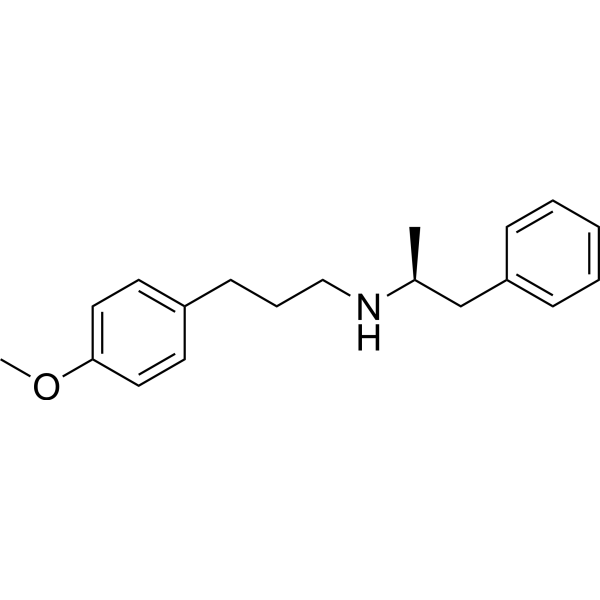
GZ-11608 is a potent and selective vesicular monoamine transporter-2 (VMAT2) inhibitor with high affinity (Ki = 25 nM). GZ-11608 decreases methamphetamine-induced dopamine release from isolated synaptic vesicles from brain dopaminergic neurons. GZ-11608 exhibits rapid brain penetration and without neurotoxicity. GZ-11608 can be used for the research of methamphetamine use disorder .
loading...
    loading...
Cat. No.: HY-Z0283R
CAS No.: 55-21-0
Synonyms: Benzenecarboxamide (Standard); Phenylamide (Standard)
Benzamide (Standard) is the analytical standard of Benzamide. This product is intended for research and analytical applications. Benzamide (Benzenecarboxamide) is a potent poly(ADP-ribose) polymerase (PARP) inhibitor. Benzamide has protective activity against both glutamate- and methamphetamine (METH)-induced neurotoxicity in vitro. Benzamide can attenuate the METH-induced dopamine depletions and exhibits neuroprotective activity in mice, also has no acute effect on striatal dopamine metabolism and does not reduce body temperature .
loading...
    loading...
Cat. No.: HY-147529
CAS No.: 1004614-58-7
Target:  

mGluR

Research Areas:  

Neurological Disease

mGluR2 modulator 3 (compound 1) is a potent mGluR2 positive allosteric modulator with an EC50 value of 0.87 μM. mGluR2 modulator 3 has activity in psychosis disease models such as methamphetamine-induced hyperactivity and mescaline-induced scratching in mice .
loading...
    loading...
Cat. No.: HY-121609
CAS No.: 370-14-9
Pholedrine, the main metabolite of methamphetamine, is an indirectly acting sympathomimetic amine. Pholedrine is a cardiovascular agent exerting hypertensive and adrenergic effects. Pholedrine can produce mydriatic response and allow localization of the site of the interruption in the oculosympathetic pathway. Pholedrine can be used as a topical eye drop and a diagnostic agent for use in Horner's syndrome .
loading...
    loading...
Cat. No.: HY-157183
CAS No.: 1313762-77-4
Research Areas:  

Inflammation/Immunology

HSMO9 is a (+)-methamphetamine (METH)-like hapten that can be coupled to a carrier protein. HSMO9 can be used in vaccine development .
loading...
    loading...
Cat. No.: HY-107696
CAS No.: 64047-73-0
Target:  

iGluR

Research Areas:  

Neurological Disease

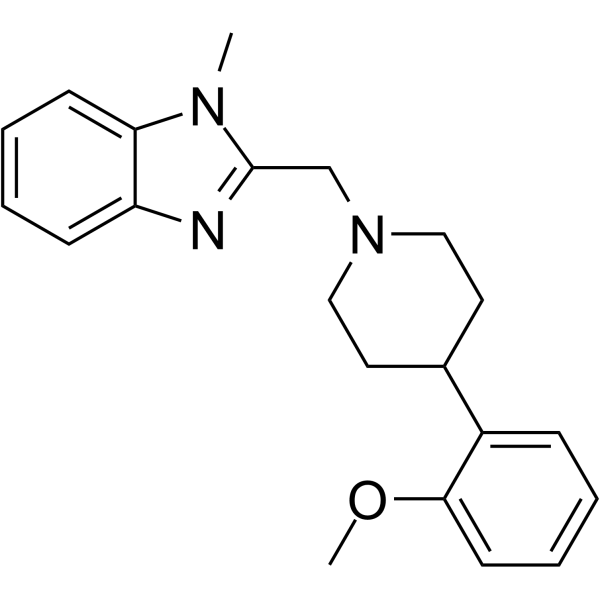
Ro 04-5595 hydrochloride is a GluN2B-selective NMDA receptor antagonist (Ki: 31 nM) .
loading...
    loading...
Cat. No.: HY-N14959
CAS No.: 114494-30-3
Deacetylravidomycin N-oxide is an antibiotic that can be produced by Streptomyces ravidus S50905. Deacetylravidomycin N-oxide is active against Gram-positive bacteria but inactive against Gram-negative bacteria. Deacetylravidomycin N-oxide has antitumor activity against P388 leukemia and methamphetamine A fibrosarcoma .
loading...
    loading...
Cat. No.: HY-115895
CAS No.: 23915-73-3
Synonyms: CI-686 free base
Trebenzomine (CI-686 free base) is a centrally acting psychotropic compound. Trebenzomine has both neuroleptic and stimulant activity. Trebenzomine potentiates Methamphetamine-induced self-stimulation. Trebenzomine reduces septal hyperirritability, suppression of conditioned avoidance behavior, blocks Apomorphine (HY-12723)-induced emesis in dogs .
loading...
    loading...
Cat. No.: HY-107541R
CAS No.: 317321-41-8
Research Areas:  

Neurological Disease

O-1602 (Standard) is the analytical standard of O-1602. This product is intended for research and analytical applications. O-1602 is an agonist of GPR55 (G protein-coupled receptor 55). O-1602 reduces the number and activation of hippocampal microglia induced by METH (methamphetamine). O-1602 decreases the expression levels of NLRP3 inflammasome proteins, including NLRP3, ASC and Caspase-1 .
loading...
    loading...
Cat. No.: HY-120788
CAS No.: 1436695-49-6
Target:  

Monoamine Transporter

Research Areas:  

Others

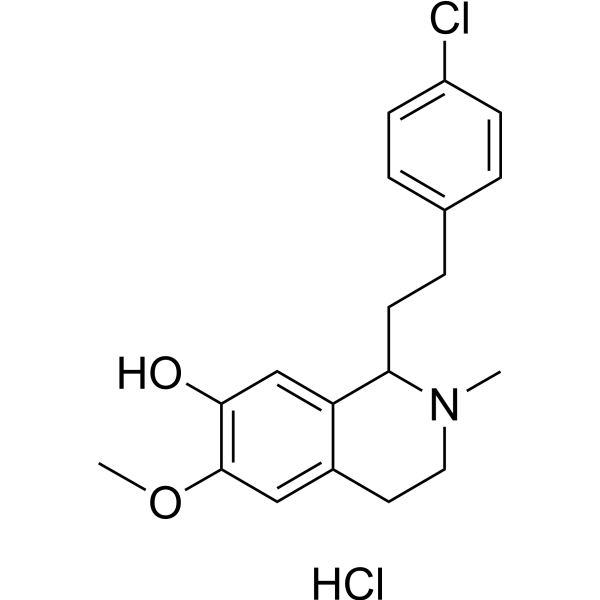
VMAT2-IN-4 (compound 11) is a vesicular monoamine transporter-2 (VMAT2) inhibitor. VMAT2-IN-4 inhibits [ 3H]-DTBZ binding (Ki = 560 nM). VMAT2-IN-4 inhibits [ 3H]-DA (Ki = 45 nM) from entering vesicles and being taken up by cells. VMAT2-IN-4 can be used in methamphetamine addiction research .
loading...
    loading...
Cat. No.: HY-118990
CAS No.: 246244-19-9
Research Areas:  

Neurological Disease

Lobelane hydrochloride is a biologically active compound that has the activity of inhibiting vesicular monoamine transporter-2 (VMAT2). Lobelane hydrochloride has a low affinity for nicotinic acetylcholine receptors (nAChR), thereby enhancing its selectivity for VMAT2. Synthetic structural changes of lobelane hydrochloride have led to some related analogs that show mild changes in affinity for VMAT2. The most potent synthetic lobelane hydrochloride obtained after structural modification has a K(i) value of 630 nM, showing significant VMAT2 selectivity. The biological activity of lobelane hydrochloride suggests that it has the potential to be used in the development of compounds to inhibit methamphetamine abuse .
loading...
    loading...
Cat. No.: HY-W385577A
(S)-2-Benzylpyrrolidine hydrochloride (Compound s1) serves as a METH hapten scaffold. (S)-2-Benzylpyrrolidine hydrochloride attenuates Methamphetamine-induced hyperlocomotion, hyperthermia and respiratory depression. (S)-2-Benzylpyrrolidine hydrochloride alleviates sedative agent-induced respiratory depression .
loading...
    loading...
Cat. No.: HY-123332
CAS No.: 73328-60-6
Target:  

Drug Derivative

Research Areas:  

Neurological Disease

YM-08050 is a new anti-psychotic and Benzamide (HY-Z0283) derivative. YM-08050 inhibits stereotyped behaviors, conditioned avoidance responses, or spontaneous movements induced by Apomorphine (HY-12723) or Methamphetamine .
loading...
    loading...
Cat. No.: HY-W385577
CAS No.: 97522-31-1
(S)-2-Benzylpyrrolidine (Compound s1) serves as a METH hapten scaffold. (S)-2-Benzylpyrrolidine attenuates Methamphetamine-induced hyperlocomotion, hyperthermia and respiratory depression. (S)-2-Benzylpyrrolidine alleviates sedative agent-induced respiratory depression .
loading...
    loading...
Cat. No.: HY-178885
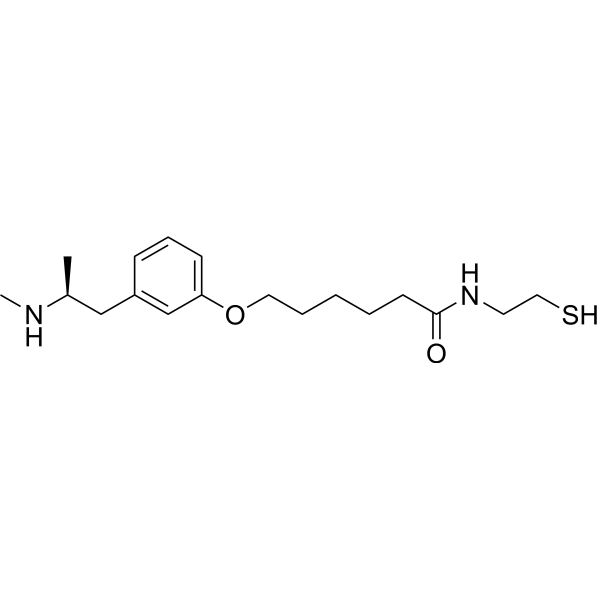
(S)-4-(4-(2-(Methylamino)propyl)phenoxy)butanoic acid (TFA) (Compound H1) is a Methamphetamine hapten.(S)-4-(4-(2-(Methylamino)propyl)phenoxy)butanoic acid (TFA) can be coupled to the BSA, Keyhole limpet hemocyanin molecule. The immunoconjugate H1-KLH strongly induces an antibody response .
loading...
    loading...
Cat. No.: HY-182504
CAS No.: 244276-65-1
NRA‑0562 is a dopamine antagonist with high affinities for dopamine D1/D2/D3/D4, 5‑HT2A and α1‑adrenoceptors. NRA-0562 dose‑dependently reverses induced suppression of firing activity in rat A9 and A10 midbrain dopamine neurons, with preferential potency at A10 neurons (ED50 = 0.3 mg/kg). NRA-0562 elevates Fos-like immunoreactivity in rat nucleus accumbens and dorsolateral striatum. NRA-0562 can be used for preclinical research on schizophrenia . .
loading...
    loading...
Cat. No.: HY-179646
CAS No.: 3122563-80-5
CIAC101 is a potent and brain-penetrant TLR4 antagonist with an IC50 of 17.0 nM in NO assay. CIAC101 blocks Lipopolysaccharides (HY-D1056) (LPS)-induced NF-κB activation and reduces the expression of pro-inflammatory mediators (iNOS, IL-1β, TNF-α, and IL-6). CIAC101 robust antineuroinflammatory activity with efficacy against drug-evoked neurobehavioral adaptations. CIAC101 can be used for the research of addiction and neurological disease .
loading...
    loading...
Cat. No.: HY-16900G
CAS No.: 61413-54-5
Rolipram GMP is Rolipram (HY-16900) produced by using GMP guidelines. GMP small molecules works appropriately as an auxiliary reagent for cell therapy manufacture. Rolipram is a PDE4 inhibitor, with blood-brain barrier permeability, that reverses β-amyloid-induced learning and memory impairment in rats. Rolipram elevates intracellular cAMP and clevels and regulates the cAMP/CREB signaling pathway, thereby alleviating neuroinflammation and apoptotic responses. Rolipram promotes neuronal differentiation of human bone marrow mesenchymal stem cells and inhibits Methamphetamine- and morphine-induced hyperlocomotion in mice. Rolipram also reduces the viability of glioblastoma stem-like cells and enhances Bevacizumab (HY-P9906)-induced cell death. Rolipram inhibits the expression of proinflammatory cytokines and enhances central noradrenergic transmission. Rolipram is mainly used in studies related to various central nervous system diseases including Alzheimer's disease, major depressive disorder, glioblastoma multiforme, and multiple sclerosis .
loading...
    loading...

