37 Results for "

object

" in MedChemExpress (MCE) Product Catalog:
Products (37)

37 Results for "object" in MCE Product Catalog:

Cat. No.: HY-151756
CAS No.: 2055138-88-8
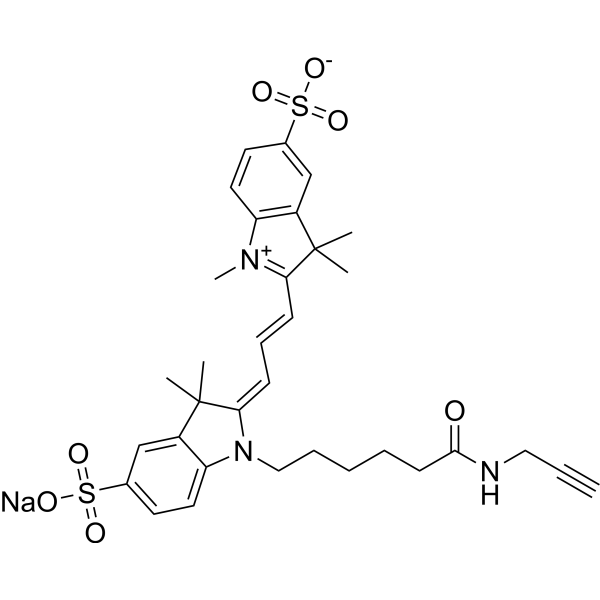
diSulfo-Cy3 alkyne is a water-soluble dye and a Click Chemistry reagent containing an alkyne group. Absorbance and emission of the dye are identical to Cy3 fluorophore. diSulfo-Cy3 alkyne can be used for the labeling of proteins, and even intact biological objects in water phase .
loading...
    loading...
Cat. No.: HY-124223
CAS No.: 118290-27-0
Target:  

mAChR

Research Areas:  

Neurological Disease

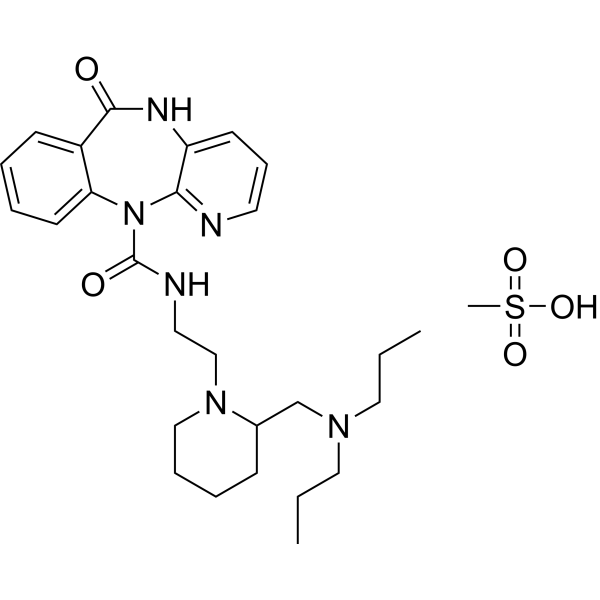
AF-DX 384 (methanesulfonate) is a selective antagonist of M2 and M4 muscarinic acetylcholine receptors (Kis=6.03 and 10 nM, respectively) . AF-DX 384 (methanesulfonate) reverses deficits in novel object recognition and passive avoidance in aged rats, as well as in young rats with impairments induced by scopolamine .
loading...
    loading...
Cat. No.: HY-W034154
CAS No.: 19529-00-1
Synonyms: Tetrakis(triphenylphosphine)ruthenium dihydride
Dihydridotetrakis(triphenylphosphine)ruthenium(II) (Tetrakis(triphenylphosphine)ruthenium dihydride) is a catalyst with good catalytic activity. Dihydridotetrakis(triphenylphosphine)ruthenium(II) can be used in organic synthesis reactions, especially in hydrogenation and dehydrogenation reactions. Dihydridotetrakis(triphenylphosphine)ruthenium(II) has received extensive attention in the study of metal catalysts, and its high efficiency makes it an ideal research object.
loading...
    loading...
Cat. No.: HY-133732
CAS No.: 60719-83-7
Synonyms: GEA 654 hydrochloride; A03 hydrochloride
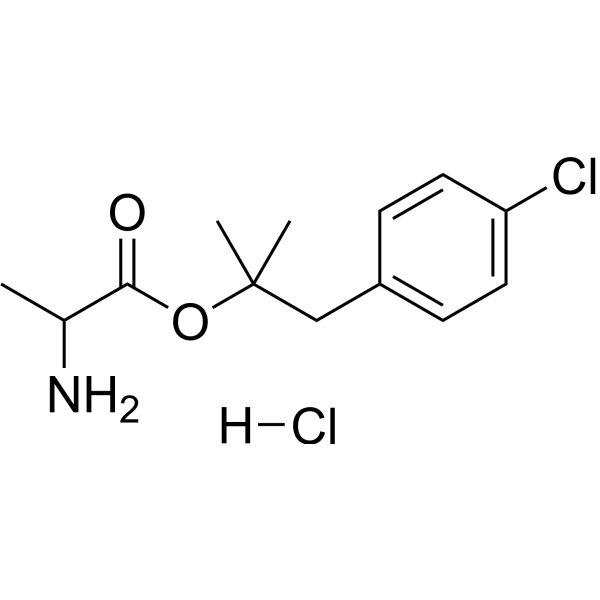
Alaproclate (GEA 654) hydrochloride is a selective and orally active serotonin re-uptake inhibitor (SSRI). Alaproclate hydrochloride also acts as a potent, reversible and noncompetitive antagonist of the NMDA receptor coupled ion flow .
loading...
    loading...
Cat. No.: HY-120783
CAS No.: 1531592-40-1
Target:  

Endogenous Metabolite

Research Areas:  

Neurological Disease

Lu AF58801 is a potent, orally available, brain-penetrant positive allosteric modulator of α7 nicotinic acetylcholine receptors with efficacy in a novel object recognition task in mice. Lu AF58801 was shown to selectively enhance the activity of α7 nicotinic acetylcholine receptors. Lu AF58801 was able to improve cognitive function in mice treated with subchronic fluchlorothiazol (PCP) .
loading...
    loading...
Cat. No.: HY-123459
CAS No.: 137431-04-0
Synonyms: ABT-232; NS-49; PNO-49B
Target:  

Adrenergic Receptor

Research Areas:  

Endocrinology

Garomefrine hydrochlorid (ABT-232) is an α1A-adrenergic agonist with the potential to inhibit urinary incontinence. Garomefrine hydrochlorid showed the greatest contractility in pig nasal mucosal vessels. The biological activity of Garomefrine hydrochlorid has been shown to give it a competitive advantage compared to other drugs. The potency of Garomefrine hydrochlorid makes it a valuable research object in related research .
loading...
    loading...
Cat. No.: HY-117560
CAS No.: 164025-33-6
Target:  

GABA Receptor

Research Areas:  

Neurological Disease

PWZ-029 is a selective inverse agonist for 5 GABAA receptors. PWZ-029 is a benzodiazepine site ligand. PWZ-029 shows a weak but significant partial agonistic effect at 1- and 3-containing receptors. PWZ-029 significantly increases retention session latency in mouse fibroblast cells. PWZ-029 can improve object recognition in normal and scopolamine-treated rat model .
loading...
    loading...
Cat. No.: HY-117408
CAS No.: 2011034-33-4
Purity:  99.61%
Target:  

mAChR

Research Areas:  

Neurological Disease

VU6004256 is a potent and selective M1 muscarinic positive allosteric modulator (PAM) with an EC50 value of 155 nM. VU6004256 has the potential for the research of schizophrenia .
loading...
    loading...
Cat. No.: HY-N0307R
CAS No.: 114902-16-8
Ciwujianoside B (Standard) is the analytical standard of Ciwujianoside B. This product is intended for research and analytical applications. Ciwujianoside B is an orally active, blood-brain barrier penetrable radioprotective agent and memory enhancer. Ciwujianoside B reduces radiation-induced DNA damage, cell cycle arrest and apoptosis, downregulates NF-κB and the Bax/Bcl-2 ratio, and enhances the proliferative capacity of bone marrow cells. Ciwujianoside B enhances object recognition memory in normal mice and induces dendritic extension in primary cultured cortical neurons. Ciwujianoside B can be used in studies related to hematopoietic system radiation injury and memory enhancement.
loading...
    loading...
Cat. No.: HY-155330
Research Areas:  

Neurological Disease

PZ-1922 (Compound 16) is a BBB-penetrable 5-HT6R/5-HT3R antagonist (Ki: 17 nM, 0.45 nM for 5-HT6R/5-HT3R respectively). PZ-1922 reversibly inhibits MAO-B (pIC50: 8.93). PZ-1922 reverses Scopolamine (SCOP) (HY-N0296) induced memory deficits in the novel object recognition (NOR) test in rats. PZ-1922 prevents Aβ-induced memory decline in the T-maze test .
loading...
    loading...
Cat. No.: HY-155330A
CAS No.: 1648745-65-6
Research Areas:  

Neurological Disease

PZ-1922 free base is a BBB-penetrable 5-HT6R/5-HT3R antagonist (Ki: 17 nM, 0.45 nM for 5-HT6R/5-HT3R respectively). PZ-1922 free base reversibly inhibits MAO-B (pIC50: 8.93). PZ-1922 free base reverses Scopolamine (SCOP) (HY-N0296) induced memory deficits in the novel object recognition (NOR) test in rats. PZ-1922 free base prevents Aβ-induced memory decline in the T-maze test .
loading...
    loading...
Cat. No.: HY-101384
CAS No.: 189744-46-5
Target:  

Dopamine Receptor

Research Areas:  

Neurological Disease

Ro 10-5824 is a potent and selective D4R partial agonist with a Ki of 5.2 nM. Ro 10-5824 increases novel object exploration in C57 mice .
loading...
    loading...
Cat. No.: HY-10936R
CAS No.: 175340-20-2
Research Areas:  

Neurological Disease

S 18986 (Standard) is the analytical standard of S 18986 (HY-10936). This product is intended for research and analytical applications. S 18986 is a selective, orally active, brain penetrant positive allosteric modulator of AMPA-type receptors. S 18986 shows cognitive enhancing properties in rodents. S 18986 activates the release of noradrenaline and acetylcholine in rat hippocampus and enhances rat memory in object-recognition tests .
loading...
    loading...
Cat. No.: HY-184052
CAS No.: 1809612-31-4
Target:  

5-HT Receptor

Research Areas:  

Neurological Disease

5-HT4R agonist-3 is a 5-HT4R agonist with an EC50 of 22 nM. 5-HT4R agonist-3 selectively modulates 5-HT4R and induces pro-cognitive activity. 5-HT4R agonist-3 can be used in research related to Alzheimer's disease .
loading...
    loading...
Cat. No.: HY-186284
CAS No.: 2245952-60-5
Target:  

Estrogen Receptor/ERR

Research Areas:  

Neurological Disease Endocrinology

EGX358 is a selective, orally active estrogen receptor β (ERβ) agonist with an EC50 of 27.4 nM for ERβ. EGX358 enhances object recognition ability, spatial memory and memory consolidation, and attenuates drug-induced vasomotor responses. EGX358 alleviates partial uterine atrophy without inducing uterine hypertrophy, while it does not alter anxiety-like behavior, depression-like behavior or body weight. EGX358 can be used in research related to Alzheimer's disease and menopause .
loading...
    loading...
Cat. No.: HY-187700
Research Areas:  

Neurological Disease

BRD3290 is a GluA3-preferring AMPA receptor positive allosteric modulator with brain exposure in Mus musculus (mice) following peripheral administration. BRD3290 preferentially potentiates GluA3-containing AMPA receptors over GluA1/2-containing AMPA receptors. BRD3290 increases cerebellar cGMP levels in Mus musculus (mice). BRD3290 does not induce convulsions, alter motor function, or improve novel object recognition task performance in Mus musculus (mice) at tested doses. BRD3290 can be used for the research of schizophrenia .
loading...
    loading...
Cat. No.: HY-179724A
PZ-1657 hydrochloride (Compound 57) is a potent, selective and orally active 5-HT7 receptor inverse agonist with a Ki of 5 nM. PZ-1657 hydrochloride can inhibit the constitutive cAMP production mediated by the Gs signaling pathway (EC50 = 2.93 nM). PZ-1657 hydrochloride can significantly reduce the MMP-9 activity mediated by 5-HT7 receptors in the hippocampus of mice, and the effect is comparable to that of SB-269970 (HY-15370). PZ-1657 hydrochloride can reverse the cognitive deficits observed in the rat novel object recognition test induced by Phencyclidine without affecting the animals' spontaneous activities. PZ-1657 hydrochloride can be used for the research of emotional disorders, such as depression and bipolar disorder .
loading...
    loading...

