36 Results for "

outward current

" in MedChemExpress (MCE) Product Catalog:
Products (36)

36 Results for "outward current" in MCE Product Catalog:

Cat. No.: HY-B1302R
CAS No.: 6151-40-2
Quinidine hydrochloride monohydrate (Standard) is the analytical standard of Quinidine hydrochloride monohydrate (HY-B1302). This product is intended for research and analytical applications. Quinidine hydrochloride monohydrate is an orally active antiarrhythmic agent. Quinidine hydrochloride monohydrate reduces the expression level of P-gp, inhibits P-gp-mediated efflux, increases the intracellular accumulation of P-gp substrates, induces PARP cleavage and Caspase-3 activation, and elevates the proportion of Apoptotic cells at the sub-G1 phase. Quinidine hydrochloride monohydrate exerts sustained block and open-channel block effects on IK(f). Quinidine hydrochloride monohydrate alters the urinary metabolic ratio of Amphetamine, modulates the Pentylenetetrazol-induced seizure threshold, and regulates the anticonvulsant effect of Dextromethorphan. Quinidine hydrochloride monohydrate can be used in studies related to uterine sarcoma and seizures .
loading...
    loading...
Cat. No.: HY-119211
CAS No.: 72456-63-4
Target:  

Potassium Channel

Research Areas:  

Neurological Disease

LY 97241 accelerates the apparent rate of inactivation of transient outward K current. LY 97241 is an antiarrhythmic drug .
loading...
    loading...
Cat. No.: HY-P5921
CAS No.: 152618-71-8
Synonyms: TsTx-Kα
Target:  

Potassium Channel

Research Areas:  

Neurological Disease

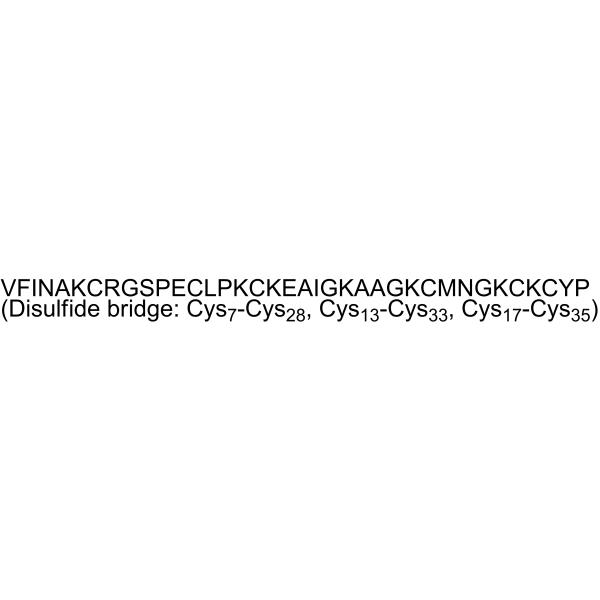
Tityustoxin-Kα (TsTx-Kα) is an inhibitor of potassium voltage-gated channels. Tityustoxin-Kα shows a dose-dependent block of the sustained outward current in cultured hippocampal neurons .
loading...
    loading...
Cat. No.: HY-12773A
CAS No.: 86383-32-6
Synonyms: GPV-129 hydrochloride
Target:  

Drug Metabolite

Research Areas:  

Cardiovascular Disease

5-Hydroxy Propafenone (hydrochloride) is an inhibitor of cardiac myocyte repolarizing currents. 5-Hydroxy Propafenone is an active metabolite of propafenone. 5-Hydroxy Propafenone (hydrochloride) inhibits transient outward potassium current (Ito) in isolated human arterial myocytes with an IC50 of 1.5 μM. 5-Hydroxy Propafenone (hydrochloride) is potent Ito inhibitor in neonatal rat ventricular myocytes .
loading...
    loading...
Cat. No.: HY-126704
CAS No.: 90961-53-8
Synonyms: KC-8857
Target:  

Potassium Channel

Research Areas:  

Cardiovascular Disease

Tedisamil (KC-8857) is an antiarrhythmic compound with important biological activities. Tedisamil exhibits a significant slowing effect on heart rate, which is achieved by inhibiting the transient outward potassium current (I(to)) in the atrium. Tedisamil inhibits multiple potassium currents, including IK, K(ATP), and PKA-activated chloride channels, thereby prolonging the cardiac action potential and QT interval, and increasing cardiac reentry. Tedisamil has antiarrhythmic effects on ventricular arrhythmias and atrial flutter in animal models .
loading...
    loading...
Cat. No.: HY-B0432R
CAS No.: 54063-53-5
Synonyms: SA-79 (Standard)
Propafenone (Standard) is the analytical standard of Propafenone. This product is intended for research and analytical applications. Propafenone (SA-79), a sodium-channel blocker, acts an antiarrhythmic agent. Propafenone also has high affinity for the β receptor (IC50=32 nM) . Propafenone blocks the transient outward current (Ito) and the sustained delayed rectifier K current (Isus) with IC50 values of 4.9 μm and 8.6 μm, respectively . Propafenone suppresses esophageal cancer proliferation through inducing mitochondrial dysfunction and induce apoptosis .
loading...
    loading...
Cat. No.: HY-15691A
CAS No.: 1322001-35-3
PF-4455242 hydrochloride is an orally bioavailable, blood-brain barrier-permeable κ-opioid receptor (KOR) inhibitor. PF-4455242 hydrochloride blocks in vivo effects induced by KOR and MOR agonists, and elicits KOR-independent outward currents in ventral tegmental area neurons. PF-4455242 hydrochloride promotes energy expenditure and activates the hypothalamic mTOR pathway. PF-4455242 hydrochloride attenuates stress-induced behavioral effects and produces antidepressant-like effects. PF-4455242 hydrochloride can be used in studies related to pain, depression, addictive disorders, and obesity induced by estrogen withdrawal .
loading...
    loading...
Cat. No.: HY-19397
CAS No.: 275375-69-4
Research Areas:  

Neurological Disease

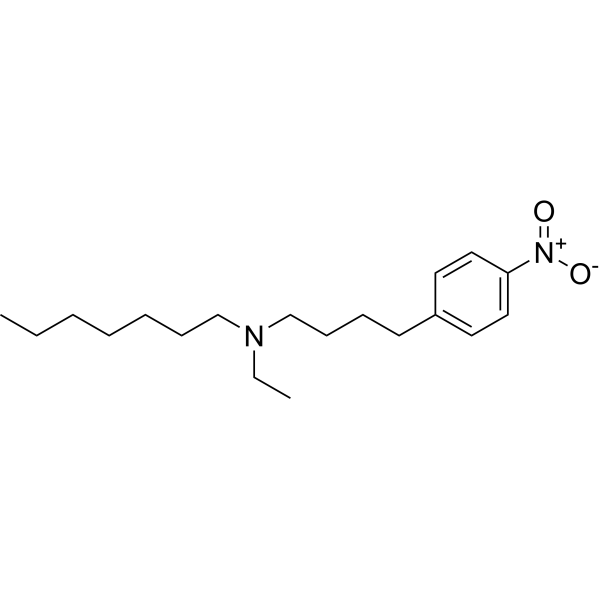
BMS-223131 (Compound 1) is a potent maxi-K potassium channel opener. BMS-223131 has a strong inhibitory effect on the CYP2C9 enzyme (IC50 = 1.7 μM) and also shows varying degrees of inhibition on other common CYP enzymes such as CYP1A2, CYP2C19, CYP2D6, and CYP3A4. BMS-223131 can enhance the outward current mediated by maxi-K, by promoting K + efflux to hyperpolarize the cell membrane and reducing Ca 2+ influx. BMS-223131 can be used for the research of neurological disease, such as stroke .
loading...
    loading...
Cat. No.: HY-B1751S1
Quinidine- 13C, d2 hydrochloride is the 13C, d2 labeled Quinidine hydrochloride (HY-W115674). Quinidine hydrochloride is an orally active antiarrhythmic agent. Quinidine hydrochloride reduces the expression level of P-gp, inhibits P-gp-mediated efflux, increases the intracellular accumulation of P-gp substrates, induces PARP cleavage and Caspase-3 activation, and elevates the proportion of Apoptotic cells at the sub-G1 phase. Quinidine hydrochloride exerts sustained block and open-channel block effects on IK(f). Quinidine hydrochloride alters the urinary metabolic ratio of Amphetamine, modulates the Pentylenetetrazol-induced seizure threshold, and regulates the anticonvulsant effect of Dextromethorphan. Quinidine hydrochloride can be used in studies related to uterine sarcoma and seizures .
loading...
    loading...
Cat. No.: HY-108608R
CAS No.: 313981-55-4
Research Areas:  

Others

o-3M3FBS (Standard) is the analytical standard of o-3M3FBS (HY-108608). This product is intended for research and analytical applications. o-3M3FBS is the negative control of m-3M3FBS. o-3M3FBS inhibits inward and outward currents via mechanisms independent of PLC acting in an antagonistic manner. In contrast, o-3M3FBS also causes an increase in [Ca2+]i in an agonistic manner .
loading...
    loading...
Cat. No.: HY-P5157
Target:  

Potassium Channel

Research Areas:  

Neurological Disease

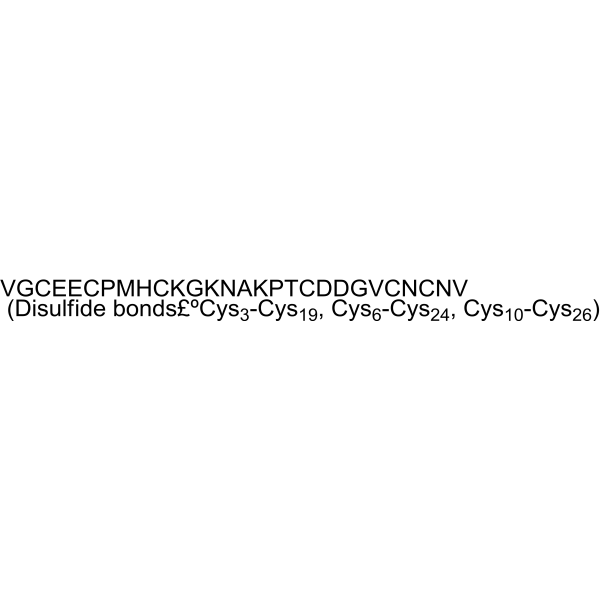
BmP02 is a selective Kv1.3 channel blocker and a highly-selective Kv4.2 modulator, which can be isolated from Chinese scorpion (Buthus martensi Karsch) venom. BmP02 also delays the inactivation of Kv4.2 in HEK293T cells, with an EC50 value of ~850 nM. BmP02 inhibits the transient outward potassium currents (Ito) in ventricular muscle cells .
loading...
    loading...
Cat. No.: HY-126704A
CAS No.: 132523-84-3
Synonyms: KC-8857 dihydrochloride
Target:  

Potassium Channel

Research Areas:  

Cardiovascular Disease

Tedisamil (KC-8857) dihydrochloride is an antiarrhythmic compound with important biological activities. Tedisamil dihydrochloride exhibits a significant slowing effect on heart rate, which is achieved by inhibiting the transient outward potassium current (I(to)) in the atrium. Tedisamil dihydrochloride inhibits multiple potassium currents, including IK, K(ATP), and PKA-activated chloride channels, thereby prolonging the cardiac action potential and QT interval, and increasing cardiac reentry. Tedisamil dihydrochloride has antiarrhythmic effects on ventricular arrhythmias and atrial flutter in animal models .
loading...
    loading...
Cat. No.: HY-FL14188
CAS No.: 19774-82-4
Amiodarone hydrochloride solution is mainly composed of Amiodarone hydrochloride (HY-14188). Amiodarone hydrochloride, a benzofuran-based Class III antiarrhythmic agent, inhibits WT outward ionic current (IhERG) tails with an IC50 of ∼45 nM . Amiodarone hydrochloride induces cell proliferation and myofibroblast differentiation via ERK1/2 and p38 MAPK signaling in fibroblasts . Amiodarone hydrochloride can be used in the research of both supraventricular and ventricular arrhythmias .
loading...
    loading...
Cat. No.: HY-18740
CAS No.: 79855-88-2
Synonyms: HL 725 free base
Research Areas:  

Endocrinology

Trequinsin (HL 725 free base) is a PDE inhibitor, CatSper channel activator, and sperm potassium channel modulator. Trequinsin targets PDE3 with an IC50 of <1 nM. Trequinsin enhances currents and elevates intracellular calcium and cGMP levels via direct activation of the CatSper channel, while inhibiting the outward current conductance of sperm potassium channels. Without inducing premature acrosome reaction, Trequinsin significantly enhances sperm hyperactivated motility, forward motility, and the ability to penetrate viscous media. Trequinsin exerts age-specific positive inotropic and positive lusitropic effects on rabbit ventricular papillary muscles. Trequinsin has been used in studies on the mechanisms underlying male infertility (e.g., asthenozoospermia) .
loading...
    loading...
Cat. No.: HY-107659R
CAS No.: 837424-39-2
YM-244769 hydrochloride (Standard) is the analytical standard of YM-244769 (hydrochloride) (HY-107659). This product is intended for research and analytical applications. YM-244769 hydrochloride is a potent, selective and orally active Na+/Ca2+ exchanger (NCX) inhibitor. YM-244769 hydrochloride preferentially inhibits NCX3 and suppresses the unidirectional outward NCX current (Ca2+ entry mode), with IC50s of 18 nM and 50 nM, respectively. YM-244769 hydrochloride efficiently protects against hypoxia/reoxygenation-induced SH-SY5Y neuronal cell damage. YM-244769 hydrochloride can also increase urine volume and urinary excretion of electrolytes in mice .
loading...
    loading...
Cat. No.: HY-W115674
CAS No.: 1668-99-1
Quinidine hydrochloride is an orally active antiarrhythmic agent. Quinidine hydrochloride reduces the expression level of P-gp, inhibits P-gp-mediated efflux, increases the intracellular accumulation of P-gp substrates, induces PARP cleavage and Caspase-3 activation, and elevates the proportion of Apoptotic cells at the sub-G1 phase. Quinidine hydrochloride exerts sustained block and open-channel block effects on IK(f). Quinidine hydrochloride alters the urinary metabolic ratio of Amphetamine, modulates the Pentylenetetrazol-induced seizure threshold, and regulates the anticonvulsant effect of Dextromethorphan. Quinidine hydrochloride can be used in studies related to uterine sarcoma and seizures .
loading...
    loading...

