45 Results for "

visual

" in MedChemExpress (MCE) Product Catalog:
Products (45)

45 Results for "visual" in MCE Product Catalog:

Cat. No.: HY-175663
Target:  

RPE65

Domaines de recherche:  

Metabolic Disease

EYE-002 is a RPE65 inhibitor with an IC50 of 69 nM. EYE-002 promotes recovery of scotopic ERG a-/b-wave amplitudes. EYE-002 regulates the visual cycle in mice by reducing 11-cis-retinal (11cRAL) (HY-116711) synthesis and increasing all-trans-retinyl esters (atREs). EYE-002 exerts protective effects against photic retinal damage in mice. EYE-002 can be used for the study of visual cycle-associated retinopathies, such as Stargardt disease type 1 (STGD1) .
loading...
    loading...
Cat. No.: HY-175664
Target:  

RPE65

Domaines de recherche:  

Metabolic Disease

EYE-003 is an orally active RPE65 inhibitor with an IC50 of 102 nM. EYE-003 regulates the visual cycle in mice by reducing 11-cis-retinal (11cRAL) (HY-116711) synthesis and increasing all-trans-retinyl esters (atREs). EYE-003 suppresses scotopic ERG b-wave amplitude and exerts protective effects against retinal degeneration in Abca4 ⁻/⁻ Rdh8 ⁻/⁻ mice (a STGD1 model) by reducing retinal autofluorescent puncta and preserving outer nuclear layer (ONL) thickness in a dose-dependent manner. EYE-003 can be used for the study of visual cycle-associated retinopathies, such as Stargardt disease type 1 (STGD1) .
loading...
    loading...
Cat. No.: HY-137016
CAS No.: 54364-02-2
Target:  

HCN Channel

Domaines de recherche:  

Neurological Disease

8-Pcpt-cGMP is an agonist for cyclic nucleotide-gated (CNG) channel with an EC50 of 0.5 μM. 8-Pcpt-cGMP exhibits good membrane permeability. 8-Pcpt-cGMP can be used in studies about the function of CNG channels in visual signal transduction and olfactory transduction .
loading...
    loading...
Cat. No.: HY-W110780
CAS No.: 845-10-3
Methyl red sodium is a pH-sensitive acid-base indicator and colorimetric reagent with a pKa of 5.1. Methyl red sodium achieves visual judgment of the titration endpoint through reversible structural changes of protonation (red, pH < 4.4) and deprotonation (yellow, pH > 6.2). Methyl red sodium is widely used in acid-base titration in chemical analysis and buffer pH monitoring in biochemistry .
loading...
    loading...
Cat. No.: HY-D2338
PMBD is a lysosome (Lyso)-targeting fluorescent probe. PMBD selectively and sensitively detects endogenous N-acylethanolamine amidase (NAAA), allowing real-time visual monitoring of endogenous NAAA in living cells. PMBD has a maximum absorption peak at 350 nm. After the metabolism of NAAA, the maximum absorption peak of the product AMBD shifts red to 450 nm, and a significant fluorescence emission signal appears at 550 nm .
loading...
    loading...
Cat. No.: HY-Y0699R
CAS No.: 493-52-7
Methyl red (Standard) is the analytical standard of Methyl red (HY-Y0699). This product is intended for research and analytical applications. Methyl red is a pH-sensitive acid-base indicator and colorimetric reagent with a pKa of 5.1. Methyl red achieves visual judgment of the titration endpoint through reversible structural changes of protonation (red, pH < 4.4) and deprotonation (yellow, pH > 6.2). Methyl red is widely used in acid-base titration in chemical analysis and buffer pH monitoring in biochemistry .
loading...
    loading...
Cat. No.: HY-167632
CAS No.: 31272-50-1
Synonyms: (3R,3′S)-Zeaxanthin
meso-Zeaxanthin ((3R,3′S)-Zeaxanthin) is an orally active xanthophyll carotenoid. meso-Zeaxanthin inhibits CYP1A1, CYP1A2, CYP2B1/2, COX-2, TNF-α and iNOS, and enhances the activities of Uridine diphosphate glucuronosyltransferase and Glutathione-S-transferase. meso-Zeaxanthin quenches oxygen free radicals. meso-Zeaxanthin filters short-wavelength blue light, alleviates oxidative damage and visual abnormalities. meso-Zeaxanthin reduces tumor incidence, prolongs tumor latency and survival rate of tumor-bearing mice, and inhibits paw edema. meso-Zeaxanthin can be used in research related to sarcoma and age-related macular degeneration .
loading...
    loading...
Cat. No.: HY-136564A
Target:  

Potassium Channel

Domaines de recherche:  

Neurological Disease

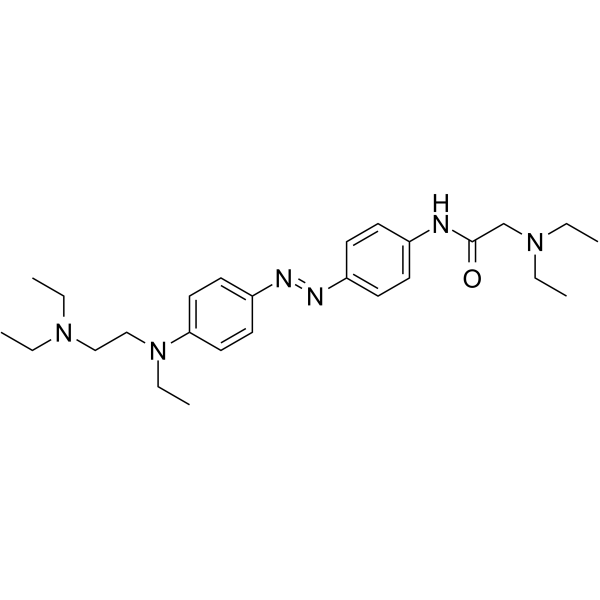
DAD is a type of ion channel blocker that blocks voltage-gated potassium channels. DAD is a third-generation photoswitch that responds to visible light. DAD has the potential for restoring visual function .
loading...
    loading...
Cat. No.: HY-136564
Target:  

Potassium Channel

Domaines de recherche:  

Neurological Disease

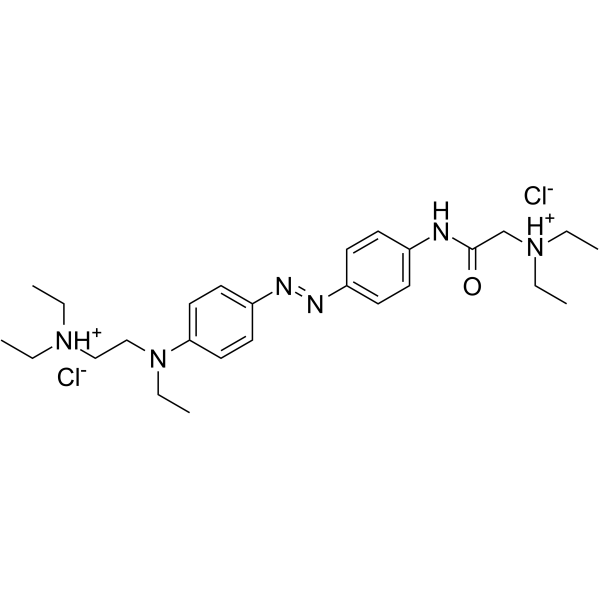
DAD dichloride is a type of ion channel blocker that blocks voltage-gated potassium channels. DAD dichloride is a third-generation photoswitch that responds to visible light. DAD dichloride has the potential for restoring visual function .
loading...
    loading...
Cat. No.: HY-100743R
CAS No.: 6323-99-5
Synonyms: 2-Amino-4-phosphonobutyric acid (Standard)
Domaines de recherche:  

Neurological Disease Metabolic Disease

DL-AP4 (Standard) is the analytical standard of DL-AP4. This product is intended for research and analytical applications. DL-AP4 (2-Amino-4-phosphonobutyric acid) is a glutamate antagonist. DL-AP4 behaves as a competitive inhibitor of glutamate binding with an apparent Kd of 66 μM. DL-AP4 can be used for the research of central nervous system and visual system .
loading...
    loading...
Cat. No.: HY-110262
CAS No.: 1124381-43-6
Target:  

MAP3K p38 MAPK

Domaines de recherche:  

Inflammation/Immunology

MSC 2032964A is an orally active, selective inhibitor for apoptosis signal-regulating kinase 1(ASK1) with IC50 of 96 nM. MSC 2032964A preserves the visual responses in EAE mice model and exhibits potency in ameliorating the neuroinflammation .
loading...
    loading...
Cat. No.: HY-W145108
CAS No.: 63451-28-5
Methyl red hydrochloride is a pH-sensitive acid-base indicator and colorimetric reagent with a pKa of 5.1. Methyl red hydrochloride achieves visual judgment of the titration endpoint through reversible structural changes of protonation (red, pH < 4.4) and deprotonation (yellow, pH > 6.2). Methyl red hydrochloride is widely used in acid-base titration in chemical analysis and buffer pH monitoring in biochemistry .
loading...
    loading...
Cat. No.: HY-N2125R
CAS No.: 174972-80-6
Parishin C (Standard) is the analytical standard of Parishin C (HY-N2125). This product is intended for research and analytical applications. Parishin C is a brain-penetrant major bioactive component found in Gastrodia elata Blume. Parishin C is a 5-HT1A receptor agonist with an EC50 of 34 nM. Parishin C has antipsychotic and neuroprotective effects. Parishin C protects against Aβ-induced long-term potentiation damage and NMDA receptor current impairment. Parishin C reduces oxidative stress, pro-inflammatory cytokine levels, caspase activity, brain water content, and cerebral infarct volume; increases antioxidant enzyme activity and BDNF levels; improves nerve function and histopathological brain damage. Parishin C attenuates phencyclidine-induced immobility time increases, sociability deficits, and visual recognition memory impairment. Parishin C can be used for the research of ischemic stroke, Alzheimer's disease, and schizophrenia-like psychosis .
loading...
    loading...
Cat. No.: HY-D3267
CAS No.: 1314527-28-0
ACu1 is a copper (I)-selective two-photon fluorescent probe that enables the visual imaging of Cu + distribution in living cells and tissues .
loading...
    loading...
Cat. No.: HY-D2975
TTVP is a high-performance, blood activated AIE near-infrared fluorescent probe. TTVP can display hemorrhagic areas in the mouse brain with ultra sensitivity and high contrast specificity. TTVP provides a visual assessment tool for the study of hemorrhagic conditions .
loading...
    loading...
Cat. No.: HY-P810789
Synonyms: ARR1, ARRB1, Beta-arrestin-1, Arrestin beta-1, Non-visual arrestin-2

Host:  

Rabbit

Application:  

WB

Reactivity:  

Human

loading...
    loading...
Cat. No.: HY-P811657
Synonyms: ARB2, ARR2, ARRB2, Beta-arrestin-2, Arrestin beta-2, Non-visual arrestin-3

Host:  

Rabbit

Application:  

WB, IHC-P, IF-Tissue, IP, ELISA

Reactivity:  

Human, Mouse, Rat

loading...
    loading...
Cat. No.: HY-120291
CAS No.: 1401807-89-3
Domaines de recherche:  

Neurological Disease

ASP9436 is an orally active and blood-brain barrier permeable PDE10A inhibitor with an IC50 of 8 nM against human PDE10A. ASP9436 attenuates locomotor activity in mouse hyperactivity models and ameliorates visual recognition memory impairment in neonatal mice. ASP9436 is applicable to research related to schizophrenia .
loading...
    loading...
Cat. No.: HY-119059
CAS No.: 946249-82-7
Target:  

RPE65

Domaines de recherche:  

Metabolic Disease

CU239 is a potent and competitive non-retinoic acid inhibitor of RPE65 with an IC50 for RPE65 isomerase (11-cis retinal) of 6 μM. CCU239 exhibits delayed chromophore regeneration after light bleach, and conferrs a partial protection of the retina against injury from high intensity light. CU239 can be used for the study of retinal degeneration .
loading...
    loading...
Cat. No.: HY-D3392
Thalidomide-cyanine 5 is a fluorescent probe prepared by conjugating the CRBN binder Thalidomide (HY-14658) with the near-infrared fluorescent dye Cy5. Thalidomide-cyanine 5 binds to DDB1-CRBN protein complex with a Kd of 121.6 nM. Thalidomide-cyanine 5 binds to CRBN to form a binary complex, and is mainly used for the visual tracking research of degradants such as PROTAC (Ex/Em = 650/665 nm) .
loading...
    loading...

