


87 Results for "

CAMKII

" in MedChemExpress (MCE) Product Catalog:
Products (87)

87 Results for "CAMKII" in MCE Product Catalog:

Cat. No.: HY-P10638A
Target:  

CaMK

TAT-CN21 (scrambled) is a nonsense sequence control peptide fused with the TAT cell-penetrating sequence. It exerts no inhibitory effect on CaMKII activity and serves as a negative control for TatCN21 (HY-P10638) .
loading...
    loading...
Cat. No.: HY-171932A
Target:  

CaMK

Research Areas:  

Cardiovascular Disease

CaMKIIδ-IN-1 (Compound 15e) hydrochloride is a pyrimidine-based inhibitor of CaMKIIδ with an IC50 of 12 nM .
loading...
    loading...
Cat. No.: HY-134261
CAS No.: 59259-77-7
Synonyms: 8-Bromoadenosine-5'-O-diphosphoribose
Target:  

TRP Channel CaMK

Research Areas:  

Metabolic Disease Cancer

8-Br-ADPR (8-Bromoadenosine-5'-O-diphosphoribose) is a TRPM2 inhibitor and ADPR signaling pathway antagonist. 8-Br-ADPR inhibits glucagon-mediated nuclear calcium signaling and downstream CaMKII/CREB phosphorylation by blocking ADPR-induced TRPM2 activation. 8-Br-ADPR significantly reduces gluconeogenic gene expression and blood glucose levels in diabetic models. 8-Br-ADPR effectively blocks ADPR-mediated calcium signal transduction in NK cells, inhibits immune synapse formation, granzyme B release and cytolytic activity against melanoma cells. 8-Br-ADPR is widely used in studies related to diseases such as diabetes, melanoma and lymphoma .
loading...
    loading...
Cat. No.: HY-P5525
Synonyms: Autocamtide-3 Derived Inhibitory Peptide
Target:  

CaMK

Research Areas:  

Others

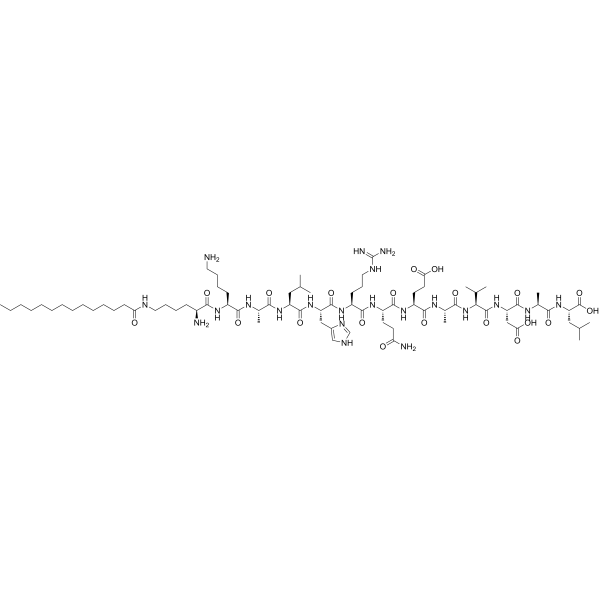
AC3-I, myristoylated is a biological active peptide. (This is a myristoylated form of Autocamtide-3-Derived Inhibitory Peptide (AC3-I), a highly specific inhibitor of Calmodulin-Dependent Protein Kinase ll (CaMKII) that is resistant to proteolysis. AC3-I is derived from Autocamtide-3, a substrate for CaMKII, with the Thr-9 phosphorylation site substituted with Ala.)
loading...
    loading...
Cat. No.: HY-P5961
CAS No.: 289652-77-3
Research Areas:  

Others

Chktide is a synthetic peptide substrate applicable for activity assays of Chk1 kinase and cyk/CaMKII. Chktide contains the Ser53 phosphorylation site of Xenopus cyclin B2 .
loading...
    loading...
Cat. No.: HY-P0271
CAS No.: 108334-68-5
Target:  

CaMK Autophagy

Research Areas:  

Neurological Disease

Syntide 2, a Ca 2+- and calmodulin (CaM)-dependent protein kinase II (CaMKII) substrate peptide, selectively inhibits the gibberellin (GA) response, leaving constitutive and abscisic acid-regulated events unaffected .
loading...
    loading...
Cat. No.: HY-137658
CAS No.: 23197-96-8
Synonyms: PTP
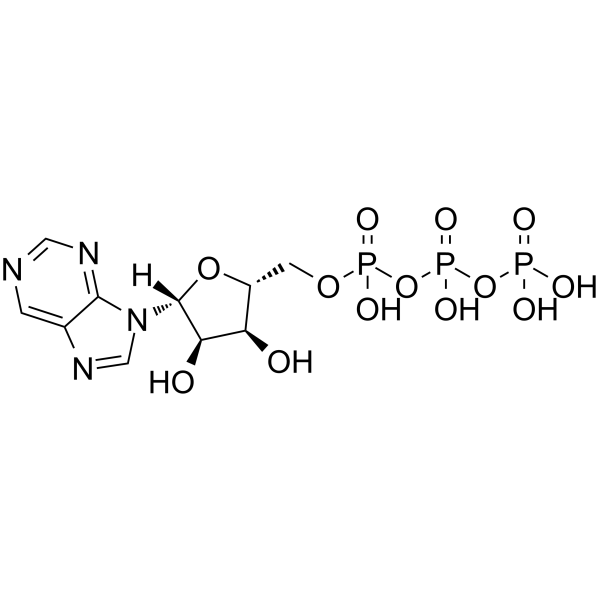
Purine riboside-5'-O-triphosphate, an active metabolite of Nebularine (HY-103694), acts as an inhibitor of DNA primase ATP and GTP polymerization activities, with IC50 values of 35 µM and 28 µM for the human enzyme, respectively. Purine riboside-5'-O-triphosphate also inhibits calmodulin-dependent protein kinase II (CaMKII) with a Ki value of 590 µM .
loading...
    loading...
Cat. No.: HY-15136R
CAS No.: 193275-84-2
Synonyms: Sch66336 (Standard)
Lonafarnib (Standard) (Sch66336 (Standard)) is the analytical standard of Lonafarnib (HY-15136). This product is intended for research and analytical applications. Lonafarnib (Sch66336) is an orally active, blood-brain barrier penetrant farnesyltransferase (FPTase) inhibitor. Lonafarnib increases the phosphorylation levels of Akt, CaMKII and CREB, upregulates BDNF expression in the hippocampus, elevates the content of α7nAChR on cell membranes, and blocks the isoprenylation of H-Ras. Lonafarnib repairs synapses and reverses spatial memory deficits in Aβ1-42 model mice. Lonafarnib inhibits RSV fusion and replication, and alleviates virus-induced lung injury. Lonafarnib activates the lysosomal and autophagic pathways, and reduces the phosphorylation and aggregation of tau. Lonafarnib acts synergistically with Sorafenib (HY-10201) to promote apoptosis, and inhibits the proliferation and invasion of melanoma cells. Lonafarnib inhibits the farnesylation of progerin, repairs nuclear membrane defects, and activates the cGAS-STING-STAT1 signaling pathway. Lonafarnib can be used in research related to diseases including Alzheimer's disease, viral infections, melanoma, and progeria .
loading...
    loading...
Cat. No.: HY-P5987
Synonyms: Myr-CAMKIINtide
Target:  

CaMK

Research Areas:  

Neurological Disease

Calmodulin Kinase IINtide, Myristoylated (Myr-CaMKIINtide) is a selective and noncompetitive inhibitor of CaMKII .
loading...
    loading...
Cat. No.: HY-P3811
CAS No.: 142828-10-2
Target:  

CaMK

Research Areas:  

Neurological Disease

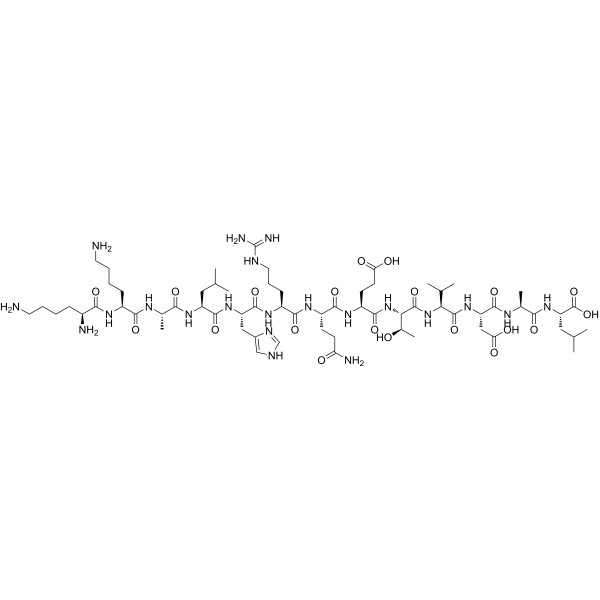
Autocamtide-3, a 13-amino-acid peptide containing Thr287, is a selective CaMKII (Ca 2+/calmodulin-dependent kinase II) (CaMK) substrate .
loading...
    loading...
Cat. No.: HY-P10499
CAS No.: 141055-85-8
Target:  

CaMK

Research Areas:  

Others

[Ala286]-Calmodulin-Dependent Protein Kinase II (281-302) is a modified fragment of calcium/calmodulin-dependent protein kinase II that contains the active domain of CaMKII and has an alanine substitution at position 286. [Ala286]-Calmodulin-Dependent Protein Kinase II (281-302) can be used to develop more potent CaMKII inhibitors .
loading...
    loading...
Cat. No.: HY-P10367
CAS No.: 518069-98-2
Research Areas:  

Others

Ziptide is a substrate for MAPK activated protein kinase 2 (MAPKAPK2, Km = 5 μM), MAPKAPK3 (Km = 30 μM), PARK (Km = 40 μM), checkpoint kinase 1 (Chk1, Km = 5 μM), AMP-activated protein kinase (AMPK, Km = 75 μM), and calcium/calmodulin-dependent protein kinase II (CamKII, Km = 300 μM) .
loading...
    loading...
Cat. No.: HY-RS01855
Research Areas:  

Others

Camk2a Mouse Pre-designed siRNA Set A contains three designed siRNAs for Camk2a gene (Mouse), as well as a negative control, a positive control, and a FAM-labeled negative control.

loading...
    loading...
Cat. No.: HY-162860
CAS No.: 1030759-58-0
Target:  

mGluR CaMK Tau Protein

Research Areas:  

Neurological Disease

FO-4-15 is an mGluR1/CaMKIIα activator. FO-4-15 has a protective effect against H2O2 in human neuroblastoma (SH-SY5Y) cells. FO-4-15 can improve cognitive impairment in Alzheimer’s disease mice by activating the mGluR1/CaMKIIα pathway, and can reduce accumulation, hyperphosphorylated Tau, and synaptic damage .
loading...
    loading...
Cat. No.: HY-156104
CAS No.: 2481744-33-4
Target:  

PROTACs CaMK

Research Areas:  

Neurological Disease

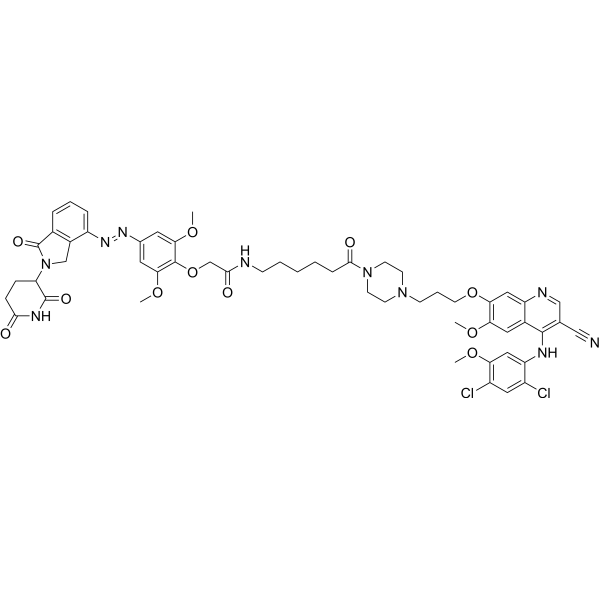
CaMKIIα-PHOTAC is a photochemically targeted chimera (PHOTAC) targeting Ca2+/calmodulin-dependent protein kinase II α (CaMKIIα). Molecules such as PHOTAC can catalyze the ubiquitination and degradation of target proteins through the endogenous proteasome under specific wavelengths of light. CaMKIIα-PHOTAC reduces synaptic function under light conditions, and it attenuates the intensity of evoked field excitatory postsynaptic potentials in the mouse hippocampus in response to physiological stimuli. CaMKIIα-PHOTAC plays a critical role in maintaining long-term potentiation and memory capacity in subcellular dendritic domains .
loading...
    loading...
Cat. No.: HY-135167
CAS No.: 867178-11-8
Target:  

CaMK

Research Areas:  

Neurological Disease

HOCPCA is a compound with neuroprotective activity that improves sensorimotor function in mice after experimental stroke. HOCPCA selectively binds to the CaMKIIα hub domain, modulates signaling of different CaMKII pools, and alleviates abnormal CaMKII signaling after cerebral ischemia. HOCPCA promotes hippocampal neuronal activity and enhances working memory. HOCPCA also normalizes Thr286 autophosphorylation in the cytoplasm after ischemia and downregulates ischemia-specific expression of active CaMKII enzymatic cleavage fragments. HOCPCA binds to the GHB binding site with 27-fold higher affinity than GHB and has good blood-brain barrier penetration ability .
loading...
    loading...
Cat. No.: HY-111093
CAS No.: 926319-75-7
Target:  

CaMK

Research Areas:  

Neurological Disease

Protein kinase inhibitor 8 (Compound CK59) is a calmodulin-dependent protein kinase II (CaMKII) inhibitor. By inhibiting the activity of CaMKII, Protein kinase inhibitor 8 can attenuate the cytotoxicity induced by perfluorooctane sulfonic acid (PFOS) and alleviate the downregulation of GLT-1 expression caused by PFOS, thereby reducing neuronal damage. Protein kinase inhibitor 8 may be useful in research related to neurodegenerative diseases .
loading...
    loading...
Cat. No.: HY-P0215A
Target:  

CaMK Autophagy

Research Areas:  

Neurological Disease

Autocamtide-2-related inhibitory peptide, myristoylated TFA is the myristoylated Autocamtide-2-related inhibitory peptide. Autocamtide-2-related inhibitory peptide is a highly specific and potent inhibitor of CaMKII with an IC50 of 40 nM .
loading...
    loading...
Cat. No.: HY-163978
CAS No.: 1350113-04-0
Target:  

Adenosine Receptor

Research Areas:  

Neurological Disease

YGZ-331 is a sedative with a calming effect. YGZ-331 is a derivative of the adenosine nucleoside NGBA, which can increase GABA levels. YGZ-331 exerts a sedative-hypnotic effect by activating A1R and A2aR, and inhibiting CaMKII phosphorylation (pCaMKII) levels. YGZ-331 can reduce the spontaneous motor activity of mice .
loading...
    loading...
Cat. No.: HY-137658A
CAS No.: 35892-95-6
Synonyms: PTP tetrasodium
Purine riboside-5'-O-triphosphate sodium, an active metabolite of Nebularine (HY-103694), acts as an inhibitor of DNA primase ATP and GTP polymerization activities, with IC50 values of 35 µM and 28 µM for the human enzyme, respectively. Purine riboside-5'-O-triphosphate sodium inhibits calmodulin-dependent protein kinase II (CaMKII) with a Ki value of 590 µM .
loading...
    loading...