83 Results for "

degranulation

" in MedChemExpress (MCE) Product Catalog:
Products (83)

83 Results for "degranulation" in MCE Product Catalog:

Cat. No.: HY-101225
CAS No.: 1451210-48-2
Research Areas:  

Inflammation/Immunology

8 Hydroxy PIPAT oxalate is a 5-HT1A receptor agonist that promotes histamine release. 8 Hydroxy PIPAT oxalate selectively activates 5-HT1A receptors, thereby triggering mast cell degranulation and histamine release. 8 Hydroxy PIPAT oxalate is applicable to research related to irritable bowel syndrome .
loading...
    loading...
Cat. No.: HY-161815
Anti-inflammatory agent 89 is a multi-target glucocorticoid-isothiocyanate hybrid with anti-inflammatory activity. Anti-inflammatory agent 89 releases hydrogen sulfide via its isothiocyanate group, inhibits antigen-induced mast cell degranulation, alleviates pulmonary inflammation, and suppresses bronchial hyperresponsiveness and airway fibrosis. Anti-inflammatory agent 89 can be used in asthma research .
loading...
    loading...
Cat. No.: HY-P2442
CAS No.: 95648-98-9
Target:  

Bacterial

Research Areas:  

Others

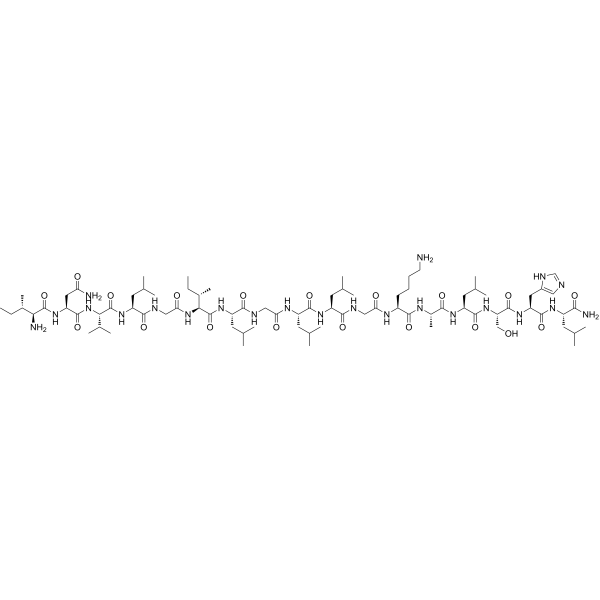
Bombolitin V is a potent antimicrobial peptide with an ED 50 value of 2 micrograms/ml in causing mast cell degranulation .
loading...
    loading...
Cat. No.: HY-U00168
CAS No.: 76239-32-2
Synonyms: AL136
Target:  

Histamine Receptor

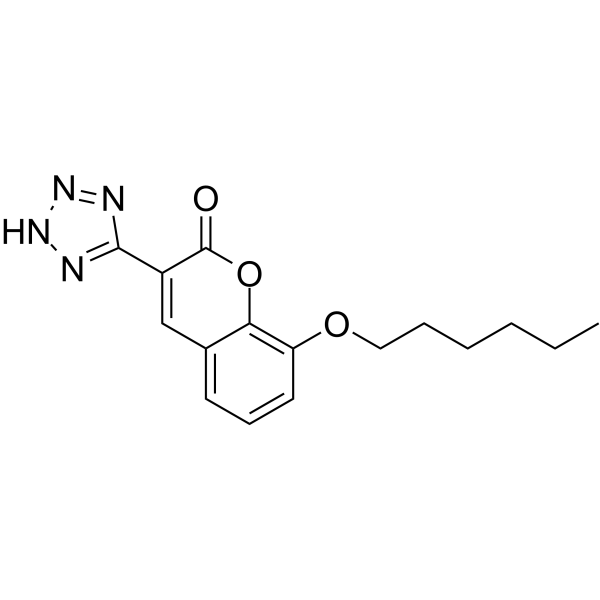
KP136 (AL136) is an orally effective antiallergic agent. The IC50 is 76.1 μg/mL for histamine release and 63 ug/mL for degranulation .
loading...
    loading...
Cat. No.: HY-106306
CAS No.: 90749-32-9
Synonyms: S 9795
Research Areas:  

Cardiovascular Disease

Laprafylline (S 9795), a xanthine derivative, is a bronchodilator. Laprafylline has potent anti-bronchoconstrictive effects, inhibiting action on mast cell degranulation and phosphodiesterase (PDE) activity (IC50 of 6 μM) .
loading...
    loading...
Cat. No.: HY-N4207R
CAS No.: 14348-21-1
Cnidicin (Standard) is the analytical standard of Cnidicin. This product is intended for research and analytical applications. Cnidicin, a coumarin, inhibits the degranulation of mast cell and the nitric oxide (NO) generation in RAW 264.7 cells .
loading...
    loading...
Cat. No.: HY-N15423
CAS No.: 18904-40-0
Acrophylline is an antiallergic compound. Acrophylline inhibits mast cell degranulation. Acrophylline reduces the plasma leakage in mouse ear in a passive cutaneous anaphylactic (PCA) reaction. Acrophylline is an alkaloid can be isolated from acronychia haplophylla .
loading...
    loading...
Cat. No.: HY-N1684
CAS No.: 75567-38-3
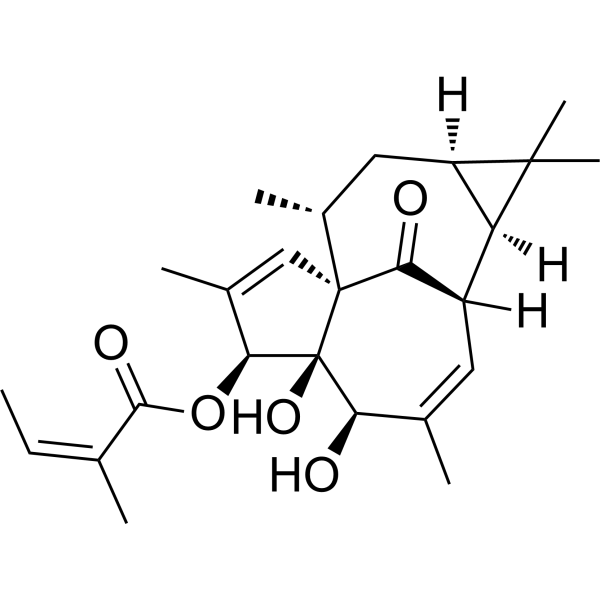
20-Deoxyingenol 3-angelate (DI3A) increases degranulation and interferon-gamma secretion of NK cells. 20-Deoxyingenol 3-angelate enhances NK cell tumoricidal activity .
loading...
    loading...
Cat. No.: HY-123014
CAS No.: 120772-66-9
Target:  

Leukotriene Receptor

Research Areas:  

Cancer

(Rac)-SC-45694 is a racemate of SC-45694. SC-45694 has full LTB4 agonist activity for neutrophil chemotaxis and has antagonist activity against LTB4-induced neutrophil degranulation .
loading...
    loading...
Cat. No.: HY-P11128
CAS No.: 1427516-68-4
Target:  

Inhibitory Antibodies

Research Areas:  

Others

Mastoparan-V1 is a peptide belonging to the Mastoparan family. Mastoparan-V1 exhibits modest mast cell degranulation activity, with EC50 of 130.24 μM in RBL-2H3 cells. Mastoparan-V1 can be used for the study of allergic reactions induced by wasp stings .
loading...
    loading...
Cat. No.: HY-N2344R
CAS No.: 103883-03-0
Synonyms: Proanthocyanidin A1 (Standard)
Procyanidin A1 (Standard) is the analytical standard of Procyanidin A1. This product is intended for research and analytical applications. Procyanidin A1 (Proanthocyanidin A1) is a procyanidin dimer, which inhibits degranulation downstream of protein kinase C activation or Ca2+ influx from an internal store in RBL-213 cells. Procyanidin A1 has antiallergic effects .
loading...
    loading...
Cat. No.: HY-158316
CAS No.: 2758569-43-4
Target:  

Fc Receptor (FcR)

Research Areas:  

Others

BTL-MK (Compound 19) an orally active antiallergic agent, that inhibits degranulation of mast cells with an IC50 of 6.7 μM, through binding to the inhibitory receptor FcγRIIB. BTL-MK improves the metaboilic stability in human liver microsomes. BTL-MK ameliorates the allergic response in Ovalbumin, low endotoxin (HY-W250978A)-induced food allergy mice model. BTL-MK exhibits a good pharmacokinetic character with metabolic stability .
loading...
    loading...
Cat. No.: HY-N16668
CAS No.: 718638-77-8
(3R,5S)-5'-Methoxyoctahydrocurcumin (Compound 4) is a diarylheptanoidfound in Curcuma comosa. (3R,5S)-5'-Methoxyoctahydrocurcumin exhibits strong antiallergic activity by inhibiting β-hexosaminidase release and the degranulation of mast cells. (3R,5S)-5'-Methoxyoctahydrocurcumin can be used for the research of immunology, such as asthma .
loading...
    loading...
Cat. No.: HY-111198
CAS No.: 887647-69-0
Target:  

Endogenous Metabolite

Research Areas:  

Inflammation/Immunology

YM-355179 fumarate is a newly synthesized selective CCR3 antagonist with the potential to inhibit eosinophil-related allergic inflammatory diseases. YM-355179 can effectively inhibit the binding of CCL11 and CCL5 to CCR3-expressing cells, with IC50 values of 7.6 nM and 24 nM respectively. In functional experiments, YM-355179 can inhibit CCL11-induced intracellular Ca(2+) influx, chemotaxis and eosinophil degranulation, IC50 The values are 8.0 nM, 24 nM and 29 nM respectively .
loading...
    loading...
Cat. No.: HY-N0078R
CAS No.: 20261-38-5
Synonyms: Ginkgolic acid (13:0) (Standard); Ginkgoneolic Acid (Standard); 6-Tridecylsalicylic acid (Standard)
Ginkgolic Acid (C13:0) (Standard) is the analytical standard of Ginkgolic Acid (C13:0) (HY-N0078). This product is intended for research and analytical applications. Ginkgolic Acid (C13:0) (Ginkgoneolic Acid) is an anti-cariogenic agent and a PI3Kδ inhibitor (IC50: 2.49 μM). Ginkgolic Acid (C13:0) exhibits antibacterial and anti-parasitic activities. Ginkgolic Acid (C13:0) can also inhibit mast cell degranulation (IC50: 2.40 μM) .
loading...
    loading...
Cat. No.: HY-N8593R
CAS No.: 1120-21-4
Undecane (Standard) is an analytical standard of Undecane (HY-N8593).Undecane is a potent cAMP agonist with anti-allergic and anti-inflammatory activities. Undecane inhibits degranulation and the secretion of histamine and TNF-α. Undecane reverses the increased levels of p38 phosphorylation, NF-κB transcriptional activity and target cytokine/chemokine genes, including thymus and activation-regulated chemokine (TARC), macrophage-derived chemokine (MDC) and interleukin-8 (IL-8). Undecane can be used for the study of skin inflammatory disorders, such as atopic dermatitis .
loading...
    loading...
Cat. No.: HY-N8593S
CAS No.: 164858-54-2
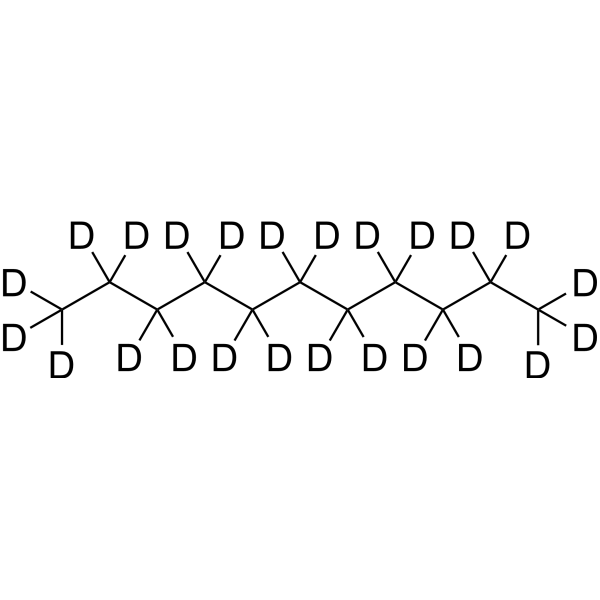
Undecane-d24 is the deuterium labeled Undecane (HY-N8593).Undecane is a potent cAMP agonist with anti-allergic and anti-inflammatory activities. Undecane inhibits degranulation and the secretion of histamine and TNF-α. Undecane reverses the increased levels of p38 phosphorylation, NF-κB transcriptional activity and target cytokine/chemokine genes, including thymus and activation-regulated chemokine (TARC), macrophage-derived chemokine (MDC) and interleukin-8 (IL-8). Undecane can be used for the study of skin inflammatory disorders, such as atopic dermatitis .
loading...
    loading...
Cat. No.: HY-13568R
CAS No.: 51234-28-7
Synonyms: LRCL 3794 (Standard)
Benoxaprofen (Standard) is the analytical standard of Benoxaprofen. This product is intended for research and analytical applications. Benoxaprofen (LRCL 3794) is a nonsteroidal anti-inflammatory agent that blocks the biosynthesis of inflammatory mediators such as leukotrienes and prostaglandins by inhibiting 5-LOX, PGH2 synthase and cytochrome P-450. Benoxaprofen exhibits significant toxicity: it not only alters cellular redox status, uncouples oxidative phosphorylation and disrupts calcium ion homeostasis, but also causes liver injury through the formation of covalent adducts between its active metabolites and hepatic proteins. Benoxaprofen shows strong phototoxicity under ultraviolet irradiation, and induces erythrocyte lysis, mast cell degranulation and histamine release. Benoxaprofen is widely used in studies of urticaria and related phototoxic mechanisms .
loading...
    loading...
Cat. No.: HY-W778179
CAS No.: 1329840-53-0
Synonyms: LRCL 3794-13C,d3
Benoxaprofen- 13C, d3 is the 13C-labeled Benoxaprofen (HY-13568). Benoxaprofen (LRCL 3794) is a nonsteroidal anti-inflammatory agent that blocks the biosynthesis of inflammatory mediators such as leukotrienes and prostaglandins by inhibiting 5-LOX, PGH2 synthase and cytochrome P-450. Benoxaprofen exhibits significant toxicity: it not only alters cellular redox status, uncouples oxidative phosphorylation and disrupts calcium ion homeostasis, but also causes liver injury through the formation of covalent adducts between its active metabolites and hepatic proteins. Benoxaprofen shows strong phototoxicity under ultraviolet irradiation, and induces erythrocyte lysis, mast cell degranulation and histamine release. Benoxaprofen is widely used in studies of urticaria and related phototoxic mechanisms .
loading...
    loading...
Cat. No.: HY-189392
DAT-003 is a MRGPRX2 antagonist that selectively blocks MRGPRX2-mediated, IgE-independent mast cell degranulation without affecting IgE-dependent activation. DAT-003 can be used in studies of mast cell-related diseases, such as chronic spontaneous urticaria .
loading...
    loading...

