
73 Results for "

nuclear localization

" in MedChemExpress (MCE) Product Catalog:
Products (73)

73 Results for "nuclear localization" in MCE Product Catalog:

Cat. No.: HY-174793
Target:  

mRNA

Research Areas:  

Others

The Cas9-T2A-GFP mRNA encodes a Cas9 nuclease gene with two nuclear localization signals (NLS) and a green fluorescent protein (GFP), which could be used in genome engineering experiments. The incorporation of N1-Methylpseudo-UTP can reduce the immunogenicity of the resulting mRNA.
loading...
    loading...
Cat. No.: HY-170983
Target:  

PROTACs FKBP

Research Areas:  

Cancer

MC-25B is a DCAF16-recruiting FKBP12 PROTAC degrader with a DC50 of 0.35 μM. MC-25B promotes the formation of a ternary complex with DCAF16 and nuclear-localized FKBP12_NLS, thereby mediating DCAF16-dependent degradation of FKBP12_NLS via the proteasome and Cullin-RING ligase pathway .
loading...
    loading...
Cat. No.: HY-147196
CAS No.: 2384184-42-1
Target:  

FKBP PROTACs

Research Areas:  

Cancer

KB03-SLF is a bifunctional PROTAC, formed by conjugating the cysteine-targeting KB03 exploratory fragment with SLF (HY-114872), an FKBP12 ligand that does not support the degradation of FKBP12 NLS. KB03-SLF fails to degrade nuclear-localized FKBP12 NLS in cells, nor can it mediate the interaction between DCAF16 and FKBP12 NLS in a manner similar to KB02-SLF (HY-129610) .
loading...
    loading...
Cat. No.: HY-174499
Target:  

mRNA

Research Areas:  

Others

Cas9 Nickase D10A mRNA expresses a version of the Streptococcus pyogenes SF370 Cas9 protein (CRISPR Associated Protein 9) that contains a D10A amino acid substitution. This mRNA also contains a C-terminal nuclear localization signal followed by a HA tag.Cas9 functions as part of the CRISPR (clustered regularly interspaced short palindromic repeats) genome editing system. In the CRISPR system, an RNA guide sequence targets the site of interest and the Cas9 protein is employed to perform the DNA cleavage. While wild-type Cas9 creates a double-stranded break at the target site, Cas9 nickase creates a single-stranded break. This favors homology-directed repair and decreases the occurrence of non-homologous end joining.
loading...
    loading...
Cat. No.: HY-125535
CAS No.: 1290069-19-0
OSU-53 is an orally active AMPK activator and mTOR inhibitor, with an IC50 of 0.3 μM for AMPK, an EC50 of 2-5 μM for AMPK, and an IC50 of 8.23 μM for mTOR. OSU-53 inhibits the Akt signaling pathway, directly activates AMPK by binding to its autoinhibitory domain, reduces IKKβ-mediated phosphorylation of Foxo3a, blocks Akt-mediated phosphorylation of MDM2, and promotes the nuclear localization and stabilization of Foxo3a, while directly inhibiting mTOR. OSU-53 inhibits epithelial-mesenchymal transition (EMT), induces epithelial phenotype, suppresses invasion and metastasis, induces autophagy, inhibits the activation of ERK and Akt, reduces the secretion of nitric oxide and proinflammatory cytokines, and inhibits the migration of MDSC; at high doses, it induces MDSC apoptosis, attenuates the immunosuppressive effect of MDSC, reduces MDSC levels, and blocks incision-induced mechanical hyperalgesia. OSU-53 can be used in studies related to breast cancer, prostate cancer, thyroid cancer, melanoma and postoperative pain .
loading...
    loading...
Cat. No.: HY-P11231
CAS No.: 2780353-11-7
Synonyms: FUS(364-369)-TAT
Target:  

Inhibitory Antibodies

Research Areas:  

Cancer

β4-TAT is a kind of β-sheet peptide foldamer. β4-TAT is composed of two parts: the β4 sequence (derived from the β-sheet fragment of the RRM domain of fused in sarcoma (FUS)) and the TAT sequence (a nuclear localization signal peptide that helps the entire peptide penetrate the nuclear membrane). β4-TAT influences FUS aggregation by targeting its RNA recognition motifs (RRM). β4-TAT effectively induces FUS aggregation within cells, leading to the death of cancer cells. β4-TAT can be used for the study of FUS .
loading...
    loading...
Cat. No.: HY-P3657A
Target:  

Fluorescent Dye

Research Areas:  

Cancer

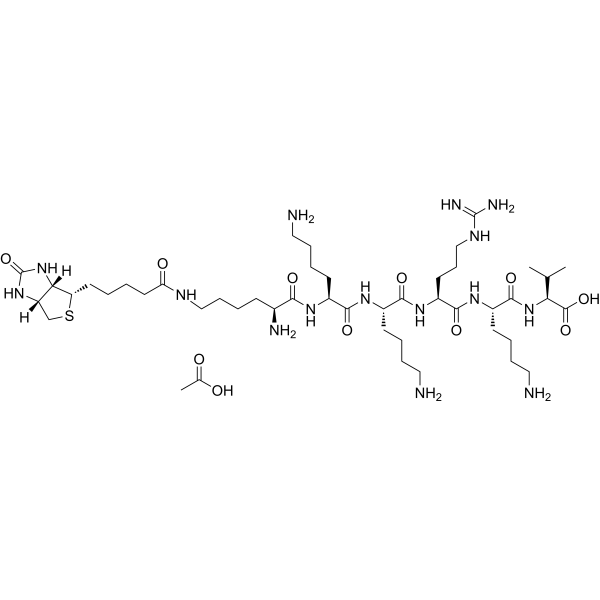
Biotin-KKKRKV acetate is the biotinylated KKKRKV acetate. KKKRKV is a nuclear localization signal (NLS) peptide derived from simian virus 40 .
loading...
    loading...
Cat. No.: HY-174792
Target:  

mRNA

Research Areas:  

Others

The Cre-T2A-GFP mRNA is a capped and polyadenylated messenger RNA encoding a Cre recombinase with a nuclear localization sequence (NLS) and a green fluorescent protein (GFP).
loading...
    loading...
Cat. No.: HY-155972A
CAS No.: 3032506-81-0
Target:  

CRM1 Apoptosis

Research Areas:  

Cancer

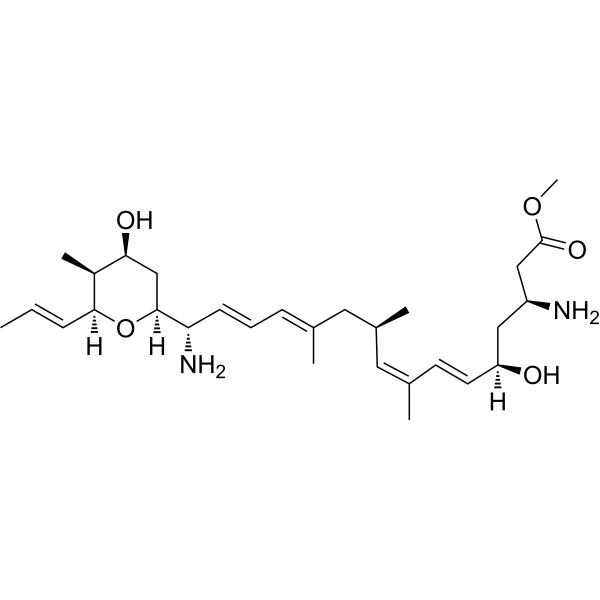
CRM1-IN-2 (Compound KL2) is a noncovalent CRM1 inhibitor. CRM1-IN-2 localizes CRM1 in the nuclear periphery, depletes nuclear CRM1, and inhibits CRM1-mediated nuclear export. CRM1-IN-2 inhibits growth of colorectal cancer cells, and induces apoptosis .
loading...
    loading...
Cat. No.: HY-155524
Target:  

Apoptosis

Research Areas:  

Cancer

Anticancer agent 134 (compound 6a) is a environment-sensitive fluorescent probe and an apoptosis inducer, making a distinction between the tumor and normal tissues. Anticancer agent 134 localizes to the nuclear bodies in tumor slices .
loading...
    loading...
Cat. No.: HY-170814
Target:  

G-quadruplex

Research Areas:  

Cancer

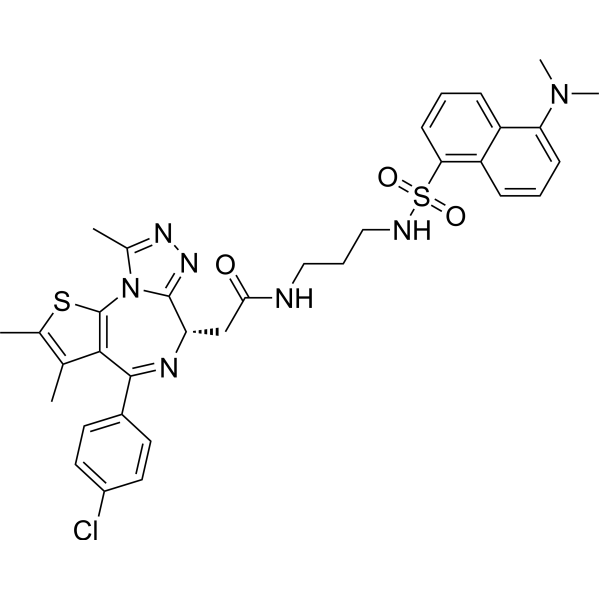
G-quadruplex ligand 3 (Compound 16) is a G-quadruplex ligand with anticancer effects that chelate iron. G-quadruplex ligand 3 stabilizes G-quadruplexes in human leukemia Jurkat cells. G-quadruplex ligand 3 localizes in the cell nucleus, serving as a fluorescent nuclear tracer for the labile iron pool .
loading...
    loading...
Cat. No.: HY-P990140

Target:  

MHC

Research Areas:  

Inflammation/Immunology

Anti-Rat β-2-Microglobulin Antibody (4C9) is an anti-rat β-2-Microglobulin IgG1 monoclonal antibody. Anti-Rat β-2-Microglobulin Antibody (4C9) reduces pJNK nuclear translocation and restore SMAD nuclear localization. Anti-Rat β-2-Microglobulin Antibody (4C9) is often used in immunoprecipitation experiments .
loading...
    loading...
Cat. No.: HY-N0001S
CAS No.: 1217780-28-3
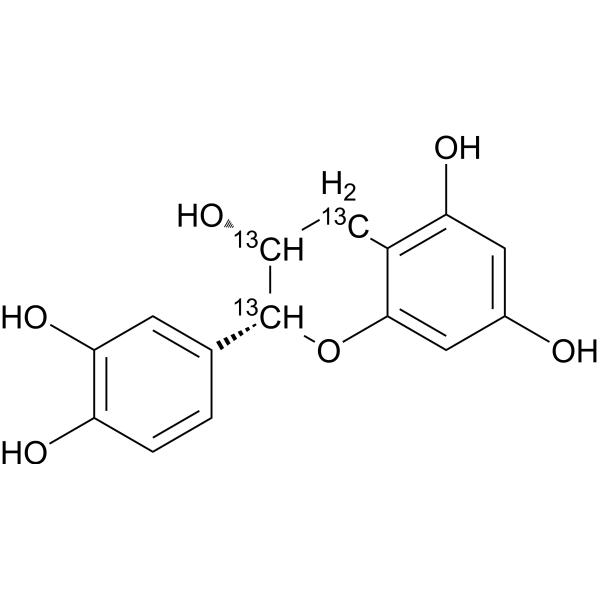
(±)-Epicatechin- 13C3 is the 13C labeled (±)-Epicatechin. (-)-Epicatechin (HY-N0001) inhibits cyclooxygenase-1 (COX-1) with an IC50 of 3.2 μM. (-)-Epicatechin inhibits the IL-1β-induced expression of iNOS by blocking the nuclear localization of the p65 subunit of NF-κB .
loading...
    loading...
Cat. No.: HY-N0001S2
Synonyms: (-)-Epicatechol-13C3; Epicatechin-13C3; epi-Catechin-13C3
(-)-Epicatechin- 13C3 ((-)-Epicatechol- 13C3) is 13C labeled (-)-Epicatechin. (-)-Epicatechin inhibits cyclooxygenase-1 (COX-1) with an IC50 of 3.2 μM. (-)-Epicatechin inhibits the IL-1β-induced expression of iNOS by blocking the nuclear localization of the p65 subunit of NF-κB.
loading...
    loading...
Cat. No.: HY-403733B
CAS No.: 1998094-24-8
Research Areas:  

Cancer

(+)-JJ-450 is a non-competitive antagonist targeting the androgen receptor (AR) that inhibits AR nuclear localization and transcriptional activity in the absence of androgen. (+)-JJ-450 is less active than (-)-JJ-450 (HY-403733A) in inhibiting prostate-specific antigen (PSA) expression in LN95 cells, possibly because (+)-JJ-450 targets the ligand binding domain (LBD) of AR. (+)-JJ-450 inhibits the transcriptional activity of AR and its splice variants (e.g., ARv7) by promoting the degradation of unliganded AR in the nucleus and reducing the binding of AR to androgen response elements (AREs). (+)-JJ-450 can be used in castration-resistant prostate cancer (CRPC) studies that are resistant to enzalutamide (MDV3100) (HY-70003) .
loading...
    loading...
Cat. No.: HY-P11948
CAS No.: 253328-16-4
Target:  

c-Myc

Research Areas:  

Others

c-Myc NLS is a non-canonical nuclear localization signal (NLS) derived from the oncoprotein c-Myc, with the sequence PAAKRVKLD and containing 3 basic amino acids. c-Myc NLS mediates the nuclear localization of fusion proteins, and all its regions are essential or play important roles in nuclear import. c-Myc NLS can target fused pyruvate kinase to the nuclei of transfected cells .
loading...
    loading...
Cat. No.: HY-P11948A
Target:  

c-Myc

Research Areas:  

Others

c-Myc NLS TFA is a non-canonical nuclear localization signal (NLS) derived from the oncoprotein c-Myc, with the sequence PAAKRVKLD and containing 3 basic amino acids. c-Myc NLS TFA mediates the nuclear localization of fusion proteins, and all its regions are essential or play important roles in nuclear import. c-Myc NLS TFA can target fused pyruvate kinase to the nuclei of transfected cells .
loading...
    loading...
Cat. No.: HY-P1876D
CAS No.: 1818224-73-5
Target:  

Inhibitory Antibodies

Research Areas:  

Others

Cys-NLS is a cysteine-containing nuclear localization signal peptide derived from the simian virus 40 large T antigen, which enhances nuclear import. Cys-NLS can undergo a coupling reaction through the common backbone of Cys .
loading...
    loading...
Cat. No.: HY-P11744
CAS No.: 503474-42-8
Target:  

Inhibitory Antibodies

Research Areas:  

Others

Nuclear localizing sequence is a peptide sequence that functions as an inducer and exhibits membrane permeability in mammalian cells. Nuclear localizing sequence enhances cellular uptake and directs conjugated ruthenium (II) complexes to the nucleus for nuclear DNA imaging .
loading...
    loading...
Cat. No.: HY-P11947
CAS No.: 254103-71-4
Target:  

MDM-2/p53 NF-κB

Research Areas:  

Others

p53 Bipartite NLS is a bipartite nuclear localization signal derived from p53. When p53 Bipartite NLS is fused to the N-terminus of p65 and the single-component nuclear localization signal of p65 itself is mutated, it alters the nuclear import pathway of p65. p53 Bipartite NLS renders p65 resistant to TTP (HY-P60128)-mediated inhibition of NF-κB transcriptional activity and nuclear import .
loading...
    loading...

