804 Results for "

essential

" in MedChemExpress (MCE) Product Catalog:
Products (804)

804 Results for "essential" in MCE Product Catalog:

Cat. No.: HY-N0229R
CAS No.: 56-41-7
Synonyms: L-2-Aminopropionic acid (Standard)
L-Alanine (Standard) is the analytical standard of L-Alanine. This product is intended for research and analytical applications. L-Alanine is a non-essential amino acid, involved in sugar and acid metabolism, increases immunity, and provides energy for muscle tissue, brain, and central nervous system. In Vitro: The viability of both hiPSCs, 201B7 cells and ehiPSCs decrease with an increase in L-Alanine concentration, and reach 7.5±1.3% and 3.7±0.7% respectively at 1.2 M of L-Alanine. On the other hand, no decrease in the viability of hFBs and hSkMCs are observed. Although the viability of iCMs slightly decreases along with the increase of the L-Alanine concentration, viability of iCMs at 1.2 M concentration of L-Alanine, 49.4±6.9%, is significantly higher than that of undifferentiated iPSCs, 201B7 cells and ehiPSCs (p< 0.01). The viability of hiPSCs, 201B7 cells and ehiPSCs, drastically decrease even after 2 or 4 h treatment. In contrast, the viability of hFBs fails to decrease at 1, 2, and 4 h and shows a small decrease at 24 h treatment. The viability of 201B7 cells in suspension culture decreases to 11.8±6.0% following treatment with 1.2 M L-Alanine for 2 h, whereas that of hFBs is 72.9±14.2% .
loading...
    loading...
Cat. No.: HY-N0469R
CAS No.: 56-87-1
L-Lysine (Standard) is the analytical standard of L-Lysine. This product is intended for research and analytical applications. L-lysine is an essential amino acid for humans with orally activity. L-lysine can inhibit the occurrence of HSV infections and is used in herpes research. L-lysine increases calcium absorption, reduces diabetes-related diseases, improves gut health, and alleviates pancreatic inflammation. L-lysine can be used in research on metabolism, infection, and inflammation . IC50 & Target:L-lysine (150 mg/kg) promotes, but not initiates, bladder cancer. The administration of L-lysine to rats submitted to colovesical cystoplasty accelerates the development of transitional metaplasia of the intestinal epithelium .
L-lysine (10 mg/kg) treatment attenuates pancreatic tissue injury induced by L-arginine by inhibiting the release of the inflammatory cytokine IL-6 and enhance antioxidant activity . In Vivo:L-lysine (10?mg/kg, p.o., pre-treated or post-treated, administration duration 15 days) treatment attenuates pancreatic tissue injury induced by L-arginine by inhibiting the release of the inflammatory cytokine IL-6 and enhance antioxidant activity in acute pancreatitis mice model . L-lysine (5 or 10?mg/kg, p.o., 45 days) ameliorates sepsis-induced acute lung injury in a lipopolysaccharide (HY-D1056)-induced mouse model .
loading...
    loading...
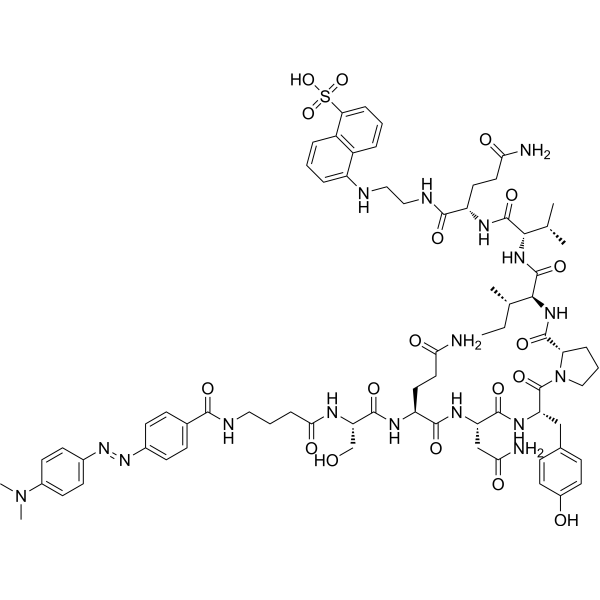
Cat. No.: HY-P5415
CAS No.: 127134-13-8
Target:  

HIV

Research Areas:  

Others

DABCYL-GABA-Ser-Gln-Asn-Tyr-Pro-Ile-Val-Gln-EDANS is a biological active peptide. (DABCYL-GABA-Ser-Gln-Asn-Tyr-Pro-Ile-Val-Gln-EDANS is also called HIV protease substrate I in some literature. It is widely used for the continuous assay for HIV protease activity. The 11-Kd protease (PR) encoded by the human immunodeficiency virus 1 (HIV-1) is essential for the correct processing of viral polyproteins and the maturation of infectious virus, and is therefore a target for the design of selective acquired immunodeficiency syndrome (AIDS) therapeutics. The FRET-based fluorogenic substrate is derived from a natural processing site for HIV-1 PR. Incubation of recombinant HIV-1 PR with the fluorogenic substrate resulted in specific cleavage at the Tyr-Pro bond and a time-dependent increase in fluorescence intensity that is linearly related to the extent of substrate hydrolysis. The fluorescence quantum yields of the HIV-1 PR substrate in the FRET assay increased by 40.0- and 34.4-fold, respectively, per mole of substrate cleaved. Because of its simplicity and precision in the determination of reaction rates required for kinetic analysis, this substrate offers many advantages over the commonly used HPLC or electrophoresis-based assays for peptide substrate hydrolysis by retroviral PRs. Abs/Em = 340nm/490nm.)
loading...
    loading...
Cat. No.: HY-L045
4,317 compounds

Oxygen homeostasis regulation is the most fundamental cellular process for adjusting physiological oxygen variations, and its irregularity leads to various human diseases, including cancer. Hypoxia is closely associated with cancer development, and hypoxia/oxygen-sensing signaling plays critical roles in the modulation of cancer progression.

Hypoxia-inducible factor 1 (HIF-1) is a transcription factor that functions as a master regulator of oxygen homeostasis. A variety of HF-1 target genes have been identified thus far which encode proteins that play key roles in critical developmental and physiological processes including angiogenesis/vascular remodeling, erythropoiesis, glucose transport, glycolysis, iron transport, and cell proliferation/survival.

HIF-1 is a heterodimeric transcription factor consisting of a constitutively expressed β-subunit and an oxygen-regulated α-subunit. The unique feature of HIF-1 is the regulation of HIF-1α expression and activity based upon the cellular O2 concentration. Under normoxic conditions, hydroxylation of HIF-1α on these different proline residues is essential for HIF proteolytic degradation by promoting interaction with the von Hippel-Lindau tumor-suppressor protein (pVHL) through hydrogen bonding to the hydroxyproline-binding pocket in the pVHL β-domain. As oxygen levels decrease, hydroxylation of HIF decreases; HIF-1α then no longer binds pVHL, and becomes stabilized, allowing more of the protein to translocate to the cell’s nucleus, where it acts as a transcription factor, upregulating (often within minutes) the production of proteins that stimulate blood perfusion in tissues and thus tissue oxygenation.

MCE offers a unique collection of 4,317 oxygen sensing related compounds targeting HIF/HIF Prolyl-Hydroxylase, MAPK/ERK, PI3K/AKT signaling pathways, etc. MCE Oxygen Sensing Compound Library is a useful tool to study hypoxia, oxidative stress and discover new anti-cancer drugs.

