98 Results for "

zebrafish model

" in MedChemExpress (MCE) Product Catalog:
Products (98)

98 Results for "zebrafish model" in MCE Product Catalog:

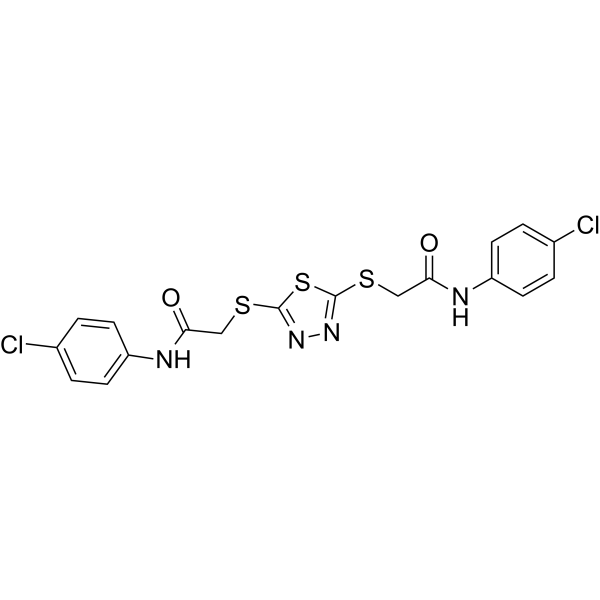
Cat. No.: HY-155726
CAS No.: 444792-16-9
Target:  

Others

Research Areas:  

Others

Cy-FBP/SBPase-IN-1 (compound S5) is a Cy-FBP/SBPase inhibitor, which is an important regulatory enzyme in cyanobacterial photosynthesis. Thus Cy-FBP/SBPase-IN-1 inhibits Calvin cycle and photosystem, and decreases photosynthetic efficiency in cyanobacterial photosynthesis. Cy-FBP/SBPase-IN-1 potently inhibits the growth of cyanobacteria, as well as Synechocystis sp.PCC6803. Cy-FBP/SBPase-IN-1 shows safety profile in human-derived cells and zebrafish models .
loading...
    loading...
Cat. No.: HY-180946
CAS No.: 2678601-07-3
AChE-IN-105 (Compound C5) is a potent, mixed AChE inhibitor with an IC50 of 5.02 μM. AChE-IN-105 scavenges ROS, decreases Hydrogen peroxide-induced Caspase-3 activation, reduces activity of the Nrf2-ARE pathway. AChE-IN-105 prevents memory impairments in the Scopolamine (HY-N0296)-induced cognitive dysfunction zebrafish model. AChE-IN-105 has potent antioxidant activity. AChE-IN-105 can be used in the research of Alzheimer's disease .
loading...
    loading...
Cat. No.: HY-147412D
Target:  

Fluorescent Dye

Research Areas:  

Neurological Disease

FAM labled Ultevursen sodiumis a FAM labled Ultevursen sodium (HY-147412A). Ultevursen sodium (QR-421a) is a splice-modulating antisense oligonucleotide targeting exon 13 of the USH2A gene, which restores the functional expression of Usherin protein by inducing exon skipping. Ultevursen sodium binds to USH2A pre-mRNA and modulates the splicing process to specifically skip exon 13 carrying the pathogenic mutation c.2299delG, generating an in-frame transcript and a truncated yet functionally normal protein. Ultevursen sodium exhibits concentration-dependent exon skipping activity in human cells and retinal organoid models, and restores Usherin expression and retinal function in zebrafish and gene-edited mouse models. Ultevursen sodium can be used for related research on type 2 Usher syndrome and non-syndromic retinitis pigmentosa .
loading...
    loading...
Cat. No.: HY-147412E
Target:  

Fluorescent Dye

Research Areas:  

Neurological Disease

Cy3 labled Ultevursen sodium is a Cy3 labled Ultevursen sodium (HY-147412A). Ultevursen sodium (QR-421a) is a splice-modulating antisense oligonucleotide targeting exon 13 of the USH2A gene, which restores the functional expression of Usherin protein by inducing exon skipping. Ultevursen sodium binds to USH2A pre-mRNA and modulates the splicing process to specifically skip exon 13 carrying the pathogenic mutation c.2299delG, generating an in-frame transcript and a truncated yet functionally normal protein. Ultevursen sodium exhibits concentration-dependent exon skipping activity in human cells and retinal organoid models, and restores Usherin expression and retinal function in zebrafish and gene-edited mouse models. Ultevursen sodium can be used for related research on type 2 Usher syndrome and non-syndromic retinitis pigmentosa .
loading...
    loading...
Cat. No.: HY-183611
Research Areas:  

Infection

LPZ-51 is a Vibrio β-lactam resistance sensor kinase (VbrK) inhibitor with a Ki value of 1.09 μM. LPZ-51 inhibits blaA gene expression at the transcriptional level by blocking the kinase activity of VbrK, reduces β-lactamase synthesis, and does not affect bacterial growth. LPZ-51 acts synergistically with β-lactam antibiotics. LPZ-51 decreases bacterial load, alleviates intestinal inflammation, and improves survival rate in zebrafish infection models. LPZ-51 can be used in studies related to Vibrio parahaemolyticus infection .
loading...
    loading...
Cat. No.: HY-P12336
MPQPPAK is a polypeptide obtained from the enzymatic hydrolysis of C-phycocyanin (HY-D1025) and possesses neuroprotective activity. MPQPPAK enhances the activities of antioxidant enzymes SOD, CAT, and GSH-Px, reduces ROS, inhibits apoptosis and acetylcholinesterase (AChE) activity in brain tissue, and decreases protein carbonyl content. In the MPTP (HY-W114750)-induced zebrafish Parkinson's disease model, MPQPPAK exhibits antioxidant effects, inhibits autophagy and apoptosis, reverses the loss of dopaminergic neurons and cerebral blood vessels, and alleviates motor deficits. MPQPPAK can be used for research on Parkinson's disease .
loading...
    loading...
Cat. No.: HY-P12337
MTAAAR is a polypeptide obtained from the enzymatic hydrolysis of C-phycocyanin (HY-D1025) and possesses neuroprotective activity. MTAAAR enhances the activities of antioxidant enzymes SOD, CAT, and GSH-Px, reduces ROS, inhibits apoptosis and acetylcholinesterase (AChE) activity in brain tissue, and decreases protein carbonyl content. In the MPTP (HY-W114750)-induced zebrafish Parkinson's disease model, MTAAAR exhibits antioxidant effects, inhibits autophagy and apoptosis, reverses the loss of dopaminergic neurons and cerebral blood vessels, and alleviates motor deficits. MTAAAR can be used for research on Parkinson's disease .
loading...
    loading...
Cat. No.: HY-116452
CAS No.: 1246566-47-1
Target:  

VEGFR

Research Areas:  

Cancer

YLT192 is an orally active and highly bioavailable VEGFR2 inhibitor with potent anti-angiogenic activity and anti-tumor efficacy. YLT192 significantly inhibited the kinase activity of VEGFR2 and inhibited the proliferation, migration, invasion and tube formation of human umbilical cord vascular endothelial cells. YLT192 also inhibited VEGF-induced VEGFR2 phosphorylation and its downstream signaling regulators. YLT192 also showed the ability to inhibit angiogenesis in vivo in zebrafish embryo models and alginate-coated tumor cell experiments. YLT192 can directly inhibit the proliferation of cancer cells and induce their apoptosis .
loading...
    loading...
Cat. No.: HY-181071
Research Areas:  

Cancer

POLRMT-IN-3 is a photosensitive inhibitor of mitochondrial RNA polymerase (POLRMT). POLRMT-IN-3 is biologically inactive in the dark but rapidly releases the active parent compound LJ03 upon illumination with 405 nm light, enabling spatiotemporally precise inhibition of POLRMT. POLRMT-IN-3 exhibits antitumor activity and can be used in research on tumors such as pancreatic cancer and ovarian cancer .
loading...
    loading...
Cat. No.: HY-182672
CAS No.: 65194-64-1
Target:  

YAP

Research Areas:  

Cancer

VT101 is a TEAD inhibitor with an IC50 of 454 nM. VT101 is applicable for cancer research .
loading...
    loading...
Cat. No.: HY-182372
CAS No.: 1638153-78-2
Target:  

Epoxide Hydrolase

Research Areas:  

Neurological Disease

SH-11037 is a potent inhibitor of soluble epoxide hydrolase (sEH) and docks to the substrate binding cleft in the sEH hydrolase domain. SH-11037 dose-dependently suppresses angiogenesis in the choroidal sprouting assay ex vivo and inhibited ocular developmental angiogenesis in zebrafish larvae. SH-11037 reduces choroidal neovascularisation lesion volume in the laser-induced CNV mouse model. SH-11037 synergises with anti-VEGF treatments in vitro and in vivo. SH-11037 induces G2/M phase blockade and retains retinal endothelial cell viability at active concentrations without overt toxicity. SH-11037 can be used for the research of retinal neovascularization and ocular neovascularization .
loading...
    loading...
Cat. No.: HY-P0267A
CAS No.: 1036322-26-5
Melanotan (MT)-II acetate is a melanocortin receptor agonist. Melanotan (MT)-II acetate activates melanocortin receptor 3 and melanocortin receptor 4, and stimulates the release of central endogenous oxytocin. Melanotan (MT)-II acetate reverses recognition memory impairment, increased anxiety levels and reduced exploratory tendency in zebrafish exposed to short-term high-fat diet. Melanotan (MT)-II acetate improves impaired social behavior indicators in mouse models of autism spectrum disorder. Melanotan (MT)-II acetate induces weight loss, reduces food intake and exerts anorectic effects. Melanotan (MT)-II acetate increases intracavernous pressure and erectile activity in brown rats. Melanotan (MT)-II acetate can be used in studies related to memory impairment, anxiety, reduced exploratory behavior, autism spectrum disorder, obesity and erectile dysfunction .
loading...
    loading...
Cat. No.: HY-D3067
Target:  

Fluorescent Dye

Research Areas:  

Metabolic Disease Cancer

ASSI-Leu is a novel AIE fluorescent probe based on an asymmetric tetraaryl imidazole skeleton, which can be used for ratiometric imaging detection of endogenous leucine aminopeptidase. ASSI-Leu contains an L-leucine-based recognition group that blocks the excited-state intramolecular proton transfer (ESIPT) in its 2-(2'-hydroxyphenyl) benzothiazole (HBT) skeleton, thereby generating an enol-form emission signal at Ex/Em = 365/417 nm. ASSI-Leu undergoes cleavage of the L-leucine group mediated by LAP to form ASSI-OH, which further activates aggregation-induced emission (AIE) and ESIPT, generating a keto-form emission signal at Ex/Em = 365/554 nm and producing a ratiometric fluorescent signal. ASSI-Leu enables real-time tracking of LAP in cancer cells and zebrafish models .\n
loading...
    loading...
Cat. No.: HY-189263
Research Areas:  

Cancer

VEGFR-2/P-gp-IN-2 is a VEGFR-2 inhibitor (IC50 = 126.4 nM) and P-glycoprotein inhibitor. VEGFR-2/P-gp-IN-2 induces G1 phase cell cycle arrest and Apoptosis. VEGFR-2/P-gp-IN-2 can be used for research on cervical cancer .
loading...
    loading...
Cat. No.: HY-D3132
CAS No.: 1616505-01-1
Target:  

Fluorescent Dye

Research Areas:  

Others

Spring Red is a fluorescent probe for mitochondrial pH detection (Ex/Em = 530/680 nm) that can be taken up by live cells and mitochondria. The detection mechanism of Spring Red depends on pH changes and mitochondrial membrane potential. Fluorescence intensity increases with elevated pH, and a significant pH-dependent fluorescent response is observed in the pH range of 5.0‑8.0. Spring Red is suitable for long-term live-cell imaging and in vivo imaging, and can be used to monitor dynamic mitochondrial pH changes .
loading...
    loading...
Cat. No.: HY-184737
TPP-C8-CO-DSG bromide is a derivative of Diosgenin (HY-N0177) and an anticancer agent. TPP-C8-CO-DSG bromide downregulates Bcl-2 expression and upregulates Bax expression. TPP-C8-CO-DSG bromide promotes the cleavage of Caspase 9, Caspase 3 and PARP-1. TPP-C8-CO-DSG bromide depolarizes mitochondrial membrane potential, reduces intracellular ATP production, and induces intracellular ROS accumulation. TPP-C8-CO-DSG bromide promotes Apoptosis. TPP-C8-CO-DSG bromide exhibits anticancer activity against prostate cancer, breast cancer, lung adenocarcinoma, cervical cancer and colorectal cancer. TPP-C8-CO-DSG bromide can be used in the research of cervical cancer .
loading...
    loading...
Cat. No.: HY-180155
CAS No.: 3105470-83-2
Keap1/Nrf2/ARE activator 2 is an activator of Keap1/Nrf2/ARE pathway and non-competitively inhibits AChE with an IC50 of 14.79 μM and a Ki of 1.35 μM. Keap1/Nrf2/ARE activator 2 promotes Nrf2 nuclear translocation, leading to antioxidant gene upregulation and enhanced cellular defense against oxidative stress. Keap1/Nrf2/ARE activator exhibits robust neuroprotection against both H2O2- and Scopolamine (SCA) (HY-N0296)-induced injury in PC12 cells. Keap1/Nrf2/ARE activator 2 ameliorates memory impairment and the neuro-inflammation associated with SCA-initiated cognitive dysfunction in a zebrafish model. Keap1/Nrf2/ARE activator 2 can be used for the research of Alzheimer's disease .
loading...
    loading...
Cat. No.: HY-N17406
CAS No.: 244303-77-3
Dankasterone A is a secondary metabolite. Dankasterone A can be derived from the Fungus Talaromyces purpurogenu. Dankasterone A upregulates HO-1 protein expression, induces Apoptosis, induces excessive ROS production. Dankasterone A has anti-cancer activity against prostate cancer .
loading...
    loading...

