186 Results for "

CD4 T

" in MedChemExpress (MCE) Product Catalog:
Products (186)

186 Results for "CD4 T" in MCE Product Catalog:

Cat. No.: HY-P991762

Research Areas:  

Inflammation/Immunology

Anti-Rat CD4 Antibody (W3/25) reacts with rat CD4. Anti-Rat CD4 Antibody (W3/25) inhibits CD4+ T cell activation by downregulating the CD4 molecule on the surface of lymphocytes. Anti-Rat CD4 Antibody (W3/25) inhibits antigen-induced T cell proliferation and IL2 production in MLR experiments. Anti-Rat CD4 Antibody (W3/25) can be used for the study of experimental allergic encephalomyelitis (EAE). Recommend Isotype Controls: Mouse IgG1 kappa, Isotype Control (HY-P99977) .
loading...
    loading...
Cat. No.: HY-K0360

MCE Mouse CD4+ CD25+ Regulatory T Cell Positive Selection Kit is designed for the isolation of CD4+ CD25+ regulatory T cells (Tregs) from mouse splenic single-cell suspensions. The kit utilizes a two-step isolation strategy. First, CD4 Enrichment Beads are used to deplete non-target cells and enrich CD4+ T cells. Subsequently, CD25 Capture Antibody specifically binds to CD25+ cells, which are then captured by Releasable Magnetic Beads. Following isolation, the magnetic beads are gently detached from the cell surface using Magnetic Beads Release Buffer, yielding label-free CD4+ CD25+ regulatory T cells with no residual magnetic beads.

loading...
    loading...
Cat. No.: HY-P991892

Research Areas:  

Cancer

IT1208 is a humanized anti-CD4 monoclonal IgG1 antibody. IT1208 depletes CD4 + T cells with a manageable safety profile in vivo. IT1208 can be used for colon cancer research .
loading...
    loading...
Cat. No.: HY-P991753

Target:  

CXCR

Research Areas:  

Infection

Anti-Mouse CCL5 Antibody (R6G9) is a neutralizing agent that binds to CCL5 to inhibit its chemotactic activity towards CD4 + T cells .Anti-Mouse CCL5 Antibody (R6G9) does not suppress CD4 + T cell migration towards infection-derived liver cells, reduce CD4 + T cell hepatic accumulation, or impair CD4 + T cell migratory capacity .Anti-Mouse CCL5 Antibody (R6G9) serves as a tool to assess CCL5’s role in in vivo target cell killing by LCMV-specific CD8 + effector T cells .Anti-Mouse CCL5 Antibody (R6G9) can be used for the research of malaria infection and lymphocytic choriomeningitis virus infection .
loading...
    loading...
Cat. No.: HY-W244412
CAS No.: 133081-27-3
Research Areas:  

Cancer

2,5-Dioxopyrrolidin-1-yl 6-hydrazinylnicotinate hydrochloride is an intermediate of a radionuclide molecular probe targeting the CD4 receptor. 2,5-Dioxopyrrolidin-1-yl 6-hydrazinylnicotinate hydrochloride serves as an imaging agent for heart transplant rejection. This CD4 probe is prepared by mixing leukocyte differentiation antigen 4 monoclonal antibody with a solution of 6-hydrazinylnicotinoyl succinimide ester hydrochloride, followed by extraction and reaction to obtain 6-hydrazinylnicotinate-leukocyte differentiation antigen 4 monoclonal antibody; this antibody is then mixed with N-tris (hydroxymethyl) glycine, stannous chloride and technetium for an oscillatory reaction. This CD4 probe exhibits high affinity for CD4 + T lymphocytes, along with the characteristics of high sensitivity and high specificity, enabling early diagnosis of acute rejection .
loading...
    loading...
Cat. No.: HY-N17465
CAS No.: 526222-27-5
Dendronobiloside D is a sesquiterpene glycoside that can be isolated from Dendrobium officinale. Dendronobiloside D is an immunosuppressant that promotes the differentiation of CD4 + T cells into Treg cells .
loading...
    loading...
Cat. No.: HY-P992434

Research Areas:  

Cancer

OSE-279 is a high-affinity humanized monoclonal bivalent antibody targeting PD-1, the recommended isotype control is HY-P99003. OSE-279 blocks PD-1 ligand binding, inhibits PDL1-induced SHP1 phosphorylation, restores T cell activation, and promotes reactivation of primary T cell effector functions. OSE-279 binds hFcRn receptor, predicts long half-life, induces CD4 and CD8 T cell proliferation, and promotes interleukin 2 and interferon gamma secretion. OSE-279 can be used for the research of advanced malignancies, colon cancer, hepatocarcinoma, mesothelioma .
loading...
    loading...
Cat. No.: HY-189477
CAS No.: 1557236-81-3
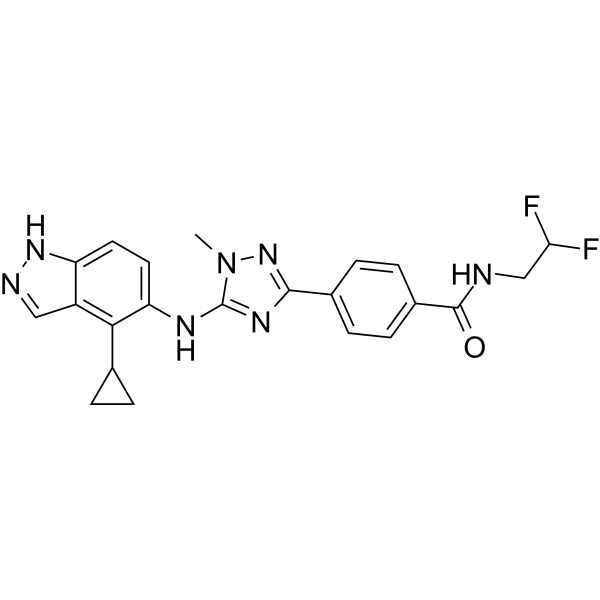
GNE-7056 is an orally active interleukin-2-inducible T-cell kinase (ITK) inhibitor with a Ki of 0.2 nM against human kinase, and exhibits high selectivity over LCK kinase. GNE-7056 inhibits PLCγ-1 phosphorylation, suppresses the production of IL-2, IL-4, IL-13 and TH2 cytokines, reduces CD4 + T-cell proliferation, and inhibits activation-induced cell death of CD4 + T cells by decreasing the abundance of FasL. GNE-7056 can be used in asthma-related research .
loading...
    loading...
Cat. No.: HY-174625
Target:  

mRNA

Research Areas:  

Inflammation/Immunology

Human IL2 mRNA encodes the human interleukin 2 (IL2) protein, a member of the interleukin 2 (IL2) cytokine subfamily. IL2 is produced by activated CD4+ and CD8+ T lymphocytes. It is important for the proliferation of T and B lymphocytes.
loading...
    loading...
Cat. No.: HY-P991892A

Research Areas:  

Cancer

IT1208 (FUT8-KO) is a humanized anti-CD4 monoclonal IgG1 antibody that has knocked out the fucosyltransferase 8 gene (FUT8). It exhibits enhanced antibody-mediated cytotoxicity (ADCC) effect. IT1208 (FUT8-KO) can effectively eliminate CD4+ T cells in vivo and shows controllable safety. IT1208 (FUT8-KO) can be used in related research on colon cancer .
loading...
    loading...
Cat. No.: HY-188104
Target:  

mRNA

Research Areas:  

Inflammation/Immunology

Human IL2 mRNA-LNP is a lipid nanoparticle (LNP) encapsulating Human IL2 mRNA. Human IL2 mRNA encapsulates human interleukin 2 (IL2) protein, which belongs to the interleukin 2 (IL2) cytokine subfamily. IL2 is produced by activated CD4+ and CD8+ T lymphocytes and is essential for the proliferation of T cells and B lymphocytes.
loading...
    loading...
Cat. No.: HY-P12140
CAS No.: 245092-22-2
Target:  

Myosin

Research Areas:  

Cardiovascular Disease

MyHC-α 614-629 is a specific polypeptide fragment of cardiac α-myosin heavy chain. MyHC-α 614-629 acts as an autoantigen to induce CD4 + T cell-mediated autoimmune responses in the immune system, thereby causing inflammatory infiltration and damage to myocardial tissue. MyHC-α 614-629 is applicable to the research of experimental autoimmune myocarditis .
loading...
    loading...
Cat. No.: HY-183784
Target:  

P2X Receptor FAK MMP

Research Areas:  

Cancer

P2X7R antagonist-1 is an orally active P2X7 receptor antagonist with an IC50 of 3.57 μM. P2X7R antagonist-1 inhibits the proliferation, invasion and metastasis abilities of cancer cells. P2X7R antagonist-1 downregulates the expression of FAK and MMP-9. P2X7R antagonist-1 suppresses tumor growth and metastasis in a mouse breast cancer model. P2X7R antagonist-1 promotes the activation of CD4 and CD8 T cells. P2X7R antagonist-1 can be used in breast cancer-related research .
loading...
    loading...
Cat. No.: HY-186205
CAS No.: 1299471-83-2
Target:  

Drug Metabolite

Research Areas:  

Cancer

(Rac)-EGC-M5 is an orally active metabolite of green tea Catechin (EGC) (HY-N0898). (Rac)-EGC-M5 enhances the activity of CD4 + T cells. (Rac)-EGC-M5 boosts the cytotoxic activity of NK cells in vivo. (Rac)-EGC-M5 can be used in cancer-related research .
loading...
    loading...
Cat. No.: HY-P991336
CAS No.: 2708115-83-5
Synonyms: INBRX-106; ES-102
Ordastobart (INBRX-106; ES-102) is a hexavalent OX40 agonist antibody. Ordastobart enhances OX40 receptor clustering, signaling, and downstream activation, thereby increasing the proliferation and activation of CD4 + and CD8 + T cells in vitro and in vivo. Ordastobart exhibits anti-tumor effects and improves survival in mouse models of cancer. Ordastobart is indicated for research in cancers such as fibrosarcoma and colorectal cancer .
loading...
    loading...
Cat. No.: HY-148808
CAS No.: 2365193-22-0
Purity:  99.33%
Synonyms: RXC007
Target:  

ROCK

Research Areas:  

Cancer

Zelasudil (RXC007) is an orally active, highly selective small molecule Rho-associated coiled-coil containing protein kinase 2 (ROCK2) inhibitor with anti-fibrotic efficacy. Zelasudil elicits positive immunomodulatory effects in metastatic pancreatic tumors with increase of CD8+ and CD4+ T cell infiltrate into the tumor cortex and reduction in immunosuppressive FOXP3+ regulatory T cells at the tumor border. Zelasudil is promising for research of pancreatic ductal adenocarcinoma .
loading...
    loading...
Cat. No.: HY-P10826
Target:  

PD-1/PD-L1

Research Areas:  

Cancer

PD-1/PD-L1 inhibitory peptide C8 is inhibits PD-1/PD-L1 interaction, promotes the activation of CD8+ and CD4+ T cells, and increases the IFN-γ secretion. PD-1/PD-L1 inhibitory peptide C8 exhibits antitumor efficacy in mouse model .
loading...
    loading...
Cat. No.: HY-W387035
CAS No.: 2799-15-7
Target:  

MHC

D-α-Methyl DOPA is an inhibitor of the binding of DQ8 peptide to MHC class II molecules. D-α-Methyl DOPA occupies a pocket along the DQ8 peptide binding groove. D-α-Methyl DOPA inhibits the binding of a DQ8 peptide to an MHC class II molecule for presentation to CD4 + T cells, thereby slowing the development or progression of type 1 diabete or celiac disease .
loading...
    loading...
Cat. No.: HY-P990175
Anti-Mouse OX40L/CD134L Antibody (RM134L) is an anti-mouse OX40L/CD134L IgG2b monoclonal antibody. Anti-Mouse OX40L/CD134L Antibody (RM134L) reduces immune response by inhibiting the OX40/OX40L signaling pathway. Anti-Mouse OX40L/CD134L Antibody (RM134L) can inhibit plasma cell differentiation and antibody secretion. Anti-Mouse OX40L/CD134L Antibody (RM134L) can prolong the survival time of cell transplantation by inhibiting CD4 + T cells. Anti-Mouse OX40L/CD134L Antibody (RM134L) can be used for researches on inflammation and cancer such as graft versus host disease (GVHD), allergic reaction, lupus nephritis and hepatocellular carcinoma (HCC) .
loading...
    loading...
Cat. No.: HY-176273
Target:  

ROR Interleukin Related

Research Areas:  

Inflammation/Immunology

RORγt inverse agonist 35 (Compound 22) is a RORγt inverse agonist with an IC50 of 1.51 μM. RORγt inverse agonist 35 significantly inhibits Th17 differentiation and proinflammatory properties in human CD4 + T cells. RORγt inverse agonist 35 can be used for research of Th17-driven autoimmune diseases, such as psoriasis, multiple sclerosis, and inflammatory bowel disease (IBD) .
loading...
    loading...

