152 Results for "

Peripheral effects

" in MedChemExpress (MCE) Product Catalog:
Products (152)

152 Results for "Peripheral effects" in MCE Product Catalog:

Art. -Nr.: HY-183853
CAS. Nr.: 35516-99-5
Arecaidine-propargyl ester is a selective M2 muscarinic receptor agonist with blood-brain barrier permeability, with a pKi of 5.91 for hm1, 7.06 for hm2, 6.07 for hm3, 6.01 for hm4, and 6.03 for hm5. Arecaidine-propargyl ester stimulates central and peripheral muscarinic receptors. Arecaidine-propargyl ester increases intracellular ROS, induces DNA damage and Apoptosis, and upregulates the expression of MnSOD and SIRT1. Arecaidine-propargyl ester reduces sympathetic nerve outflow, induces dose-dependent hypotension, and triggers negative chronotropic effects at high peripheral doses. Arecaidine-propargyl ester can be used in research related to Alzheimer's disease and glioblastoma .
loading...
    loading...
Art. -Nr.: HY-184796
AChE-IN-119 is a selective acetylcholinesterase (AChE) inhibitor with an IC50 of 0.0641 μM and a Ki of 0.01648 μM. AChE-IN-119 exerts antioxidant effects by scavenging DPPH free radicals. AChE-IN-119 exhibits mixed-type inhibition and interacts with both the catalytic active site and the peripheral anionic site of acetylcholinesterase. AChE-IN-119 can be used for the research of Alzheimer's disease .
loading...
    loading...
Art. -Nr.: HY-145128A
CAS. Nr.: 126766-42-5
Target:  

Opioid Receptor

Forschungsgebiete:  

Neurological Disease

GR103545 is a κ opioid receptor (KOR) selective PET radiotracer and functional agonist with blood-brain barrier permeability and comparable peripheral and central antinociceptive efficacy, with an IC50 of 0.02 nM for KOR agonistic activity. GR103545 selectively binds to KORs in the brain. GR103545 induces antinociceptive effects. GR103545 can be used in research related to neurological disorders such as depression and Alzheimer's disease .
loading...
    loading...
Art. -Nr.: HY-119514
CAS. Nr.: 423744-89-2
BC12 is a barbituric acid derivative and a phosphodiesterase 7 (PDE7) inhibitor, with an IC50 of 0.77 μM against human targets. BC12 inhibits the enzymatic activity of PDE7, but this activity is not the driver of its immunomodulatory effects on T lymphocytes. BC12 blocks the upregulation of IL-2 transcription in activated T cells. BC12 modulates the transcriptional response of T cells upon stimulation, exerting anti-inflammatory and pro-stress effects. BC12 inhibits the proliferation of primary mouse T cells and the IL-2 secretion of human peripheral blood T lymphocytes. BC12 exerts immunosuppressive and immunomodulatory effects on T lymphocyte function. BC12 can be used in research related to T lymphocyte-mediated diseases .
loading...
    loading...
Art. -Nr.: HY-183578
Target:  

LPL Receptor

Forschungsgebiete:  

Inflammation/Immunology

TYY-31 is an orally active, selective S1PR1 agonist with an EC50 of 1.13 pM. TYY-31 promotes the phosphorylation of ERK1/2. TYY-31 exerts anti-inflammatory and immunosuppressive effects, ameliorates DSS-induced colitis in mice, and reduces peripheral blood lymphocyte counts in mice in a dose-dependent manner. TYY-31 can be used for the research of ulcerative colitis .
loading...
    loading...
Art. -Nr.: HY-113858A
CAS. Nr.: 3026677-28-8
Synonyms: Brefanolol hydrochloride
Target:  

Adrenergic Receptor

Forschungsgebiete:  

Cardiovascular Disease

Brefonalol (Brefanolol) hydrochloride is an orally active, non-selective β-adrenergic receptor blocker with vasodilatory properties. Brefonalol hydrochloride exhibits an optimal balance between β-blockade and vasodilatory effects at low doses: it reduces blood pressure and slows heart rate, while increasing stroke volume instead of decreasing it, causing no significant elevation in peripheral resistance and increasing reactive hyperemia; at high doses, the β-blockade effect dominates. Brefonalol hydrochloride can be used in the research of arterial hypertension .
loading...
    loading...
Art. -Nr.: HY-106004R
CAS. Nr.: 1080028-80-3
Synonyms: BIA 5-1058 (Standard)
Zamicastat (Standard) is the analytical standard of Zamicastat (HY-106004). This product is intended for research and analytical applications. Zamicastat (BIA 5-1058) is a dopamine β-hydroxylase (DBH) inhibitor and can cross the blood-brain barrier (BBB) to cause central as well as peripheral effects. Zamicastat is also a concentration-dependent dual P-gp and BCRP inhibitor with IC50 values of 73.8 μM and 17.0 μM, respectively . Zamicastat reduces high blood pressure .
loading...
    loading...
Art. -Nr.: HY-W745845
CAS. Nr.: 131741-08-7
Synonyms: (rac)-Levosimendan; (rac)-Simsndan; (rac)-OR-1259
Forschungsgebiete:  

Cardiovascular Disease

Simendan ((rac)-Levosimendan; (rac)-Simsndan; (rac)-OR-1259) is a calcium-sensitizing positive inotropic vasodilator compound that enhances myocardial contractility through calcium-dependent binding to cardiac troponin C and selectively inhibits cardiac phosphodiesterase (Phosphodiesterase) III, while inducing coronary and peripheral vasodilation and anti-ischemic effects. Simendan can be used for research on congestive heart failure, acute heart failure, myocardial infarction, myocardial ischemia, and thrombotic diseases .
loading...
    loading...
Art. -Nr.: HY-183997
CAS. Nr.: 2815221-18-0
Forschungsgebiete:  

Cancer

Cbl-b-IN-33 is an orally active, selective inhibitor of Casitas B-lineage lymphoma-b (Cbl-b) with an IC50 of 7 nM and a Kd of 1.2 nM. Cbl-b-IN-33 inhibits non-phosphorylated E3 ubiquitin ligase Cbl-b, induces IL-2 activation in peripheral blood mononuclear cells, and exerts tumor growth inhibitory effects in a mouse colon cancer model. Cbl-b-IN-33 can be used for the research of colon cancer .
loading...
    loading...
Art. -Nr.: HY-107111R
CAS. Nr.: 932373-87-0
Forschungsgebiete:  

Neurological Disease

GSK1034702 (Standard) is the analytical standard of GSK1034702 (HY-107111). This product is intended for research and analytical applications. GSK1034702 is an orally active and allosteric agonist of M1 mAChR (pEC50=8.1) that can cross the blood-brain barrier. GSK1034702 activates the Gq/11 protein-mediated signaling pathway, enhancing neuronal firing and long-term potentiation (LTP) in the CA1 region of the hippocampus. GSK1034702 can modulate hippocampal function, improve memory encoding in the nicotine withdrawal cognitive dysfunction model, and show pro-cognitive effects in rodents. GSK1034702 can be used for the study of the mechanisms of cognitive impairment diseases such as Alzheimer's disease, and has certain peripheral M receptor activation-related side effects (such as gastrointestinal reactions) .
loading...
    loading...
Art. -Nr.: HY-183301
Forschungsgebiete:  

Cardiovascular Disease

TLR2/1 agonist-1 is a selective agonist of the TLR2/1 heterodimer. TLR2/1 agonist-1 acts as a hematopoietic recovery inducer to accelerate the recovery of peripheral blood cells. TLR2/1 agonist-1 serves as a G-CSF production inducer to increase serum G-CSF levels. TLR2/1 agonist-1 exhibits radioprotective effects in mice exposed to radiation. TLR2/1 agonist-1 can be used in studies related to acute radiation syndrome .
loading...
    loading...
Art. -Nr.: HY-134440
CAS. Nr.: 104809-20-3
Target:  

P2X Receptor

Forschungsgebiete:  

Inflammation/Immunology

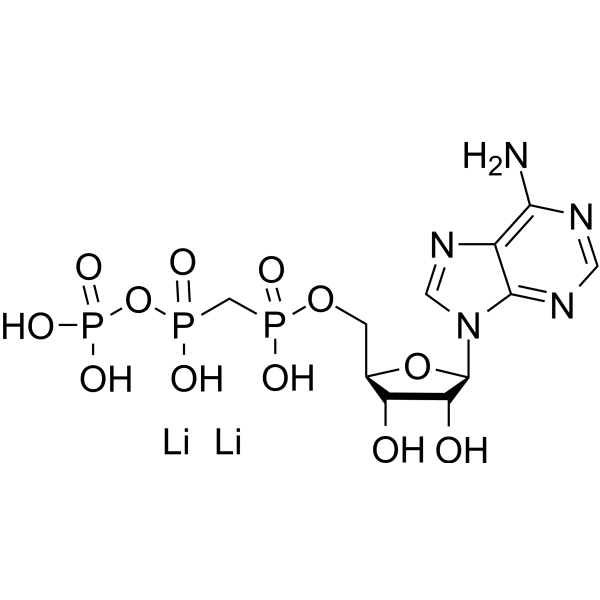
α,β-Methylene-ATP dilithium is an agonist of P2X1 and P2X3 receptors and can cross the blood-brain barrier. α,β-Methylene-ATP dilithium can trigger a reflex pressor response by activating P2X receptors in peripheral muscles and the central locus coeruleus (LC); this effect can be blocked by the P2X antagonist PPADS (HY-108960). α,β-Methylene-ATP dilithium also activates noradrenergic neurons in the central locus coeruleus, mediating antinociceptive effects; this effect can be attenuated by the locus coeruleus damaging agent DSP-4 (HY-103210/HY-121602). α,β-Methylene-ATP dilithium can be used to study the pathological mechanisms of neuropathic pain, cardiovascular reflex regulation, and antinociceptive effects of the central nervous system .
loading...
    loading...
Art. -Nr.: HY-134440A
CAS. Nr.: 7292-42-4
Target:  

P2X Receptor

Forschungsgebiete:  

Inflammation/Immunology

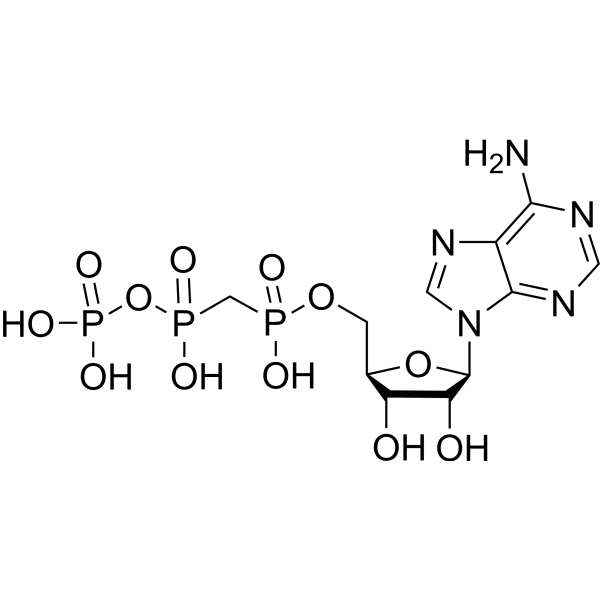
α,β-Methylene-ATP is an agonist of P2X1 and P2X3 receptors and can cross the blood-brain barrier. α,β-Methylene-ATP can trigger a reflex pressor response by activating P2X receptors in peripheral muscles and the central locus coeruleus (LC); this effect can be blocked by the P2X antagonist PPADS (HY-108960). α,β-Methylene-ATP also activates noradrenergic neurons in the central locus coeruleus, mediating antinociceptive effects; this effect can be attenuated by the locus coeruleus damaging agent DSP-4 (HY-103210/HY-121602). α,β-Methylene-ATP can be used to study the pathological mechanisms of neuropathic pain, cardiovascular reflex regulation, and antinociceptive effects of the central nervous system .
loading...
    loading...
Art. -Nr.: HY-14977
CAS. Nr.: 840523-39-9
Target:  

LPL Receptor

Forschungsgebiete:  

Inflammation/Immunology

CS-0777-P, the phosphorylated form of CS-0777, acts as a potent and selective modulator of the S1P receptor-1 (S1P1). It exhibits approximately 320-fold higher agonist activity for human S1P1 compared to S1P3, with an EC50 of 1.1 nM. In pharmacological studies, CS-0777-P demonstrated significant effects in vitro as an S1P1 and S1P3 agonist, leading to lowered peripheral blood lymphocyte counts and suppressive effects on experimental autoimmune encephalomyelitis (EAE) in rats. Pharmacokinetic studies in rats revealed rapid lymphocyte count reductions following oral administration, making CS-0777 a promising candidate currently undergoing clinical trials for the treatment of multiple sclerosis (MS) .
loading...
    loading...
Art. -Nr.: HY-W010448R
CAS. Nr.: 22884-10-2
Imidazol-1-yl-acetic acid (Standard) is the analytical standard of Imidazol-1-yl-acetic acid (HY-W010448). This product is intended for research and analytical applications. Imidazol-1-yl-acetic acid is a BRS-3 agonist that mediates anorectic effects through activation of orphan G protein-coupled receptors (Orphan GPCR) in peripheral tissues; it also serves as a green, water-soluble, recyclable bifunctional organocatalyst for transformations such as the Biginelli multicomponent reaction and epoxide ring opening. Imidazol-1-yl-acetic acid can be used for research on obesity .
loading...
    loading...
Art. -Nr.: HY-W517092
CAS. Nr.: 55673-89-7
Synonyms: 1,2,3,4,7,8,9-HpCDF
1,2,3,4,7,8,9-Heptachlorodibenzofuran (1,2,3,4,7,8,9-HpCDF) is a compound that induces the expression of CYP1A1 and CYP1B1 genes in human peripheral blood lymphocytes, while also promoting the expression of the aryl hydrocarbon receptor repressor (AhRR). 1,2,3,4,7,8,9-Heptachlorodibenzofuran can increase ethoxyresorufin-O-deethylase (EROD) activity in isolated human peripheral blood lymphocytes in a concentration-dependent manner, which serves as a marker of CYP1A1 activity. Furthermore, 1,2,3,4,7,8,9-Heptachlorodibenzofuran exhibits immunosuppressive effects by reducing the number of splenic plaque-forming cells in mice and increasing aryl hydrocarbon hydroxylase (AHH) activity in liver microsomes of mice injected with sheep red blood cells. 1,2,3,4,7,8,9-Heptachlorodibenzofuran can be used in research in the fields of immunology, metabolic diseases, and environmental toxicology .
loading...
    loading...
Art. -Nr.: HY-121465
CAS. Nr.: 67964-87-8
Target:  

Endogenous Metabolite

Forschungsgebiete:  

Metabolic Disease

Stearoyl serotonin is a hybrid molecule patterned after arachidonoyl serotonin. Arachidonoyl serotonin is a dual antagonist of fatty acid amide hydrolase (FAAH) and the transient receptor potential vanilloid-type 1 (TRPV1) channel, reducing both acute and chronic peripheral pain. The effects of replacing the arachidonoyl portion with the saturated 18-carbon stearoyl moiety have not been studied. However, replacement of arachidonate with saturated 11- or 12-carbon fatty acids produces compounds that potently inhibit capsaicin-induced TRPV1 channel activation (IC50=0.76 μM) without blocking FAAH-mediated hydrolysis of arachidonoyl ethanolamine (IC50 > 50 μM).
loading...
    loading...
Art. -Nr.: HY-W005255
CAS. Nr.: 621-54-5
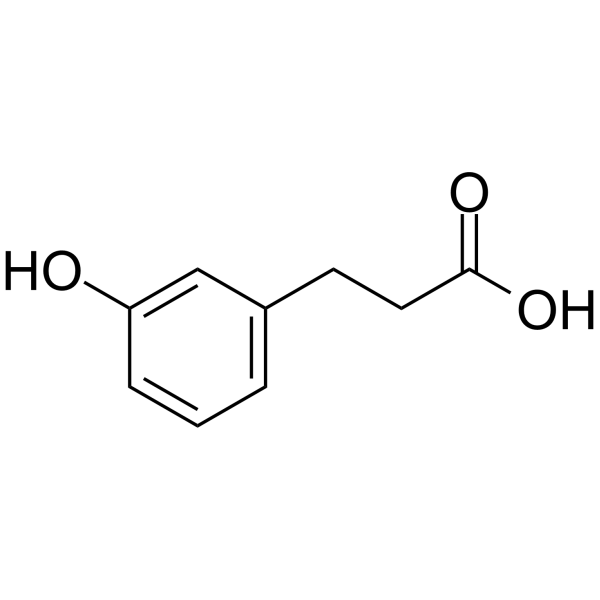
3-(3-Hydroxyphenyl)propionic acid (3HPPA) is an endothelium-dependent nitric oxide (NO) release promoter and endothelial nitric oxide synthase (eNOS) activator. 3-(3-Hydroxyphenyl)propionic acid activates eNOS to mediate vascular smooth muscle relaxation and enhances endothelial cell NO synthesis, inducing vasodilation and reducing peripheral vascular resistance. 3-(3-Hydroxyphenyl)propionic acid can dose-dependently reduce systolic and diastolic blood pressure in spontaneously hypertensive rats (SHR) without affecting cardiac contractility or heart rate. 3-(3-Hydroxyphenyl)propionic acid has antihypertensive and vascular protective effects and can be used in the prevention and treatment of cardiovascular diseases .
loading...
    loading...
Art. -Nr.: HY-179164S
CAS. Nr.: 287484-43-9
Choline- 15N chloride is the 15N-labeled Choline chloride (HY-B1337). Choline chloride is an orally active methylxanthine derivative. Choline chloride exhibits weak antihistaminic and anticholinergic activities and potentiates the effects of histamine and acetylcholine. Choline chloride relaxes bronchial smooth muscle, dilates coronary and peripheral blood vessels, increases urine output and electrolyte excretion, stimulates locomotor activity in the central nervous system, and induces transient hypotension following a pressor phase. Choline chloride modulates sleep architecture by increasing wakefulness time and reducing slow-wave sleep, without altering the frequency or severity of nocturnal hypoxemia, apnea, or hypopnea events. Choline chloride is used in studies of bronchospasm, nocturnal asthma, and chronic asthma .
loading...
    loading...
Art. -Nr.: HY-B1337R
CAS. Nr.: 67-48-1
Choline chloride (Standard) is the analytical standard of Choline chloride (HY-B1337). This product is intended for research and analytical applications. Choline chloride is an orally active methylxanthine derivative. Choline chloride exhibits weak antihistaminic and anticholinergic activities and potentiates the effects of histamine and acetylcholine. Choline chloride relaxes bronchial smooth muscle, dilates coronary and peripheral blood vessels, increases urine output and electrolyte excretion, stimulates locomotor activity in the central nervous system, and induces transient hypotension following a pressor phase. Choline chloride modulates sleep architecture by increasing wakefulness time and reducing slow-wave sleep, without altering the frequency or severity of nocturnal hypoxemia, apnea, or hypopnea events. Choline chloride is used in studies of bronchospasm, nocturnal asthma, and chronic asthma .
loading...
    loading...

