125 Results for "

broad-leaf

" in MedChemExpress (MCE) Product Catalog:
Products (125)

125 Results for "broad-leaf" in MCE Product Catalog:

Referencia número: HY-137910
No. CAS: 335104-84-2
Pureza:  98.84%
Áreas de investigación:  

Infection

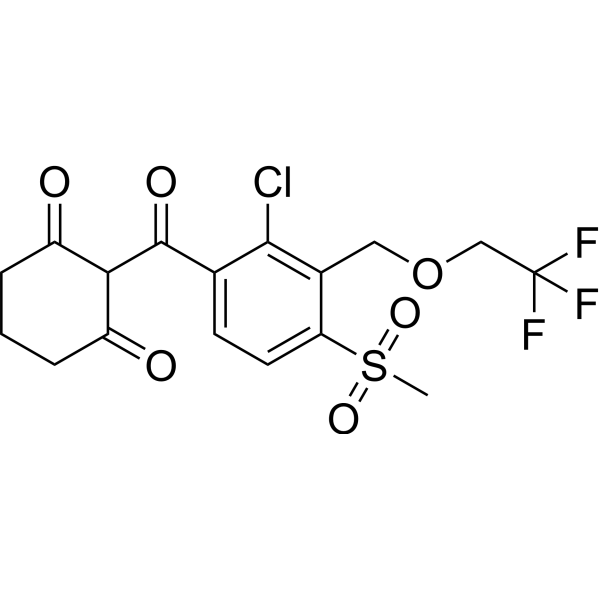
Tembotrione is a herbicide belonging to the HPPD (dioxygenase) inhibitor class with crop selectivity. Tembotrione effectively controls a variety of weeds including broadleaf and gramineous species by disrupting carotenoid synthesis, which leads to chlorophyll degradation and leaf whitening. Mixing Tembotrione with isoxaflutole or adding surfactants optimizes its efficacy and reduces phytotoxicity, with no residual impact on subsequent cruciferous crops, thus helping to increase maize grain yield. The activity of Tembotrione decreases under drought conditions, and under specific conditions (such as double-dose treatment), it may cause reversible yellowing and even yield reduction in crops such as poppy .
loading...
    loading...
Referencia número: HY-B0860R
No. CAS: 330-54-1
Áreas de investigación:  

Cancer

Diuron (Standard) is the analytical standard of Diuron (HY-B0860). This product is intended for research and analytical applications. Diuron is an orally active phenylurea herbicide. Diuron inhibits photosynthesis in plants by blocking the formation of ATP and NADH. Diuron increases the production of ROS. Diuron increases expression of p53 in certain cell lines. Diuron has herbicidal activity against annual and perennial broadleaf weeds and grass weeds. Diuron promotes DMBA/BBN-induced bladder cancer. Diuron can be used in breast cancer research .
loading...
    loading...
Referencia número: HY-W711035
No. CAS: 137641-05-5
Synonyms: AC 900001
Picolinafen is a pyridine-class herbicide that acts as a phytoene desaturase (PDS) inhibitor. Picolinafen effectively controls broadleaf weeds and disrupts carotenoid biosynthesis. Picolinafen exhibits cytotoxicity to porcine trophectoderm (pTr) and luminal epithelial (pLE) cells. Picolinafen induces (ROS accumulation, calcium depletion, and activates (MAPK and PI3K signaling pathways, leading to decreased cell viability, increased apoptosis, impaired migration, and altered expression of implantation-related genes. Picolinafen has an LD50 value of 2.7 mg/kg in mammals and 7 μg/L in fish. Picolinafen exhibits toxic effects during zebrafish embryogenesis [1][2].
loading...
    loading...
Referencia número: HY-167959
No. CAS: 26544-20-7
Target:  

Herbicide

Áreas de investigación:  

Infection

MCPA-isooctyl is a selective conductive phenoxycarboxylate herbicide and an alternative to 2,4-D Butyl ester (HY-B0867). MCPA-isooctyl effectively controls broadleaf weeds in various crop fields via post-emergence foliar or soil treatment. MCPA-isooctyl is absorbed by the roots, stems and leaves of plants; it is easily metabolized and detoxified in gramineous crops, but difficult to metabolize in dicotyledonous weeds, causing stem and leaf distortion, root deformation, and eventually weed death. When formulated into chitosan nanoparticles, MCPA-isooctyl still significantly inhibits the growth of weeds in wheat fields, and reduces their chlorophyll content and biomass at low doses .
loading...
    loading...
Referencia número: HY-137910R
No. CAS: 335104-84-2
Áreas de investigación:  

Others

Tembotrione (Standard) is the analytical standard of Tembotrione. This product is intended for research and analytical applications. Tembotrione is a drug that may reduce the productivity of carrots. Tembotrione has the activity of reducing carrot stem mass. Tembotrione can be used to study the total productivity of carrot . Tembotrione is a herbicide belonging to the HPPD (dioxygenase) inhibitor class with crop selectivity. Tembotrione effectively controls a variety of weeds including broadleaf and gramineous species by disrupting carotenoid synthesis, which leads to chlorophyll degradation and leaf whitening. Mixing Tembotrione with isoxaflutole or adding surfactants optimizes its efficacy and reduces phytotoxicity, with no residual impact on subsequent cruciferous crops, thus helping to increase maize grain yield. The activity of Tembotrione decreases under drought conditions, and under specific conditions (such as double-dose treatment), it may cause reversible yellowing and even yield reduction in crops such as poppy .
loading...
    loading...

