9 Results for "

HEK293 human embryonic kidney cells

" in MedChemExpress (MCE) Product Catalog:
Products (9)

9 Results for "HEK293 human embryonic kidney cells" in MCE Product Catalog:

Cat. No.: HY-157767
CAS No.: 3021581-79-0
Research Areas:  

Cancer

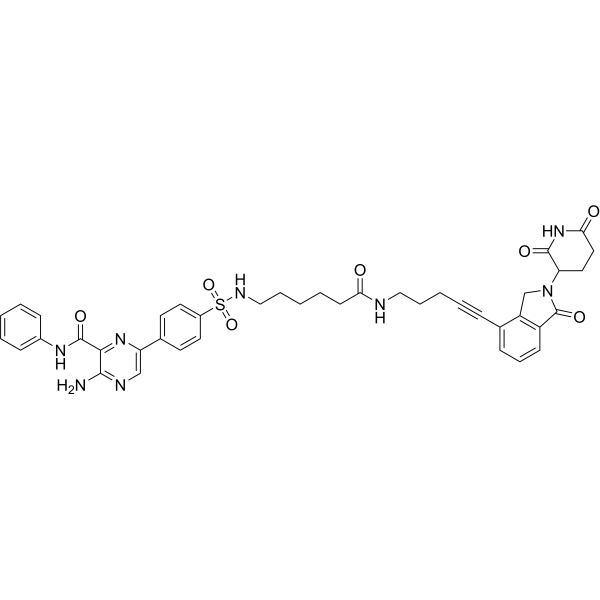
Abd110 is a selective ATR PROTAC degrader. Abd110 recruits Cereblon to induce the proteasomal degradation of ATR, and reduces the levels of phosphorylated ATR and downstream phosphorylated CHK1. Abd110 can be used for research on pancreatic cancer and cervical cancer .
loading...
    loading...
Cat. No.: HY-146369
CAS No.: 2353417-85-1
Target:  

PROTACs VEGFR

Research Areas:  

Cancer

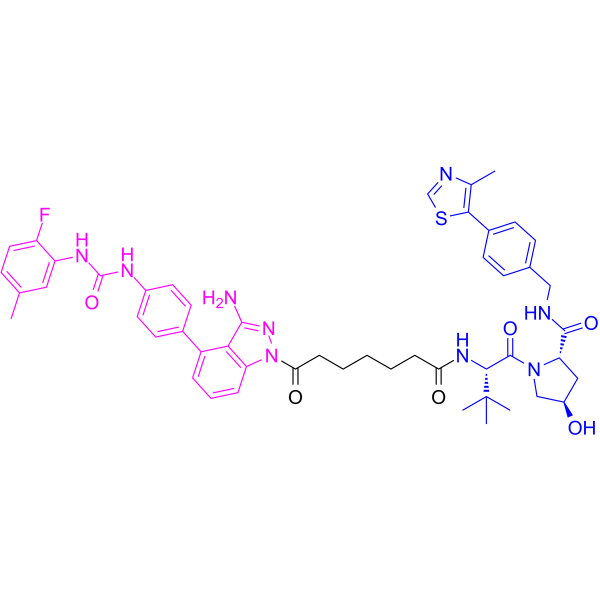
PROTAC VEGFR-2 degrader-2 is a VEGFR-2 (KDR) PROTAC degrader with weak inhibitory activity against VEGFR-2 (IC50 > 1 μM). It is applicable to the research of cancer-related pathological angiogenesis .
loading...
    loading...
Cat. No.: HY-167835A
CAS No.: 2824-94-4
Tembetarine chloride is a alkaloid that can be isolated from Tinospora cordifolia that exhibits antibacterial activity. Tembetarine chloride exhibits weak cytotoxicity against mouse fibroblasts (L929) and human embryonic kidney cells (HEK293) with IC50 of 1245.33 μg/mL and 1642.81 μg/mL, respectively .
loading...
    loading...
Cat. No.: HY-182636
CAS No.: 1895049-73-6
MT16-001 is a cell-permeable UCHL1 inhibitor with an IC50 value of 580 nM. MT16-001 also exhibits considerable inhibitory activity against USP30, and shows selectivity for other UCH family deubiquitinases (DUBs) as well as the broader proteome. MT16-001 binds covalently to the cysteine residue at the active site of UCHL1, and forms covalent interactions with ALDH2, ALDH9A1 and GATD3A in intact cells. Meanwhile, as a cytotoxic agent, it displays a steep dose-response curve in human embryonic kidney cells. MT16-001 can be used for research on various cancers, liver fibrosis and pulmonary fibrosis .
loading...
    loading...
Cat. No.: HY-181154
Research Areas:  

Infection

PROTAC SARS-CoV-2 Mpro degrader-5 is a SARS-CoV-2 main protease (Mpro) PROTAC. PROTAC SARS-CoV-2 Mpro degrader-5 engages CRBN E3 ubiquitin ligase to form a ternary complex with SARS-CoV-2 Mpro, induces K48-linked polyubiquitination of SARS-CoV-2 Mpro, and drives proteasome-dependent turnover of SARS-CoV-2 Mpro with a high selectivity index (CC50/DC50 > 10) in human embryonic kidney cells.PROTAC SARS-CoV-2 Mpro degrader-5 can be used for the research of COVID-19 .
loading...
    loading...
Cat. No.: HY-112007
CAS No.: 4776-06-1
Research Areas:  

Inflammation/Immunology Cancer

Fluorosalan is an NF-κB inhibitor. Fluorosalan blocks the NF-κB signaling pathway by inhibiting the phosphorylation of IκBα. Fluorosalan induces depolarization of mitochondrial membrane potential in cancer cells and inhibits the growth of various cancer cells. Fluorosalan can be used in studies related to cervical cancer and rheumatoid arthritis .
loading...
    loading...
Cat. No.: HY-181923
Target:  

EGFR CDK Cytochrome P450

Research Areas:  

Cancer

IMP-Zn is a pyrazole-hydrazone Schiff base zinc (II) complex. IMP-Zn exhibits significant antiproliferative activity against human colorectal cancer cells and induces cell cycle arrest. IMP-Zn shows stronger binding affinity than its free ligand IMP towards three cancer-related protein targets: EGFR kinase 1M17, cytochrome P450 3RUK, and CDK inhibitor 6GUE. IMP-Zn can be used in studies related to colorectal cancer .
loading...
    loading...
Cat. No.: HY-187196
Target:  

ATM/ATR Aurora Kinase

Research Areas:  

Cancer

ATR/AURKA-ligand 1 (Compound 8g) is a ATR/AURKA ligand. ATR/AURKA-ligand 1 serves as a target protein ligand for the synthesis of ATR/AURKA PROTAC degraders, such as Abd141 (HY-187195). ATR/AURKA-ligand 1 is applicable to the research of acute lymphoblastic leukemia .
loading...
    loading...
Cat. No.: HY-187529
CAS No.: 1144496-95-6
Target:  

Bacterial

Research Areas:  

Infection

PUN-96956 is an inhibitor of the β-barrel assembly machine (BAM) complex. By inhibiting the folding of β-barrel outer membrane proteins (OMPs) and their insertion into the outer membrane, PUN-96956 disrupts outer membrane integrity and induces the cell envelope stress response. PUN-96956 can be used in studies of bacterial infections caused by ESKAPE pathogens, uropathogenic Escherichia coli, and Gram-positive bacteria .
loading...
    loading...

