1. Search Result
Search Result
Results for "

High-performance liquid chromatography

" in MedChemExpress (MCE) Product Catalog:

23

Inhibitors & Agonists

3

Fluorescent Dyes

2

Peptides

8

Natural
Products

1

Isotope-Labeled Compounds

1

Click Chemistry

Cat. No. Product Name Target Research Areas Chemical Structure
  • HY-W027544

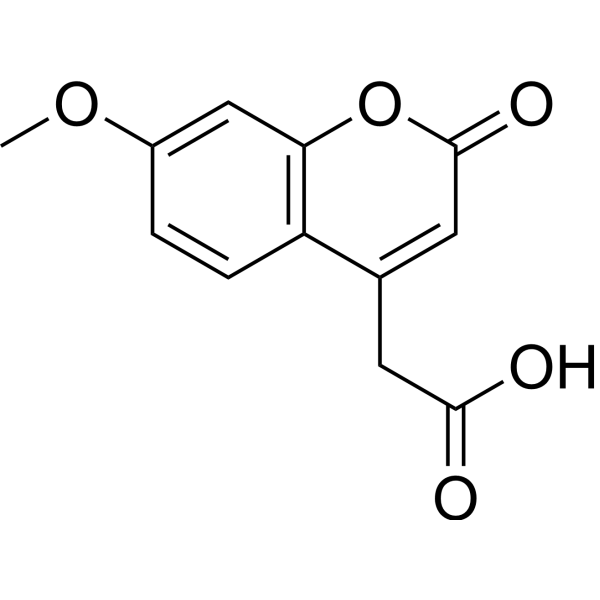
    7-Methoxycoumarin-4-acetic acid

    Fluorescent Dye Others
    MCA (7-Methoxycoumarin-4-acetic acid) is a Coumarin (HY-N0709) derivative. MCA quantitates platelet-activating factor (PAF) by high-performance liquid chromatography with fluorescent detection. MCA can modify FRET peptide substrates for analyzing protease activities .
    MCA
  • HY-N3286

    Influenza Virus Others
    Methyl 4-O-feruloylquinate (4-O-Feruloylquinic acid methyl ester) is a natural product. Methyl 4-O-feruloylquinate can be purified from Stemona Japonica by preparative high-performance liquid chromatography. Methyl 4-O-feruloylquinate has anti-H5N1 activity with a 3% protective rate at 5 μM in MDCK cells .
    Methyl 4-O-feruloylquinate
  • HY-I0169

    Drug Metabolite Neurological Disease
    (R)-Amino-N-benzyl-3-methoxypropionamide is a key intermediate for the synthesis of the antiepileptic agent (R)-Lacosamide. To improve its chiral purity and chemical stability, (R)-Amino-N-benzyl-3-methoxypropionamide can react with phosphoric acid to form a phosphate salt. Detected by high performance liquid chromatography (HPLC), this phosphate salt exhibits extremely high chiral purity, with the content of the R-enantiomer reaching up to 99.37% .
    (R)-Amino-N-benzyl-3-methoxypropionamide
  • HY-D2171

    Fluorescent Dye Others
    AF488 DBCO is a fluorescent dye and also a click chemistry reagent that can label azide-containing biomolecules. AF488 DBCO mediates the coupling reaction with azide-modified 2'-OMe RNA oligonucleotides. DBCO is a bioorthogonal partner of azides and enables covalent coupling without copper (Ex/Em = 470/520 nm) .
    AF488 DBCO
  • HY-P3570

    Lom-AKH-II

    Endogenous Metabolite Metabolic Disease
    Adipokinetic hormone II (Locusta migratoria) (Lom-AKH-II) is a insect adipokinetic hormone (AKH), enhances fat body cAMP levels in vitro. Insect adipokinetic hormones (AKHs) controls flight-directed mobilization of carbohydrate and lipid from fat body stores, which depends on AKH receptor(s) coupling to cAMP formation and glycogen phosphorylase activation via the stimulatory guanine nucleotide-binding protein (Gs) .
    Adipokinetic hormone II (Locusta migratoria)
  • HY-W100959

    Tetramethylquinone

    Drug Derivative Others
    Duroquinone (Tetramethylquinone) is a model compound of amphiphilic quinone, which can be used as an oxidative-reductive activity probe. Duroquinone can be easily reduced by biological systems to hydrogen peroxide (DQH₂) or semi-quinone free radicals (DQ•⁻). Duroquinone can freely pass through the cell membrane, facilitating the study of the electron transfer process inside and outside the cells. Duroquinone can be used to investigate the relationship between metabolism in the pulmonary circulation and endothelial cells .
    Duroquinone
  • HY-P3572

    Lom-AKH-I

    Endogenous Metabolite Endocrinology
    Adipokinetic hormone I (Locusta migratoria) (Lom-AKH-I) is a insect adipokinetic hormone (AKH), enhances fat body cAMP levels in vitro. Insect adipokinetic hormones (AKHs) controls flight-directed mobilization of carbohydrate and lipid from fat body stores, which depends on AKH receptor(s) coupling to cAMP formation and glycogen phosphorylase activation via the stimulatory guanine nucleotide-binding protein (Gs) .
    Adipokinetic hormone I (Locusta migratoria)
  • HY-115689

    Others Others
    Maohuoside B is a flavonoid, that can be isolated from Epimedium koreanum Nakai .
    Maohuoside B
  • HY-158725

    Endogenous Metabolite Others
    N-Octadecenoyl-(cis-9) -Sulfatide is a glycolipid found in the brains of mice. N-Octadecenoyl-(cis-9) -Sulfatide can be used as a standard for the determination of C18:13 '-mergogalactosyllactose in dry blood stains of patients with chromatic leukodystrophy (MLD) by ultra-high performance liquid chromatography-mass spectrometry (UPLC-MS) .
    N-Octadecenoyl-(cis-9)-sulfatide
  • HY-N17239

    TNF Receptor Interleukin Related NO Synthase Inflammation/Immunology
    Oleracone is a type of alkaloid that can be found in Portulaca oleracea L.. Oleracone exhibits a significant anti-inflammatory effect in the RAW 264.7 macrophage model induced by LPS (HY-D1056), capable of inhibiting NO production and significantly suppressing the secretion of pro-inflammatory cytokines TNF-α, IL-6, and prostaglandin E₂ (PGE₂). Oleracone can be used for the study of inflammatory diseases .
    Oleracone
  • HY-35556

    Fluorescent Dye Cardiovascular Disease Metabolic Disease
    9-Aminophenanthrene is a type of polycyclic aromatic amine compound, which can be used as a fluorescent labeling reagent for free fatty acids (FFA) .
    9-Aminophenanthrene
  • HY-16675

    Docetaxel Impurity 2

    Microtubule/Tubulin Cancer
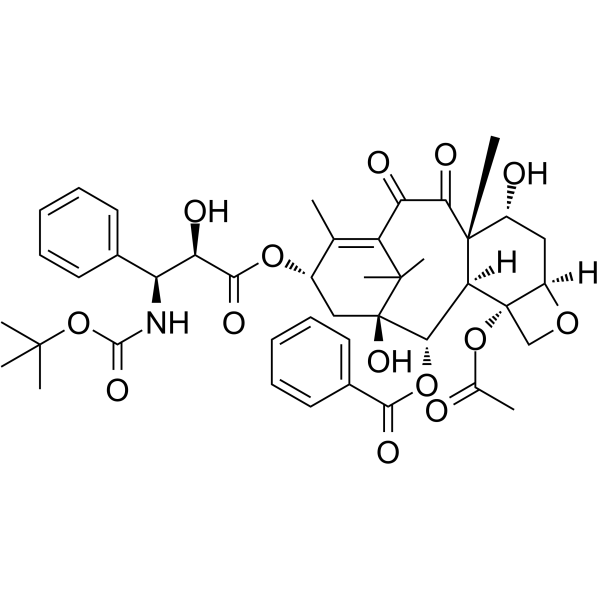
    7-Epi-10-oxo-docetaxel (Docetaxel Impurity 2) is a impurity of docetaxel detected by high performance liquid chromatography (HPLC).
    7-Epi-10-oxo-docetaxel
  • HY-W027544S

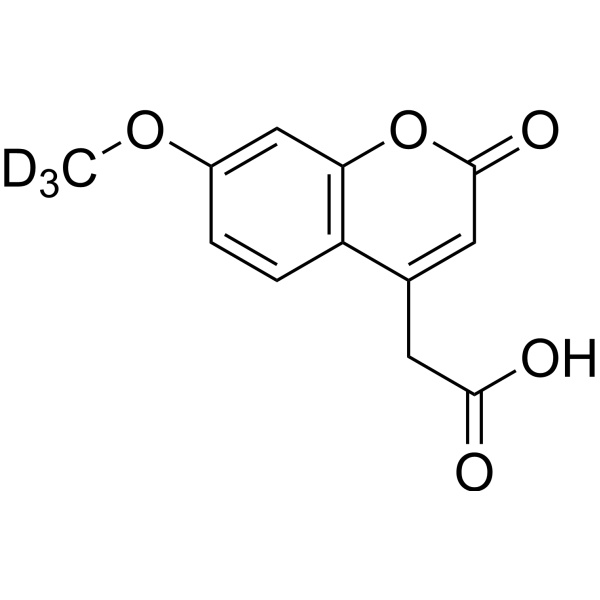
    7-Methoxycoumarin-4-acetic acid-d3

    Isotope-Labeled Compounds Fluorescent Dye Others
    MCA-d3 (7-Methoxycoumarin-4-acetic acid3) is the deuterium labeled MCA (HY-W027544) . MCA is a Coumarin (HY-N0709) derivative. MCA quantitates platelet-activating factor (PAF) by high-performance liquid chromatography with fluorescent detection. MCA can modify FRET peptide substrates for analyzing protease activities .
    MCA-d3
  • HY-131589

    Atenolol acid

    Endogenous Metabolite Others
    Metoprolol acid (Atenolol acid) is a urinary metabolite with no pharmacological activity. Metoprolol acid does not exert its pharmacological effects in vivo. Metoprolol acid can be detected by solid phase extraction and reversed phase high performance liquid chromatography. The analysis of metoprolol acid requires specific conditions, such as the use of fluorescence detection and specific eluents .
    Metoprolol acid
  • HY-131589R

    Atenolol acid (Standard)

    Endogenous Metabolite Reference Standards Others
    Metoprolol acid (Standard) is the analytical standard of Metoprolol acid. This product is intended for research and analytical applications. Metoprolol acid (Atenolol acid) is a urinary metabolite with no pharmacological activity. Metoprolol acid does not exert its pharmacological effects in vivo. Metoprolol acid can be detected by solid phase extraction and reversed phase high performance liquid chromatography. The analysis of metoprolol acid requires specific conditions, such as the use of fluorescence detection and specific eluents .
    Metoprolol acid (Standard)
  • HY-W040821R

    Reference Standards Endogenous Metabolite Neurological Disease
    Metoprolol acid (Standard) is the analytical standard of Metoprolol acid. This product is intended for research and analytical applications. Metoprolol acid (Atenolol acid) is a urinary metabolite with no pharmacological activity. Metoprolol acid does not exert its pharmacological effects in vivo. Metoprolol acid can be detected by solid phase extraction and reversed phase high performance liquid chromatography. The analysis of metoprolol acid requires specific conditions, such as the use of fluorescence detection and specific eluents .
    DL-Homocysteine (Standard)
  • HY-N12143

    Others Others
    Acetylthevetin A is a natural product isolated from oleander (Cascabela thevetioides) .
    Acetylthevetin A
  • HY-120512

    Fluorescent Dye Others
    5-Phenyl-4E-pentenol is a product of the peroxidase-catalyzed reduction of PPHP. 5-Phenyl-4E-pentenol can be rapidly isolated by solid phase extraction and quantified by isocratic reversed-phase high performance liquid chromatography (HPLC) with UV detection. 5-Phenyl-4E-pentenol is a fluorescent dye that can be used to determine the kinetic properties of heme-containing and non-heme peroxidases and to evaluate the ability of oxidative compounds to serve as substrates for peroxidase reduction. .
    5-Phenyl-4E-pentenol
  • HY-N9808

    Others Others
    Creoside III is a glycoside compound, mainly used as a component of natural product libraries for potential activity screening studies in the field of natural product chemistry. Creoside III can be naturally extracted from the dried roots of Rhodiola crenulata (a plant of the genus Rhodiola in the Crassulaceae family) through methanol reflux extraction, column chromatography separation, and high-performance liquid chromatography purification .
    Creoside III
  • HY-127151

    Levophencynonate hydrochloride

    Endogenous Metabolite Neurological Disease
    Levophencynonate is a muscarinic receptor antagonist with anticholinergic activity. The biological activity of levophencynonate makes it a key target for the determination of its concentration in human plasma in medical research. Levophencynonate was analyzed by high performance liquid chromatography tandem mass spectrometry (HPLC-MS/MS) and showed good specificity and linearity .
    R-(-)-Phencynonate hydrochloride
  • HY-135543

    Endogenous Metabolite Neurological Disease
    Levophencynonate is a muscarinic receptor antagonist with anticholinergic activity. The biological activity of levophencynonate makes it a key target for the determination of its concentration in human plasma in medical research. Levophencynonate was analyzed by high performance liquid chromatography tandem mass spectrometry (HPLC-MS/MS) and showed good specificity and linearity .
    Levophencynonate
  • HY-N13081

    Others Cancer
    3-Oxo-cinobufagin (compound 8) is a potential anticancer compound that can be isolated from the broth of M. spinosus by high-performance liquid chromatography. Compared to other isolated compounds, the hydroxyl group at the C-5 position of 3-Oxo-cinobufagin is further oxidized or isomerized, significantly reducing its cytotoxic activity against most cell lines (except HEL), while increasing its activity against the BEL cell line. The IC50 values of 3-Oxo-cinobufagin's cytotoxicity against cancer cells are: 71.3 μM (HepG2), 90.2 μM (SMMC-7221), 0.11 μM (BEL-7402), 72.5 μM (K562), 5.3 μM (HL-60), and 12 nM (HEL) .
    3-Oxo-cinobufagin
  • HY-N17719

    Others Others
    (2S)-Eriodictyol-5-O-β-D-glucopyranoside (Compound 1b) is a type of flavanone glucoside compound, which can be found in Balanophora involucrate Hook. f .
    (2S)-Eriodictyol-5-O-β-D-glucopyranoside

Inquiry Online

Your information is safe with us. * Required Fields.

Salutation


Country or Region *

Applicant Name *


Organization Name *

Department *


Email Address *


Product Name *

Cat. No.


Requested quantity *

Phone Number *


Remarks

Inquiry Online

Inquiry Information

Product Name:
Cat. No.:
Quantity:
MCE Japan Authorized Agent:

