8 Results for "

Nicotiana tabacum cells

" in MedChemExpress (MCE) Product Catalog:
Products (8)

8 Results for "Nicotiana tabacum cells" in MCE Product Catalog:

Cat. No.: HY-W001084
CAS No.: 14199-15-6
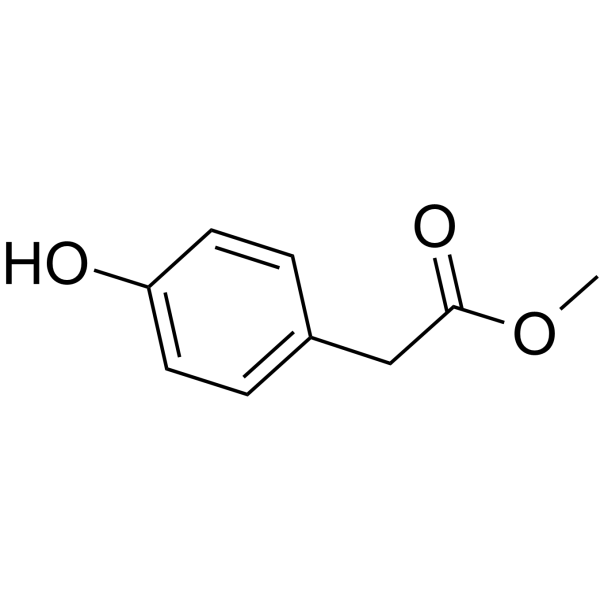
Methyl 4-hydroxyphenylacetate is a compound found in the marine fungus Penicillium oxalicum 0312F1. Methyl 4-hydroxyphenylacetate can be Methyl 4-hydroxyphenylacetate inhibits replication of tobacco mosaic virus (TMV) in Nicotiana tabacum leaf discs. Methyl 4-hydroxyphenylacetate shows inhibitory activity against proliferation of cancer cells. Methyl 4-hydroxyphenylacetate can be used for the researches of TMV infection and cancer .
loading...
    loading...
Cat. No.: HY-B0941A
CAS No.: 1214-39-7
Synonyms: Benzyladenine, suitable for plant cell culture; 6-BAP, suitable for plant cell culture; N6-Benzyladenine, suitable for plant cell culture
6-Benzylaminopurine,suitable for plant cell culture is a cytokinin that induces plant growth and development by stimulating cell division, and prolongs the freshness of green vegetables through inhibiting respiratory kinases .
loading...
    loading...
Cat. No.: HY-119963A
CAS No.: 7299-41-4
Target:  

Bacterial

Research Areas:  

Infection Inflammation/Immunology

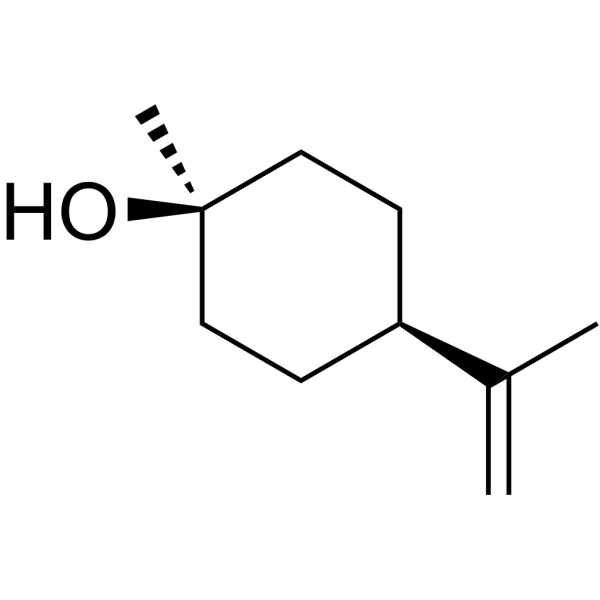
trans-β-Terpineol is a cyclic monoterpene alcohol present in Greek propolis and the essential oil of Peganum harmala seeds, with biological activities. trans-β-Terpineol serves as a substrate for biotransformation in tobacco suspension cells, where allylic hydroxylation occurs at specific sites. trans-β-Terpineol can be isolated from the leaves of Euryops arabicus. Terpineol (HY-N7851) exhibits antioxidant and antibacterial activities, and trans-β-terpineol is the bioactive compound responsible for the antibacterial effect in Euryops arabicus .
loading...
    loading...
Cat. No.: HY-W001084R
CAS No.: 14199-15-6
Methyl 4-hydroxyphenylacetate (Standard) is the analytical standard of Methyl 4-hydroxyphenylacetate (HY-W001084). This product is intended for research and analytical applications. Methyl 4-hydroxyphenylacetate is a compound found in the marine fungus Penicillium oxalicum 0312F1. Methyl 4-hydroxyphenylacetate can be Methyl 4-hydroxyphenylacetate inhibits replication of tobacco mosaic virus (TMV) in Nicotiana tabacum leaf discs. Methyl 4-hydroxyphenylacetate shows inhibitory activity against proliferation of cancer cells. Methyl 4-hydroxyphenylacetate can be used for the researches of TMV infection and cancer .
loading...
    loading...
Cat. No.: HY-N18278
CAS No.: 131831-20-4
Epicatechin-5-O-β-D-glucopyranoside (Compound 9) is a glucoside. Epicatechin-5-O-β-D-glucopyranoside forms via regioselective 5-O-β-D-glucosylation of epicatechin of quercetin 3-O-D-glucoside .
loading...
    loading...
Cat. No.: HY-N20733
CAS No.: 69687-69-0
Bruceoside B is a PI3K/Akt/NF-κB inhibitor . Bruceoside B reduces LPS (HY-D1056)-induced nitric oxide release and the secretion of TNF-α, IL-6 and IL-1β, and decreases the activation level of apoptosis. Bruceoside B inhibits the replication, coat protein accumulation and local lesion formation of tobacco mosaic virus (TMV), and enhances the anti-infection ability of plants. Bruceoside B can be used in studies related to acute lung injury and tobacco mosaic virus infection .
loading...
    loading...
Cat. No.: HY-176923
CAS No.: 28170-90-3
Research Areas:  

Infection

1,3-Bis (isothiocyanatomethyl) benzene is an isothiocyanate compound and also a plant regulator with stomatal closure-inducing activity. 1,3-Bis (isothiocyanatomethyl) benzene increases the production of ROS and NO in guard cells. 1,3-Bis (isothiocyanatomethyl) benzene can inhibit plant diseases caused by pathogens invading through plant stomata, including grape downy mildew, cucumber downy mildew and wheat leaf rust. 1,3-Bis (isothiocyanatomethyl) benzene can be used in studies related to grape downy mildew, cucumber downy mildew and wheat leaf rust .
loading...
    loading...
Cat. No.: HY-DY2041
Target:  

Fluorescent Dye

Research Areas:  

Infection

Callose Staining Solution (Aniline Blue, Bright-Field Method) is a fluorescent dye used for detecting callose in plant tissues, green algal cell walls, plant cells, and protoplasts. Callose Staining Solution (Aniline Blue, Bright-Field Method) specifically binds to callose, a β-(1,3)-D-glucan polymer, and exhibits blue-green fluorescence under alkaline conditions with reduced background staining and non-toxicity to living cells. Callose Staining Solution (Aniline Blue, Bright-Field Method) is suitable for observation under UV or epifluorescence microscopy (Ex/Em = 365-370/397-509 nm). Callose Staining Solution (Aniline Blue, Bright-Field Method) can be used in studies related to the visualization of callose deposition in plants .
loading...
    loading...

