31 Results for "

P2Y4 receptors

" in MedChemExpress (MCE) Product Catalog:
Products (31)

31 Results for "P2Y4 receptors" in MCE Product Catalog:

14
14 Publications Verification
Cat. No.: HY-13104
CAS No.: 711019-86-2
Purity:  98.15%
Target:  

P2Y Receptor Apoptosis

Research Areas:  

Cardiovascular Disease

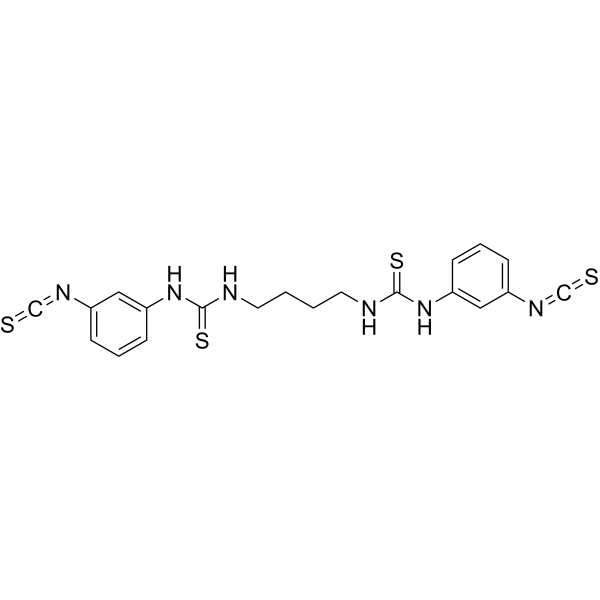
MRS 2578 is a selective and potent P2Y6 receptor antagonist with IC50s of 37 nM (human) and 98 nM (rat). MRS 2578 exhibits insignificant activity at P2Y1, P2Y2, P2Y4, and P2Y11 receptors .
loading...
    loading...
10
10 Cited Publications
Cat. No.: HY-101044
CAS No.: 192575-19-2
Purity:  ≥95.0%
Research Areas:  

Neurological Disease

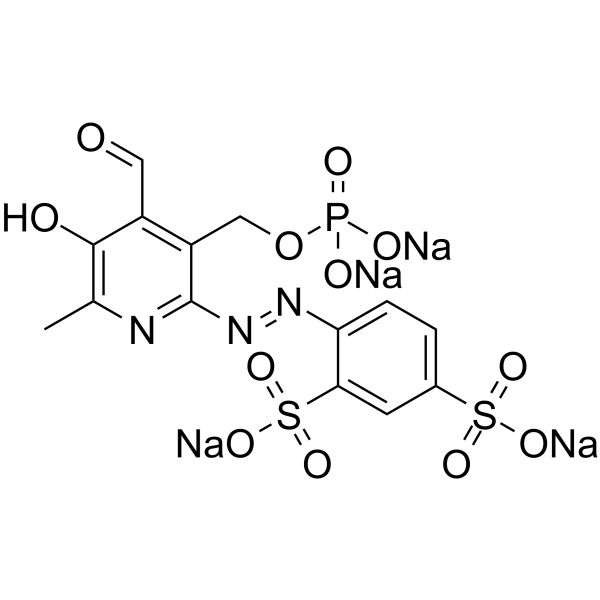
PPADS tetrasodiuma is a non-selective P2X receptor antagonist. PPADS tetrasodiuma blocks recombinant P2X1, -2, -3, -5 with IC50s ranging from 1 to 2.6 μM. PPADS tetrasodiuma blocks native P2Y2-like (IC50~0.9 mM) and recombinant P2Y4 (IC50~15 mM) receptors. PPADS tetrasodiuma is an inhibitor of the reverse mode of the Na/Ca 2+ exchanger in guinea pig airway smooth muscle .
loading...
    loading...
4
4 Cited Publications
Cat. No.: HY-110322
CAS No.: 1992047-65-0
Purity:  99.89%
Target:  

P2Y Receptor

Research Areas:  

Inflammation/Immunology

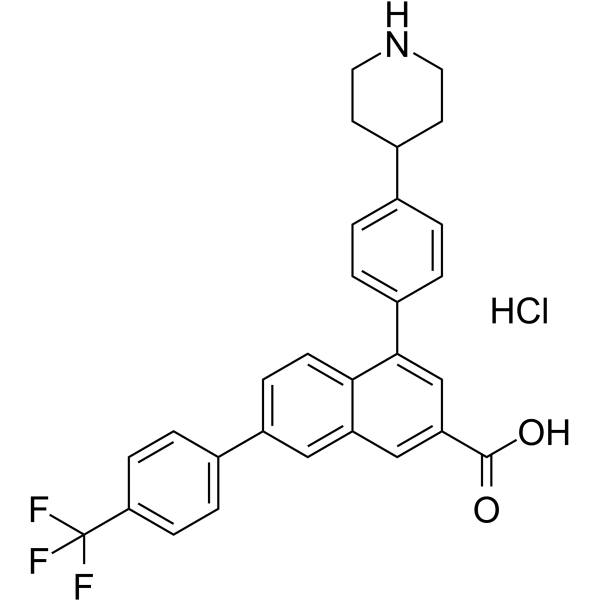
PPTN hydrochloride is a potent, high-affinity, competitive and highly selective P2Y14 receptor antagonist with a KB value of 434 pM. PPTN hydrochloride exhibits no agonist or antagonist effect at the P2Y1, P2Y2, P2Y4, P2Y6, P2Y11, P2Y12, or P2Y13 receptors. Anti-inflammatory and anti-immune activity .
loading...
    loading...
4
4 Cited Publications
Cat. No.: HY-110322A
CAS No.: 1160271-30-6
Purity:  99.63%
Target:  

P2Y Receptor

Research Areas:  

Inflammation/Immunology

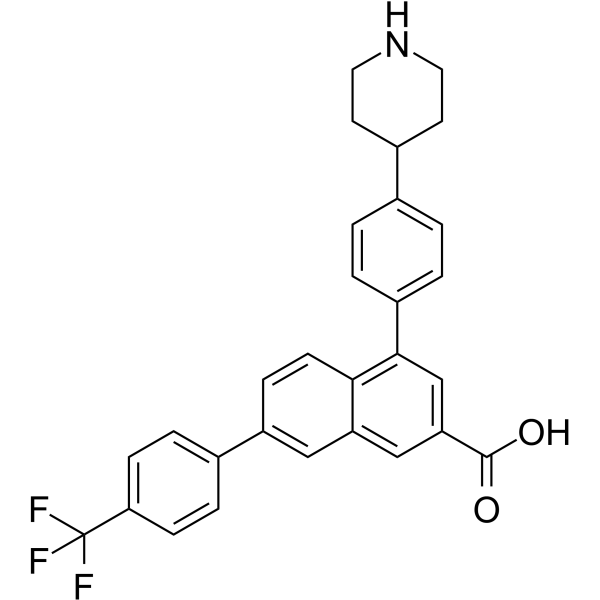
PPTN, a chemical probe, is a potent, high-affinity, competitive and highly selective P2Y14 receptor antagonist with a KB value of 434 pM. PPTN exhibits no agonist or antagonist effect at the P2Y1, P2Y2, P2Y4, P2Y6, P2Y11, P2Y12, or P2Y13 receptors. Anti-inflammatory and immune activity .
loading...
    loading...
2
2 Cited Publications
Cat. No.: HY-101308A
Purity:  99.6%
Target:  

P2Y Receptor

Research Areas:  

Cardiovascular Disease

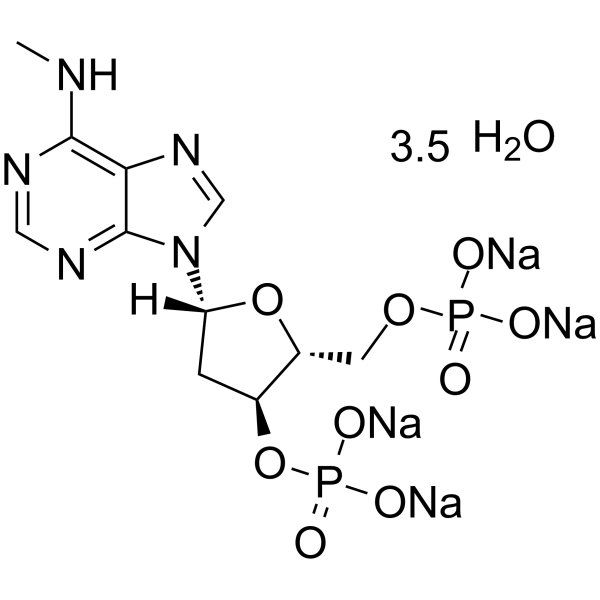
MRS2179 tetrasodium hydrate is a competitive P2Y1 receptor antagonist, with a Kb of 102 nM and a pA2 of 6.99 for turkey P2Y1 receptor. MRS2179 tetrasodium hydrate is selective for P2Y1 over P2X1 (IC50=1.15 µM), P2X3 (12.9 µM), P2X2, P2X4, P2Y2, P2Y4, and P2Y6 receptors . MRS2179 tetrasodium hydrate inhibits platelet aggregation .
loading...
    loading...
Cat. No.: HY-W250153
CAS No.: 109434-21-1
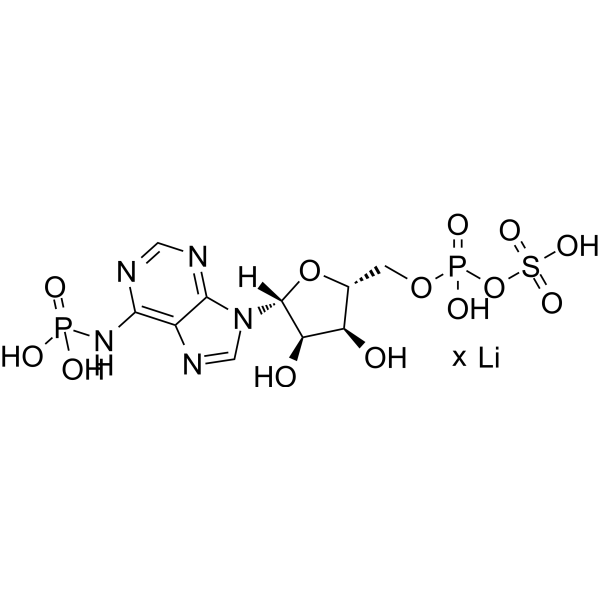
Adenosine 3'-phosphate 5'-phosphosulfate lithium, an adenine nucleotide derivative, is a selective P2Y1 antagonist with no effect on P2Y2, P2Y4, or P2Y6 receptors. Adenosine 3'-phosphate 5'-phosphosulfate lithium can competitive inhibit ADP-induced platelet aggregation, as well as the ability of ADP to cause shape change and increases in Ca 2+ in platelets, but had no effect on the inhibition of stimulated adenylate cyclase by ADP. Adenosine 3'-phosphate 5'-phosphosulfate lithium is a co-substrate used for the sulfonation of glycans. Adenosine 3'-phosphate 5'-phosphosulfate lithium can be used for Golgi-resident PAP-specific 3'-phosphatase-coupled sulfotransferase assays, which as donor substrate to transfer a sulfonate group .
loading...
    loading...
Cat. No.: HY-134807
CAS No.: 1207660-00-1
Purity:  98.05%
Research Areas:  

Cancer

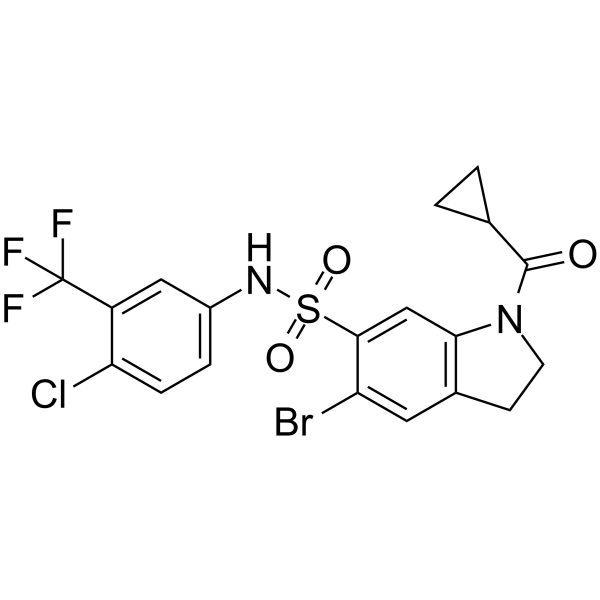
Indophagolin is a potent, indoline-containing autophagy inhibitor (IC50=140 nM). Indophagolin antagonizes the purinergic receptor P2X4 as well as P2X1 and P2X3 with IC50s of 2.71, 2.40 and 3.49 μM, respectively. Indophagolin also antagonizes the Gq-protein-coupled P2Y4, P2Y6, and P2Y11 receptors (IC50s =3.4~15.4 μM). Indophagolin has a strong antagonistic effect on serotonin receptor 5-HT6 (IC50=1.0 μM) and a moderate effect on receptors 5-HT1B, 5-HT2B, 5-HT4e, and 5-HT7 .
loading...
    loading...
Cat. No.: HY-164090
CAS No.: 482-67-7
Target:  

P2Y Receptor

Research Areas:  

Cardiovascular Disease

Adenosine 3'-phosphate 5'-phosphosulfate, an adenine nucleotide derivative, is a selective P2Y1 antagonist with no effect on P2Y2, P2Y4, or P2Y6 receptors. Adenosine 3'-phosphate 5'-phosphosulfate can competitive inhibit ADP-induced platelet aggregation, as well as the ability of ADP to cause shape change and increases in Ca 2+ in platelets, but had no effect on the inhibition of stimulated adenylate cyclase by ADP. Adenosine 3'-phosphate 5'-phosphosulfate is a co-substrate used for the sulfonation of glycans. Adenosine 3'-phosphate 5'-phosphosulfate can be used for Golgi-resident PAP-specific 3'-phosphatase-coupled sulfotransferase assays, which as donor substrate to transfer a sulfonate group .
loading...
    loading...
Cat. No.: HY-110089
CAS No.: 1309871-50-8
Target:  

P2Y Receptor

Research Areas:  

Inflammation/Immunology

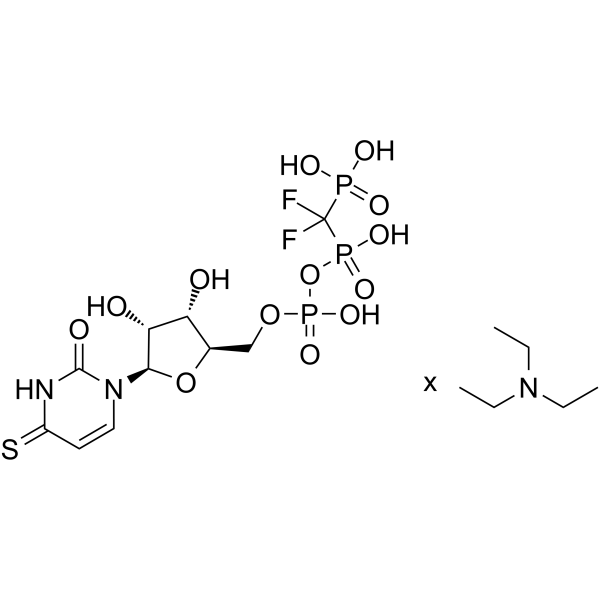
mrs 4062 (TEA) is a selective P2Y4 receptor agonist with an EC50 of 23 nM. mrs 4062 (TEA) has EC50s of 640 nM and 740 nM for P2Y2 and P2Y6, respectively .
loading...
    loading...
Cat. No.: HY-101308
CAS No.: 1454889-37-2
Target:  

P2Y Receptor

Research Areas:  

Cardiovascular Disease

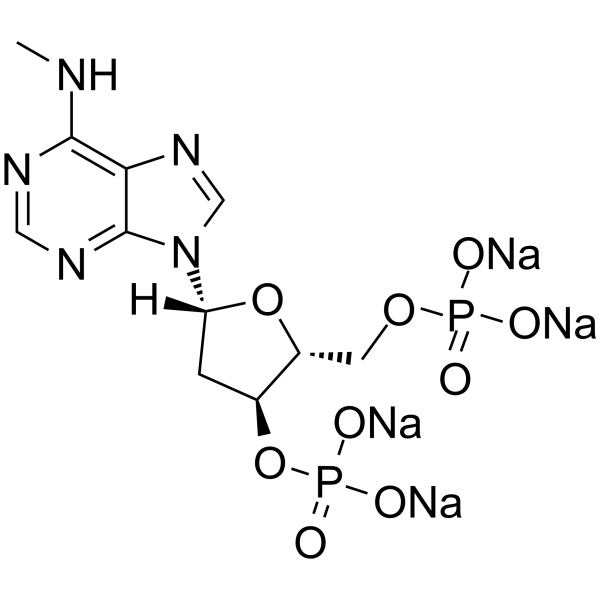
MRS2179 tetrasodium is a competitive P2Y1 receptor antagonist, with a Kb of 102 nM and a pA2 of 6.99 for turkey P2Y1 receptor. MRS2179 tetrasodium is selective for P2Y1 over P2X1 (IC50=1.15 µM), P2X3 (12.9 µM), P2X2, P2X4, P2Y2, P2Y4, and P2Y6 receptors . MRS2179 tetrasodium inhibits platelet aggregation .
loading...
    loading...
Cat. No.: HY-N9422
CAS No.: 936827-87-1
Target:  

P2Y Receptor

Research Areas:  

Cardiovascular Disease

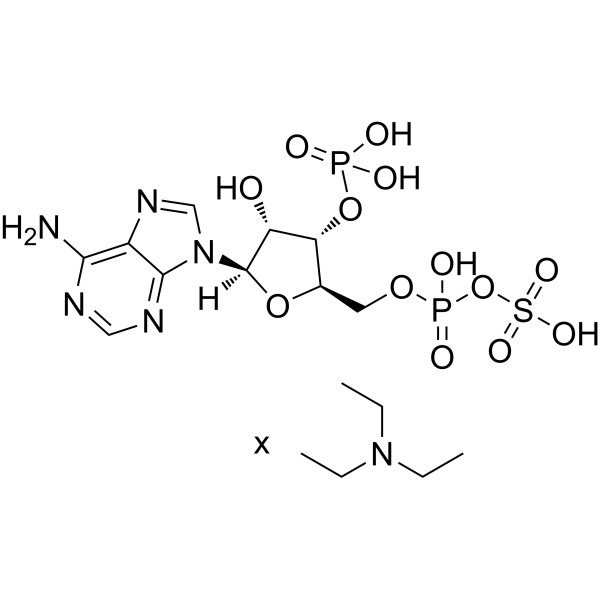
Adenosine 3'-phosphate 5'-phosphosulfate triethylamine, an adenine nucleotide derivative, is a selective P2Y1 antagonist with no effect on P2Y2, P2Y4, or P2Y6 receptors. Adenosine 3'-phosphate 5'-phosphosulfate triethylamine can competitive inhibit ADP-induced platelet aggregation, as well as the ability of ADP to cause shape change and increases in Ca 2+ in platelets, but had no effect on the inhibition of stimulated adenylate cyclase by ADP. Adenosine 3'-phosphate 5'-phosphosulfate triethylamine is a co-substrate used for the sulfonation of glycans. Adenosine 3'-phosphate 5'-phosphosulfate triethylamine can be used for Golgi-resident PAP-specific 3'-phosphatase-coupled sulfotransferase assays, which as donor substrate to transfer a sulfonate group .
loading...
    loading...
Cat. No.: HY-110092
CAS No.: 1657025-60-9
Target:  

P2Y Receptor

Research Areas:  

Metabolic Disease

PSB-1114 tetrasodium is a potent, enzymatically stable, and subtype-selective P2Y2 receptor agonist with an EC50 of 134 nM. PSB-1114 tetrasodium displays >50-fold selectivity versus the P2Y4 (EC50 of 9.3 μM) and P2Y6 (EC50 of 7.0 μM) receptors .
loading...
    loading...
Cat. No.: HY-179133
CAS No.: 3021527-82-9
Target:  

P2Y Receptor PKA Raf MEK ERK

Research Areas:  

Inflammation/Immunology

HDB-1 is a selective inhibitor of the P2Y14 receptor (P2Y14R) with an IC50 of 26 pM. HDB-1 shows no significant inhibition on P2Y1R, P2Y2R, P2Y4R, P2Y6R, and P2Y12R. HDB-1 blocks the activation of hepatic stellate cells (HSC) by inhibiting the PKA/Raf1/MEK/ERK signaling pathway mediated by P2Y14R, thereby alleviating the core pathological process of liver fibrosis. HDB-1 can be used for the study of liver fibrosis .
loading...
    loading...
Cat. No.: HY-W250153A
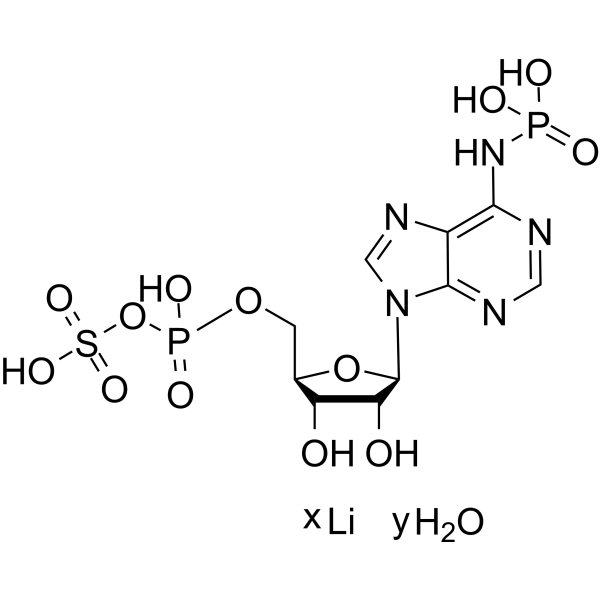
Adenosine 3'-phosphate 5'-phosphosulfate lithium hydrate, an adenine nucleotide derivative, is a selective P2Y1 antagonist with no effect on P2Y2, P2Y4, or P2Y6 receptors. Adenosine 3'-phosphate 5'-phosphosulfate lithium hydrate can competitive inhibit ADP-induced platelet aggregation, as well as the ability of ADP to cause shape change and increases in Ca 2+ in platelets, but had no effect on the inhibition of stimulated adenylate cyclase by ADP. Adenosine 3'-phosphate 5'-phosphosulfate lithium hydrate is a co-substrate used for the sulfonation of glycans. Adenosine 3'-phosphate 5'-phosphosulfate lithium hydrate can be used for Golgi-resident PAP-specific 3'-phosphatase-coupled sulfotransferase assays, which as donor substrate to transfer a sulfonate group .
loading...
    loading...
Cat. No.: HY-137612C
Synonyms: Rp-Uridine 5'-O-1-thiotriphosphate tetrasodium
Target:  

P2Y Receptor

Research Areas:  

Cancer

Rp-UTP-α-S (Rp-Uridine 5'-O-(1-thiotriphosphate)) tetrasodium is a nucleotide agonist of purinergic P2Y2 and P2Y4 receptors. Rp-UTP-α-S (tetrasodium) can induce inositol phosphate accumulation in P2Y2 or P2Y4 expressing 1321N1 cells with EC50 values of 5.4 and 27 μM .
loading...
    loading...
Cat. No.: HY-108651
CAS No.: 1266569-94-1
Synonyms: UTPγS trisodium
Target:  

P2Y Receptor

Research Areas:  

Metabolic Disease

Uridine-5'-O-(3-thiotriphosphate) trisodium, a stable analogue of UTP, is a potent agonist of the P2Y2 and P2Y4 receptors with increased metabolic stability .
loading...
    loading...
Cat. No.: HY-137612
CAS No.: 71214-29-4
Synonyms: Uridine 5'-O-1-thiotriphosphate
Target:  

P2Y Receptor

Research Areas:  

Cancer

Sp-UTP-α-S (Uridine 5-0-1-thiotrirhosphate) is a P2Y2 and P2Y4 receptor activator. Sp-UTP-α-S can be used in cancer research .
loading...
    loading...
Cat. No.: HY-137606
CAS No.: 10527-48-7
Synonyms: UP4A
Target:  

P2X Receptor

Research Areas:  

Cardiovascular Disease

Uridine adenosine tetraphosphate (UP4A) is an endothelium-derived vasoconstrictor that primarily acts through the P2X1 receptor and possibly through the P2Y2 and P2Y4 receptors. Uridine adenosine tetraphosphate can be used in the study of cardiovascular diseases .
loading...
    loading...
Cat. No.: HY-110092A
Purity:  ≥95.0%
Target:  

P2Y Receptor

Research Areas:  

Cancer

PSB-1114 triethylamine is a potent, enzymatically stable, and subtype-selective P2Y2 receptor agonist with an EC50 of 134 nM. PSB-1114 triethylamine displays >50-fold selectivity versus the P2Y4 (EC50 of 9.3 μM) and P2Y6 (EC50 of 7.0 μM) receptors .
loading...
    loading...
Cat. No.: HY-13104R
CAS No.: 711019-86-2
Target:  

P2Y Receptor Apoptosis

Research Areas:  

Cardiovascular Disease

MRS 2578 (Standard) is the analytical standard of MRS 2578. This product is intended for research and analytical applications. MRS 2578 is a selective and potent P2Y6 receptor antagonist with IC50s of 37 nM (human) and 98 nM (rat). MRS 2578 exhibits insignificant activity at P2Y1, P2Y2, P2Y4, and P2Y11 receptors .
loading...
    loading...

