1. Search Result
Search Result
Results for "

PANC-1 xenograft

" in MedChemExpress (MCE) Product Catalog:

12

Inhibitors & Agonists

1

Fluorescent Dyes

1

Inhibitory Antibodies

1

Oligonucleotides

Art. -Nr. Produktname Target Forschungsgebiete Chemical Structure
  • HY-155020

    Histone Methyltransferase GLP Receptor Cancer
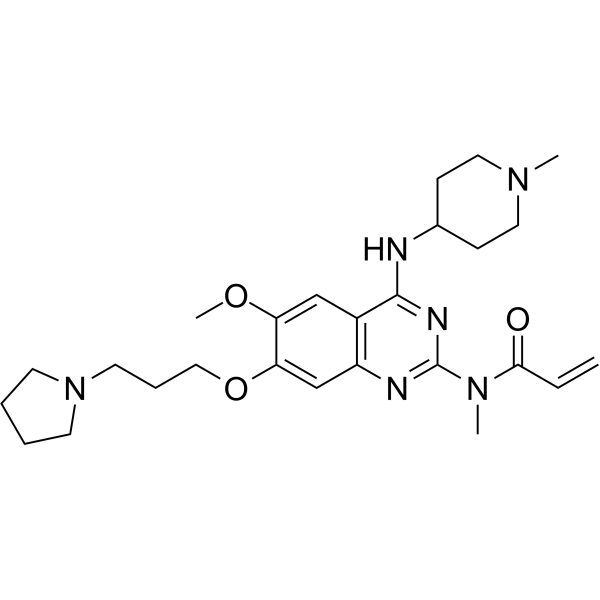
    Antitumor agent-101 is a selective covalent inhibitor of lysine methyltransferases G9a/GLP, with IC50s of 8.5 nM and 5.5 nM for G9a and GLP, respectively. Antitumor agent-101 shows antitumor efficacy in the PANC-1 xenograft model .
    Antitumor agent-101
  • HY-155991

    Apoptosis Cancer
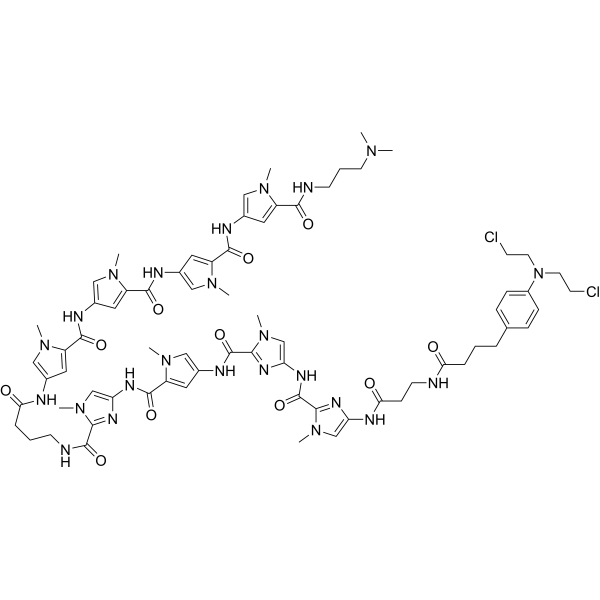
    RUNX-IN-2 (Compound Conjugate 3) covalently binds to the RUNX-binding sequences, and inhibits the binding of RUNX proteins to their target sites. RUNX-IN-2 induces the p53-dependent apoptosis and inhibits cancer cell growth. RUNX-IN-2 inhibits tumor growth in PANC-1 xenograft mice. RUNX-IN-2 has high alkylation efficiency and specificity .
    RUNX-IN-2
  • HY-161751

    GSK-3 Cancer
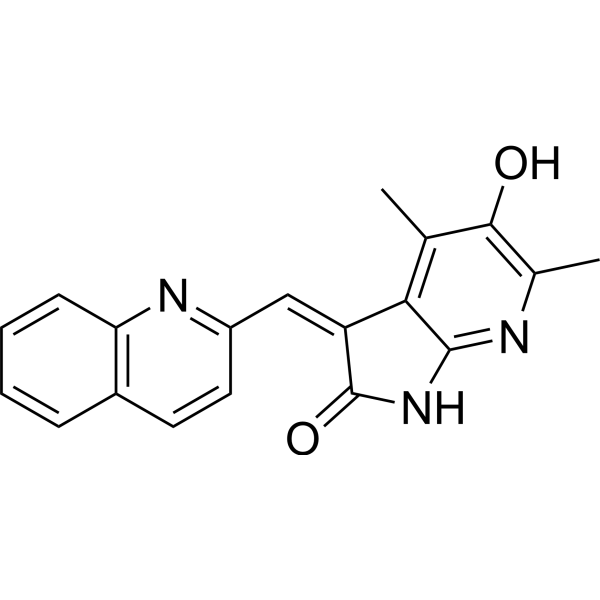
    MJ34 is a potent inhibitor of GSK-3β and GSK-3α, with the IC50s of 15.4 nM and 31.5 nM, respectively. MJ34 plays an important role in cancer research
    MJ34
  • HY-169830

    Drug Derivative Apoptosis Cancer
    2-(Cyclohexylmethyl)-plumbagin is a derivative of the naphthoquinone compound Plumbagin (HY-N1497). Under nutrient-deprived conditions, 2-(Cyclohexylmethyl)-plumbagin selectively exhibits cytotoxicity against PANC-1 human pancreatic cancer cells (PC50 = 0.11 µM) and reduces the phosphorylation of Akt and mTOR in PANC-1 cells. 2-(Cyclohexylmethyl)-plumbagin also induces apoptosis (Apoptosis) in PANC-1 cells at a concentration of 1 µM. Additionally, 2-(Cyclohexylmethyl)-plumbagin reduces tumor volume and weight in a xenograft MiaPaCa-2 pancreatic cancer mouse model .
    2-(Cyclohexylmethyl)-plumbagin
  • HY-159577

    PI3K mTOR Akt Cancer
    Nic-15 (compound 4n) is an anti-constrictive agent used to antagonize the hypovascularity of pancreatic tumors. The hypovascularity allows cancer cells to adapt to the nutrient-deficient tumor microenvironment and develop drug resistance. Nic-15 can regulate the PI3K/Akt/mTOR pathway and alleviate ER stress induced by Gemcitabine (HY-17026). Nic-15 can significantly inhibit the migration and colony formation of MIA PaCa-2 and PANC-1 pancreatic cancer cells. The combination of Nic-15 and Gemcitabine can effectively solve the problem of pancreatic tumor resistance. In an in vivo xenograft model, Nic-15 can significantly enhance the efficacy of Gemcitabine .
    Nic-15
  • HY-158726

    Fluorescent Dye Apoptosis Cancer
    Complex 3 is a fluorescent dithiocarbazate-copper complex with anticancer activity, which localizes to mitochondria. Complex 3 displays excitation/emission maxima of 455-495/535 nm, respectively. Complex 3 inhibits the growth of BxPC-3, AsPC-1, PANC-1, and WI38 pancreatic cancer cells with IC50 values of 0.74, 0.41, 0.62, and 2.06 µM, respectively. Complex 3 induces lipid peroxidation and mitochondrial rupture and shrinkage in AsPC-1 cells. Complex 3 also induces mitochondrial apoptosis and cytokine-cytokine receptor interaction dysfunction in AsPC-1 cells. Complex 3 reduces tumor volume in an AsPC-1 mouse xenograft model .
    Complex 3
  • HY-149092

    TAM Receptor Cancer
    Anticancer agent 109 (compound 6-15) is an inhibitor of the Gas6-Axl axis with anti-cancer activity. Anticancer agent 109 inhibits the expression of Gas6 and Axl, and the expression p-PI3K and p-AKT in cancer cells, leads to G1 phase arrest and promotes cancer cells apoptosis, and inhibits tumor growth significantly in nude mouse tumor bearing models .
    Anticancer agent 109
  • HY-168919

    Ras Apoptosis p38 MAPK PI3K mTOR Cancer
    KRASG12C IN-16 (Compound SK-17) is a selective, covalent and an orally active KRAS G12C inhibitor. KRASG12C IN-16 induces Apoptosis. KRASG12C IN-16 effectively prevents the activation of MAPK and PI3K/mTOR signaling pathways. KRASG12C IN-16 displays anti-tumor activity against pancreatic cancer .
    KRASG12C IN-16
  • HY-163507

    Anaplastic lymphoma kinase (ALK) Cancer
    ALK5-IN-79 (compound 57) is an ALK inhibitor with anticancer activity, by blocking TGF-β1/SMAD signaling pathway. ALK5-IN-79 attenuates the production of extracellular matrix (ECM) and deposition of collagen. ALK5-IN-79 exhibits adequate pharmacokinetic (PK) properties and good in vivo tolerance.
    ALK5-IN-79
  • HY-12440

    IAP Apoptosis Cancer
    HM90822 is an orally active IAP antagonist. HM90822 induces ubiquitination and proteasome-dependent degradation of XIAP, cIAP1 and cIAP2 in sensitive pancreatic cancer cells. HM90822 induces Apoptotic cell death. HM90822 inhibits tumor growth in Panc-1 pancreatic cancer xenograft and orthotopic mouse models. HM90822 can be used for the research of pancreatic cancer .
    HM90822
  • HY-183791A

    Ferroptosis Apoptosis Glutathione Peroxidase ACSL Family Reactive Oxygen Species (ROS) Mitochondrial Metabolism Caspase Bcl-2 Family Cancer
    Ferroptosis/apoptosis inducer-5 (Compound 14) is an orally active inducer of Ferroptosis and Apoptosis. Ferroptosis/apoptosis inducer-5 downregulates GPX4, upregulates ACSL4, promotes ROS production, activates the Caspase cascade, induces Mitochondrial dysfunction, and alters the Bcl-2/Bax balance. Ferroptosis/apoptosis inducer-5 significantly inhibits tumor growth in a pancreatic cancer xenograft mouse model. Ferroptosis/apoptosis inducer-5 can be used for the research of pancreatic cancer .
    Ferroptosis/apoptosis inducer-5
  • HY-P992098

    NEI-01

    Protein Arginine Deiminase Cancer
    Adargiminase (NEI-01) is a modified arginine-depleting enzyme and albumin binder. Adargiminase catalyzes the conversion of arginine to citrulline and ammonia, reduces plasma arginine levels to undetectable levels, and binds to serum albumin from Mus musculus (mouse), Rattus norvegicus (rat), Canis lupus familiaris (dog) and Homo sapiens (human) to extend its half-life. Adargiminase inhibits the viability of ASS1-negative pancreatic cancer cells, and reduces tumor volume and weight. Adargiminase can be used for the research of pancreatic cancer .
    Adargiminase

Online-Anfrage

Your information is safe with us. * Required Fields.

Anrede


Country or Region *

Name des Antragstellers *


Name der Organisation *

Department *


E-Mail-Addresse *


Produktname *

Art. -Nr.


Requested quantity *

Telefonnummer *


Bemerkungen

Online-Anfrage

Inquiry Information

Produktname:
Art. -Nr.:
Menge:
MCE Japan Authorized Agent:

