8 Results for "

SMA mouse models

" in MedChemExpress (MCE) Product Catalog:
Products (8)

8 Results for "SMA mouse models" in MCE Product Catalog:

16
16 Cited Publications
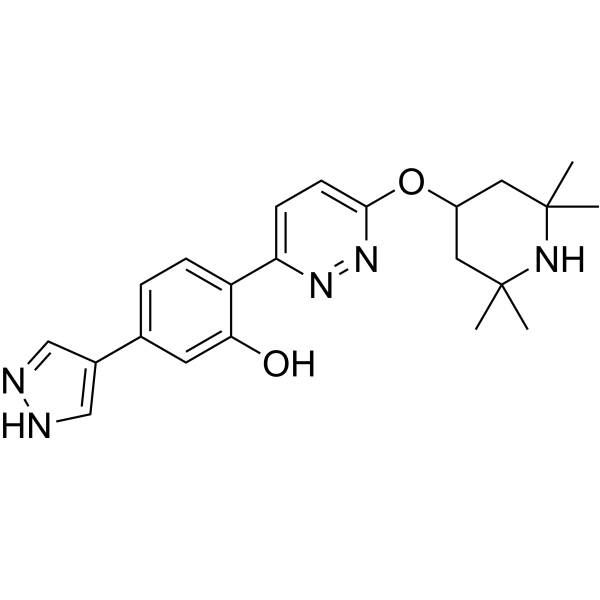
Cat. No.: HY-19620
CAS No.: 1562338-42-4
Synonyms: LMI070; NVS-SM1
Research Areas:  

Cancer

Branaplam (LMI070; NVS-SM1) is a highly potent, selective and orally active survival motor neuron-2 (SMN2) splicing modulator with an EC50 of 20 nM for SMN. Branaplam inhibits human-ether-a-go-go-related gene (hERG) with an IC50 of 6.3 μM. Branaplam elevates full-length SMN protein and extends survival in a severe spinal muscular atrophy (SMA) mouse model .
loading...
    loading...
16
16 Cited Publications
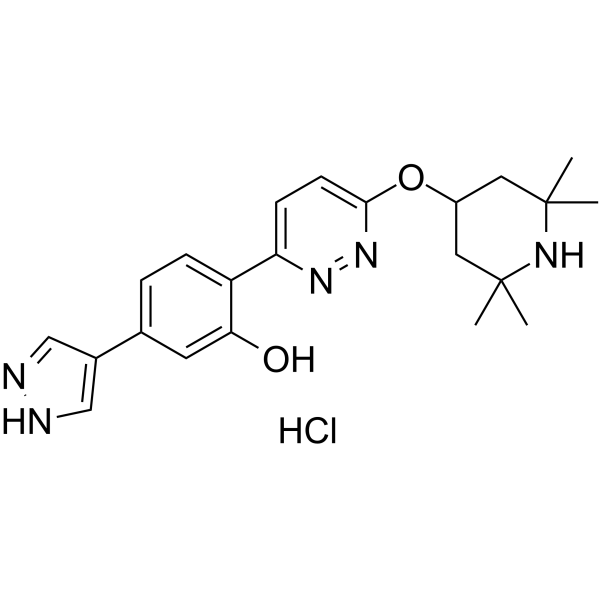
Cat. No.: HY-19620A
CAS No.: 1562338-39-9
Synonyms: LMI070 hydrochloride; NVS-SM1 hydrochloride
Research Areas:  

Cancer

Branaplam (LMI070; NVS-SM1) hydrochloride is a highly potent, selective and orally active survival motor neuron-2 (SMN2) splicing modulator with an EC50 of 20 nM for SMN. Branaplam hydrochloride inhibits human-ether-a-go-go-related gene (hERG) with an IC50 of 6.3 μM. Branaplam hydrochloride elevates full-length SMN protein and extends survival in a severe spinal muscular atrophy (SMA) mouse model .
loading...
    loading...
Cat. No.: HY-P11223
Target:  

TGF-beta/Smad

Research Areas:  

Inflammation/Immunology

CMF9, a cyclic peptide molecule, is an inhibitor of the SMAD2-SMAD4 interaction. CMF9 effectively blocks the formation of the heterodimeric complex of SMAD2 and SMAD4 by inhibiting the phosphorylation of SMAD2. CMF9 has no effect on the phosphorylation of SMAD3 or SMAD1/5/8. CMF9 downregulates the expression of fibrotic markers α-SMA and COL1A1. CMF9 exhibits potent anti-fibrotic effects in mouse models by promoting the degradation of pathological extracellular matrix (ECM) and inhibiting inflammation. CMF9 can be used for the study of liver fibrosis .
loading...
    loading...
Cat. No.: HY-172105
CAS No.: 3028778-28-8
Target:  

PPAR

Anti-NASH agent 2 (compound 21) is an inhibitor of de novo adipogenesis activity and α-SMA gene expression. Anti-NASH agent 2 improves hepatic steatosis, edema, inflammatory infiltrates, and liver fibrosis in NASH mouse models .
loading...
    loading...
Cat. No.: HY-170846
Research Areas:  

Inflammation/Immunology

FGFRs-IN-1 (Compound A16) is the orally active inhibitor for FGFR, that inhibits FGFR1/2/3/4 with IC50s of 2.3, 7, 11, and 163 nM, respectively. FGFRs-IN-1 also inhibits VEGFR1/2/3, Abl, and Flt3 with IC50s of 61, 176, 112, 26, and 353 nM, respectively. FGFRs-IN-1 exhibits weak inhibitory efficacy against CYP enzymes. FGFRs-IN-1 reduces the expression of α-SMA and collagen I, and inhibits epithelial-mesenchymal transition (EMT) in TGF-β1 stimulated A549 cell. FGFRs-IN-1 exhibits anti-inflammatory activity in Bleomycin (HY-17565)-induced mouse pulmonary fibrosis model and CCl4 (HY-Y0298)-induced mouse liver fibrosis model .
loading...
    loading...
Cat. No.: HY-172258
Target:  

5-HT Receptor

Research Areas:  

Cancer

5-HT2B antagonist-2 (Compound 19c) is a 5HT2B receptor antagonist with an IC50 of 1.09 nM. 5-HT2B antagonist-2 can downregulate the expression of fibrosis-related genes α-SMA, Timp1, Col1a1, and Col3a1, and significantly reduce the deposition of fibrosis, thereby reducing the fibrotic area and inhibiting the fibrotic process in CCl4-induced liver fibrosis mouse models. 5-HT2B antagonist-2 can be used in the study of immune inflammatory-related diseases, particularly in the research of pulmonary fibrosis diseases .
loading...
    loading...
Cat. No.: HY-184278
Research Areas:  

Inflammation/Immunology

ATX-IN-28 is an orally active autotaxin (ATX) inhibitor with an IC50 of 13.7 nM. ATX-IN-28 downregulates the expression of pro-fibrotic α-SMA, ameliorates pathological damage of lung tissues in a bleomycin (HY-108345)-induced mouse model of pulmonary fibrosis, and reduces collagen deposition. ATX-IN-28 can be used for research related to idiopathic pulmonary fibrosis .
loading...
    loading...
Cat. No.: HY-102020A
CAS No.: 1466525-84-7
Target:  

DNA/RNA Synthesis

Research Areas:  

Neurological Disease

RG3039 hydrochloride is an orally active, blood-brain barrier-permeable DcpS inhibitor with an IC50 of 4.2 nM against hDcpS. RG3039 hydrochloride inhibits the decapping activity of DcpS and maintains DcpS in a catalytically inactive conformation in the central nervous system and other tissues. RG3039 hydrochloride extends survival and improves function in spinal muscular atrophy mice. RG3039 hydrochloride is applicable to research related to spinal muscular atrophy .
loading...
    loading...

