










1. Search Result
Search Result
Results for "

T cell-mediated cytotoxicity

" in MedChemExpress (MCE) Product Catalog:

26

Inhibitors & Agonists

24

Inhibitory Antibodies

2

Oligonucleotides

Cat. No. Product Name Target Research Areas Chemical Structure
  • HY-P99392

    JNJ-7957; JNJ-64007957; Tecvayli

    CD3 Cancer
    Teclistamab is a human bispecific antibody to BCMA and CD3 that recognizes BCMA on target cells and CD3 on T cells and induces T cell-mediated cytotoxicity leading to T cell activation and subsequent target cell lysis. Teclistamab can be used in studies of diseases related to multiple myeloma (MM) .
    Teclistamab
  • HY-P9948

    Campath-IH

    Apoptosis Cancer
    Alemtuzumab (Campath-IH) is a humanized monoclonal antibody against CD52. Alemtuzumab does not cross-react with murine CD52. Alemtuzumab selectively targets the CD52 antigen to induce profound lymphocyte depletion, followed by recovery of T and B cells with regulatory phenotypes. Alemtuzumab is capable of complement-dependent cytotoxicity and antibody-dependent cell-mediated cytotoxicity (ADCC), as well as induction of apoptosis. Alemtuzumab has the potential for B-cell chronic lymphocytic leukaemia research .
    Alemtuzumab
  • HY-P991015

    JNJ-78278343; KLCB-245

    CD3 Cancer
    Pasritamig (JNJ-78278343; KLCB-245) is a bispecific T-cell engager (BiTE) that targets the complex of human kallikrein KLK2 and CD3 receptor. Pasritamig redirects the cytotoxicity of T cells to KLK2-expressing tumor cells and induces T cell-mediated lysis of KLK2-expressing prostate cancer cells. Administered via subcutaneous injection, subcutaneous infusion or intravenous infusion, Pasritamig exhibits antitumor activity against metastatic castration-resistant prostate cancer. Pasritamig has a safety profile with an extremely low incidence of cytokine release syndrome and can be safely administered in an outpatient setting. Pasritamig is applicable to the research of metastatic castration-resistant prostate cancer .
    Pasritamig
  • HY-P99117
    Cadonilimab
    1 Publications Verification

    AK104

    PD-1/PD-L1 CTLA-4 Inflammation/Immunology Cancer
    Cadonilimab (AK104) is a humanized tetravalent IgG1 bispecific antibody targeting PD1/CTLA4. Cadonilimab blocks both PD-1 and CTLA-4 pathways, thereby relieving their corresponding immunosuppressive effects and reversing tumor specific T cell exhaustion. Cadonilimab significantly downregulates Fc-mediated effector functions, including antibody-dependent cell-mediated cytotoxicity (ADCC), antibody-dependent cellular phagocytosis (ADCP), complement dependent cytotoxicity (CDC). Cadonilimab can be used for research of metastatic cervical cancer, as well as other malignancies such as gastric cancer, GEJ adenocarcinoma and non-small cell lung cancer (NSCLC) .
    Cadonilimab
  • HY-P99931
    Epcoritamab
    1 Publications Verification

    GEN3013

    CD3 CD20 Cancer
    Epcoritamab (GEN3013) is an bispecific IgG1 antibody redirecting T-cells toward CD3×CD20 + tumor cells. Epcoritamab induces potent T-cell-mediated cytotoxicity towards B-cell NHL cell lines .
    Epcoritamab
  • HY-P990688

    AMG-509

    CD3 Cancer
    Xaluritamig (AMG-509) is a bispecific T cell engager and cytolytic agent with a Kd of 27.6 nM for human CD3ε. Xaluritamig binds to CD3ε via an anti-CD3 single-chain variable fragment (scFv) domain, and to STEAP1 via a bispecific anti-STEAP1 antigen-binding fragment (Fab) domain, thereby recruiting and activating T cells and forming a bridge between T cells and STEAP1-expressing cancer cells. Xaluritamig induces T cell-mediated redirected cytotoxicity, tumor cell lysis, cytokine release, CD8 + T cell activation and expansion, as well as tumor stasis or regression. Xaluritamig contains an Fc domain with no effector function, which prolongs serum half-life, exhibits only minimal activity against cells with low STEAP1 expression and normal cells, and shows extremely low target-related off-tumor toxicity in cynomolgus monkeys. Xaluritamig is used in STEAP1×CD3 XmAb 2+1 immunotherapy and in research on metastatic castration-resistant prostate cancer and Ewing sarcoma .
    Xaluritamig
  • HY-P99014
    Cusatuzumab
    1 Publications Verification

    ARGX-110

    Fc Receptor (FcR) NF-κB Inflammation/Immunology Cancer
    Cusatuzumab (ARGX-110) is a selective competitive blocker targeting CD70 (with an equilibrium dissociation constant of 17 pM for binding to human CD70). Cusatuzumab also possesses enhanced antibody-dependent cell-mediated cytotoxicity (ADCC) activity. It is a humanized IgG1 monoclonal antibody, artificially synthesized through humanization and genetic engineering modifications (CH2 region mutation to enhance effector function). Cusatuzumab has a dual mechanism of action: firstly, it competitively blocks the interaction between CD70 and CD27, inhibiting the CD27-NF-κB signaling pathway, reducing regulatory T cell (Treg) activation and tumor cell proliferation; secondly, by enhancing binding to FcγRIIIa, it mediates ADCC and antibody-dependent cellular phagocytosis (ADCP), directly lysing CD70-positive tumor cells. Cusatuzumab can efficiently eliminate leukemia stem cells (LSCs), induce tumor cell differentiation and apoptosis, restore immune surveillance, and target CD70-positive tumors. Cusatuzumab is used in the study of acute myeloid leukemia (AML) .
    Cusatuzumab
  • HY-150741
    ODN 2216
    1 Publications Verification

    Toll-like Receptor (TLR) IFNAR Interleukin Related Infection Inflammation/Immunology Cancer
    ODN 2216 is a type A CpG oligodeoxynucleotide vaccine adjuvant and a TLR9 agonist. ODN 2216 interacts with TLR9 in the lysosomes of CD4 + T cells and activates feedback-dependent signaling pathways. ODN 2216 induces the production of type I interferons, IL-6 and TGF-β via the IRAK4/IRF7 axis, while increasing intracellular ATP levels. ODN 2216 not only induces the differentiation of CD4 + T cells into anti-inflammatory Th3-like regulatory phenotypes to inhibit autologous proliferation, but also enhances the specific CD8 + T cell-mediated cytotoxicity against Mammaglobin-A in breast cancer cells. ODN 2216 is widely used in studies related to breast cancer and systemic lupus erythematosus .
    ODN 2216
  • HY-P991155

    JNJ-79635322; JNJ-5322

    CD3 TNF Receptor Cancer
    Ramantamig (JNJ-79635322) is a humanized monoclonal antibody targeting human CD3ε, GPRC5D, and TNFRSF17 (BCMA). Ramantamig binds to BCMA and GPRC5D on multiple myeloma cells, binds to CD3ε on T cells, forms immunological synapses, and enables T-cell-mediated cytotoxicity. Ramantamig activates T cells concomitantly with inducing myeloma cell cytotoxicity, with no nonspecific T-cell activation in the absence of target myeloma cells. Ramantamig carries mutations to reduce interaction with Fc receptors and disrupt protein A binding of monomeric and homodimerized chains. Ramantamig can be used for the research of multiple myeloma .
    Ramantamig
  • HY-P991149

    YH32367; ABL105

    TNF Receptor Cancer
    Nesfrotamig (YH32367; ABL105) is a bispecific activator targeting HER2 and 4-1BB. The Kd values of Nesfrotamig for human HER2 and human 4-1BB are 0.48 nM and 3.36 nM, respectively. By blocking tumor cell growth signals, activating HER2-dependent local 4-1BB in tumors to maintain T cell survival, and inducing NK cell-mediated antibody-dependent cellular cytotoxicity, Nesfrotamig enhances the cytotoxicity and tumor infiltration ability of immune cells. Nesfrotamig promotes the generation of tumor-specific memory T cells, drives T cell-mediated tumor lysis, exhibits significant anti-tumor efficacy against both HER2-positive and HER2-low-expressing tumors, and shows synergistic activity when combined with anti-PD-1 antibodies. In cynomolgus monkey studies, Nesfrotamig demonstrates good safety and is suitable for research related to HER2-positive and HER2-low-expressing tumors .
    Nesfrotamig
  • HY-150741C
    ODN 2216 sodium
    1 Publications Verification

    Toll-like Receptor (TLR) Cancer
    ODN 2216 sodium is a type A CpG oligodeoxynucleotide vaccine adjuvant and a TLR9 agonist. ODN 2216 sodium interacts with TLR9 in the lysosomes of CD4 + T cells and activates feedback-dependent signaling pathways. ODN 2216 sodium induces the production of type I interferons, IL-6 and TGF-β via the IRAK4/IRF7 axis, while increasing intracellular ATP levels. ODN 2216 sodium not only induces the differentiation of CD4 + T cells into anti-inflammatory Th3-like regulatory phenotypes to inhibit autologous proliferation, but also enhances the specific CD8 + T cell-mediated cytotoxicity against Mammaglobin-A in breast cancer cells. ODN 2216 sodium is widely used in studies related to breast cancer and systemic lupus erythematosus .
    ODN 2216 sodium
  • HY-P99623

    MGD006; S80880

    CD3 Cancer
    Flotetuzumab (MGD006; S80880) is an investigational CD123/CD3 bispecific dual-affinity retargeting antibody (DART) molecule. Flotetuzumab reactivates T cells by simultaneously binding to CD123 in target cells and CD3 in effector T cells, leading to T-cell-mediated cytotoxicity in target cells. Flotetuzumab shows inhibitory effect on a mouse model of patient-derived xenograft (PDX) in acute myeloid leukemia (AML) .
    Flotetuzumab
  • HY-P99910

    AMG-330

    CD3 Transmembrane Glycoprotein Inflammation/Immunology Cancer
    Eluvixtamab (AMG-330) is a bispecific T-cell engager. Eluvixtamab binds to CD33 and CD3 on T cells, thereby promoting T cell-mediated cytotoxicity against CD33+ cells. Eluvixtamab can be used in the research of tumors such as relapsed/refractory acute myeloid leukemia .
    Eluvixtamab
  • HY-P991526

    CD3 Cancer
    M701 is a T-cell engager bispecific humanized antibody targeting epithelial cell adhesion molecule (EpCAM) and cluster of differentiation 3 (CD3). M701 binds to EpCAM on tumor cells and CD3 on T cells, thereby linking the two cell populations to achieve targeted cytotoxicity and T cell-mediated cytotoxicity. M701 is applicable to research related to advanced epithelial solid tumors .
    M701
  • HY-P99562

    XmAb-18087

    CD3 Cancer
    Tidutamab (XmAb-18087) is a humanized and affinity-optimized bispecific antibody (bsAb) targeting SSTR2 binding domain and T-cell binding domain (CD3). Tidutamab possesses a full Fc domain to maintain long serum half-life.Tidutamab eliminates SSTR+ tumor cells by stimulating redirected T cellmediated cytotoxicity (RTcC) .
    Tidutamab
  • HY-P99390

    MCLA 117

    CD3 Interleukin Related IFNAR TNF Receptor Inflammation/Immunology Cancer
    Tepoditamab (MCLA-117) is a full-length human IgG1 bispecific monoclonal antibody that binds to CLEC12A of myeloid cells and CD3 of cytotoxic T cells. Among others, CLEC12A is a myeloid differentiation antigen. Tepoditamab kills AML leukaemia mother cells and AML leukaemia stem cells, induces T cell-mediated proliferative lysis of AML cells. Tepoditamab induces upto 30-fold T-cell expansion. Tepoditamab results in moderate to strong cytokine (IFNγ, IL-6, IL-8, IL-10, and TNFα) and IFNγ release in human whole blood and PBMC, respectively. Tepoditamab can be used in acute myeloid leukaemia (AML) research .
    Tepoditamab
  • HY-P99746

    3C23K; GM102

    TGF-β Receptor Inflammation/Immunology Cancer
    Murlentamab (3C23K; GM102) is a humanized anti-AMHRII antibody. AMHRII is the anti-Müllerian hormone receptor. Murlentama significantly promotes macrophage-mediated antibody-dependent cell-mediated cytotoxicity (ADCC). Murlentama stimulates pro-inflammatory and anti-tumor internal environment, recruits and activates T cells. Murlentama suppresses tumors growth by inducing naïve macrophage orientation and promoting tumor-associated macrophage (TAM) reprogramming .
    Murlentamab
  • HY-161344

    IFNAR Cancer
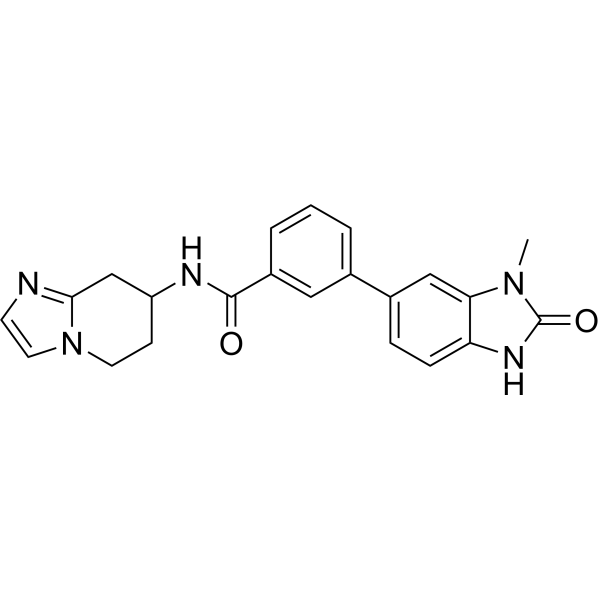
    Z36-MP5 is an Mi-2β-targeted inhibitor, with IC50 of 0.082 μM. Z36-MP5 can reduce Mi-2β ATPase activity and reactivates ISG transcription. Z36-MP5 can stimulate T-cell-mediated cytotoxicity .
    Z36-MP5
  • HY-P990953

    Gen1047

    CD3 Cancer
    Zubotamig (Gen1047) is an CD3E/VTCN1-targeting Ig(G1 -κ_G1 -λ2) type chimeric human antibody. The recommed isotype control is Human IgG1 kappa, Isotype Control (HY-P99001). Zubotamig induces T-cell mediated cytotoxicity of B7H4-positive tumor cells, triggers T-cell activation, and induces cytokine release from T cells in the presence of B7H4-expressing tumor cells. Zubotamig demonstrates antitumor activity in mouse patient-derived xenograft (PDX) models. Zubotamig can be used for the research of solid cancers (including breast, ovarian and lung cancer) .
    Zubotamig
  • HY-P991309

    C-type Lectin-like Receptors (CTLRs) Cancer
    ZM-008 is an anti-LLT1 monoclonal antibody. ZM-008 blocks the interaction between LLT1 and CD161 on the surface of NK cells and T cells. ZM-008 restores anti-tumor immune activity, shifts the tumor microenvironment to an immune-responsive state, and recovers NK cell-mediated cytotoxicity against tumor cells, thereby reversing immunosuppression in immune-resistant "cold" tumors. ZM-008 is applicable to the research of immune-resistant solid tumors .
    ZM-008
  • HY-P99027

    LAG525; IMP701; Hu5A8

    LAG-3 Cancer
    Ieramilimab (LAG525; IMP701) is a humanized IgG4 monoclonal antibody that binds to LAG-3, resulting in inhibition of LAG-3 interaction with MHC-II molecules. Ieramilimab restores T-cell and NK-cell-mediated antileukemic immunity by reducing exhaustion and augmenting cytokine output and cytotoxicity. Ieramilimab increases the infiltration of cytotoxic T lymphocytes and reduces baseline densities of regulatory T cells (Tregs) and ADAM10-expressing tumor cells. Ieramilimab can be used for the study of various malignancies including melanoma, RCC, and advanced solid tumors .
    Ieramilimab
  • HY-P992450

    TNF Receptor Cancer
    REGN6569 is a fully human IgG1 monoclonal antibody targeting glucocorticoid-induced tumor necrosis factor receptor-related protein (GITR) with high specificity for GITR. REGN6569 exerts stronger in vitro antibody-dependent cell-mediated cytotoxicity (ADCC) against regulatory T cells expressing GITR. REGN6569 selectively depletes regulatory T cells via antibody-dependent cell-mediated cytotoxicity and increases the proportion of proliferative natural killer (NK) cells in peripheral blood. REGN6569 is applicable for advanced solid malignancies. Isotype control: HY-P99001 .
    REGN6569
  • HY-P992391

    IPH43

    C-type Lectin-like Receptors (CTLRs) Apoptosis Cancer
    IPH4301 is a monoclonal antibody targeting MICA/B, with dual activities of cytotoxicity and immunoregulation . IPH4301 blocks the interaction between MICA/B and NKG2D, inhibits their hydrolysis into soluble sMICA/B, and mediates antibody-dependent cellular cytotoxicity and antibody-dependent cellular phagocytosis against tumor cells expressing MICA/MICB. IPH4301 restores the expression and function of NKG2D on primary NK cells and T cells, reverses the immunosuppression induced by M2 macrophages, and enhances NK cell-mediated tumor cell apoptosis. IPH4301 can be used in research related to cancer and triple-negative breast cancer .
    IPH4301
  • HY-P991944

    CCR Cancer
    ZL-1218 is a selective humanized IgG1 antibody, targeting CCR8. ZL-1218 induces antibody-dependent cellular cytotoxicity (ADCC), leading to NK cell-mediated depletion of CCR8-expressing regulatory T cells (Tregs). ZL-1218 blocks the binding of the CCR8 ligand CCL1 to CCR8 and reduces Treg recruitment by inhibiting the chemotaxis of CCR8 + cells. ZL-1218 reduces intratumoral Treg levels in a dose-dependent manner. ZL-1218 exerts enhanced antitumor activity when combined with the anti-PD-1 antibody. ZL-1218 can be used for solid tumour research .
    ZL-1218
  • HY-P99014A

    Transmembrane Glycoprotein Cancer
    Cusatuzumab (FUT8-KO) is an anti-CD70 monoclonal antibody that prepared by knocking out the fucosyltransferase 8 gene (FUT8) to remove fucose and thereby enhance the ADCC activity of the antibody .
    Cusatuzumab (FUT8-KO)
  • HY-184300

    PD-1/PD-L1 Inflammation/Immunology Cancer
    PDL1 degrader-4 is a PD-L1 degrader that induces PD-L1 degradation via the LAMP2-mediated lysosomal pathway, with a Kd value of 5.58 μM. PDL1 degrader-4 induces anti-tumor immunity through PD-L1 degradation. PDL1 degrader-4 is applicable to research related to non-small cell lung cancer .
    PDL1 degrader-4

Inquiry Online

Your information is safe with us. * Required Fields.

Salutation


Country or Region *

Applicant Name *


Organization Name *

Department *


Email Address *


Product Name *

Cat. No.


Requested quantity *

Phone Number *


Remarks

Inquiry Online

Inquiry Information

Product Name:
Cat. No.:
Quantity:
MCE Japan Authorized Agent:

