5 Results for "

compact protein

" in MedChemExpress (MCE) Product Catalog:
Products (5)

5 Results for "compact protein" in MCE Product Catalog:

Cat. No.: HY-160695
CAS No.: 2924858-25-1
Research Areas:  

Cancer

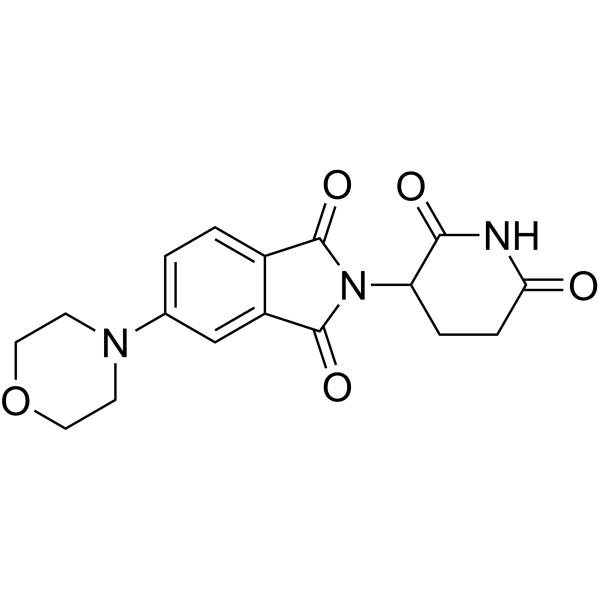
PT-179 is an orthogonal Thalidomide (HY-14658) derivative that targets cereblon without causing off-target degradation effects. PT-179 is able to specifically bind CRBN, form a ternary complex with a target protein fused to a zinc finger (ZF) degron, and mediate the degradation of the tagged protein. For example, PT-179 binds to the ubiquitin ligase substrate receptor cereblon by forming a complex with SD40 and efficiently degrades proteins N- or C-terminally fused to SD40 or SD36 (DC50 for eGFP: 4.5 nM and 14.3 nM). PT-179 can be used to develop compact protein degradation tagging platforms .
loading...
    loading...
Cat. No.: HY-P3828
CAS No.: 923949-88-6
Target:  

Fluorescent Dye

Research Areas:  

Neurological Disease

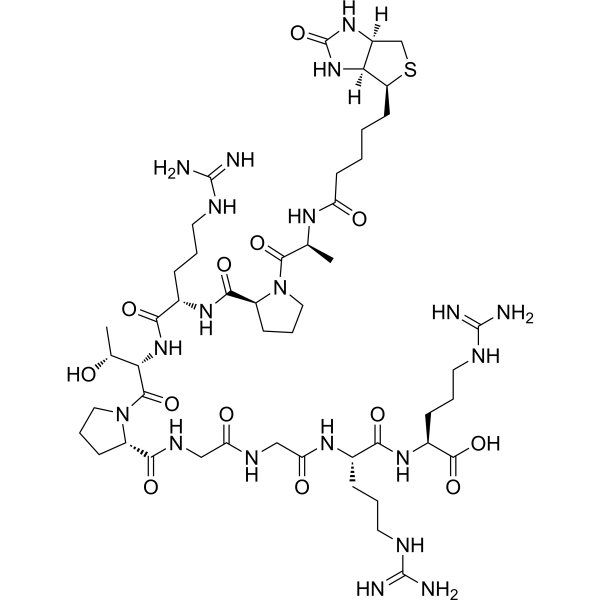
Biotin-myelin basic protein (94-102) is a peptide fragemt. Myelin basic protein is responsible for adhesion of the cytosolic surfaces of multilayered compact myelin, it plays an important role in the process of myelination of nerves in the nervous system. Myelin basic protein also acts as a membrane actin-binding protein, which might allow it to participate in transmission of extracellular signals to the cytoskeleton in oligodendrocytes and tight junctions in myelin .
loading...
    loading...
Cat. No.: HY-NP208
Myelin Basic Protein (Porcine), the second most abundant protein in central nervous system myelin, is responsible for adhesion of the cytosolic surfaces of multilayered compact myelin. Myelin Basic Protein (Porcine) mediates interactions with actin and tubulin and effect of post-translational modifications .
loading...
    loading...
Cat. No.: HY-D3072
Research Areas:  

Neurological Disease

P6-Aggrate is a fluorescent probe for aggregated proteome detection. P6-Aggrate specifically recognizes amorphous aggregated proteomes through non-covalent reversible binding, and its fluorescence enhances after heat-induced protein aggregation. P6-Aggrate reflects the polarity and compactness heterogeneity within aggregated proteomes via emission wavelength shift: short-wavelength emission (blue shift) corresponds to large aggregates with high compactness, while long-wavelength emission (red shift) corresponds to small spots with low compactness (Ex/Em = 488/520-580 nm). P6-Aggrate enables reversible monitoring of the dynamic processes of formation and clearance of stress-induced proteome aggregation such as that induced by MG132 (HY-13259) in living cells. P6-Aggrate can be used in studies related to protein homeostasis imbalance, neurodegenerative diseases and protein aggregation .
loading...
    loading...
Cat. No.: HY-181066
Research Areas:  

Infection

ACE2-SP PPI-IN-1 is an inhibitor of the interaction between the SARS-CoV-2 spike protein and ACE2, with an IC50 of 2162.77 nM. ACE2-SP PPI-IN-1 exhibits low cytotoxicity in human fibroblasts. ACE2-SP PPI-IN-1 binds to the interface region between the spike protein RBD and ACE2, reducing the flexibility of the critical receptor-binding loop and maintaining the structural compactness of the spike protein. ACE2-SP PPI-IN-1 can be used for research related to SARS-CoV-2 .
loading...
    loading...

